
OBITUARIO
Willard Bill C. Merrill
13 junio, 1926 – 2 noviembre, 2012
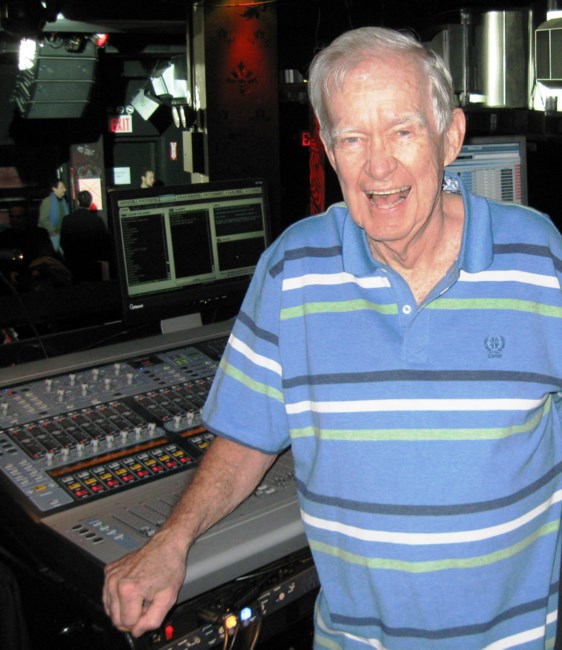
Willard Curtis Merrill (1926-2012) died peacefully at home after a long illness from cancer. He was a pioneer in Sound Design for the Broadway Theater. Known professionally as Bill Merrill, he introduced the wireless microphone to Broadway in the late 1950’s and was instrumental in turning sound into a credited design element alongside set design, costume design and lighting design.
His Broadway and Off-Broadway sound design credits include the original productions of: “Music Man” (1957), “A Party With Comden and Green” (1958), “An Evening With Nichols and May” (1960), “Carnival” (1961), “How To Succeed In Business Without Really Trying” (1961), “No Strings” (1962), “Your Own Thing” (1968), “Jacques Brel Is Alive And Well And Living In Paris” (1968), “The Real Inspector Hound” (1969), “Love Me Love My Children” (1971), “The Secret Affairs of Mildred Wilde” (1972), “Grease” (1972), “The Lieutenant” (1975), “Blues In The Night” (1982).
His most notable television credits were the live broadcasts of “Peter Pan” with Mary Martin (1955, 1956, 1960). He produced a show for the Sieman’s Sleep Pavilion at the 1964 New York Worlds Fair. In the 1970‘s, Mr Merrill also created an innovative multimedia exhibition on textile production, utilizing a moving sidewalk and synchronized audio and slide show, for the new Burlington Building on 6th Ave.
He began his sound design career working for Ed Cook at Century Lighting in the 1950‘s and soon broke away to start his own company, Port-O-Vox, which he owned and operated from the 1960’s until his death. Port-O-Vox manufactured its own wireless microphone, which he adapted and marketed for theater use.
In addition to designing specific shows, he also provided custom services and specialized electronics for the performing arts, and designed sound systems for numerous theaters around the country whose venues had to accommodate a variety of shows. He worked for NBC, ABC, and CBS, as well as for Radio City Music Hall, Paper Mill Playhouse, Westport Country Playhouse, Westbury Music Fair, Minneola Playhouse, Music Fairs (Westbury, L.I and 5 other locations), and Playhouse In The Park (both Philadelphia and Cincinnati).
A sound design prodigy, with no formal training, he had not actually intended to be a sound designer. He came to New York City, as a young man in the 1950’s, with his two best friends, Jim McKenzie (ACT San Francisco & Executive Producer Westport Country Playhouse) and Spofford Beadle (a producer and also House Manager of Phantom of the Opera for 17 years).
The three friends intended to produce shows. But the young Bill Merrill had a natural instinct for the principals of sound engineering and how to put them to work in the theater, which caused him to see and take advantage of an opportunity. He had found his entree into the Broadway world he loved. He saw a need and met it.
Asked the secret to his success in the sound business, he said it was his ears. His ability to hear things that others couldn’t.
When he arrived on Broadway, sound amplification for shows consisted of a few foot mikes with controls permanently set during rehearsal. A stage hand turned the system on before the show and off after the show. There was no sound operator. Bill Merrill changed all that.
Ironically, he was not credited for the seminal work he did on most of those early shows. It took a while before shows started listing a sound designer in the credits. But those who worked with him found him memorable and talented.
He excelled at determining the special and specific needs of a given show and finding the means to fulfill them in the chosen venue. He worked with the director, the actors and the creative team to address their specific sound needs and was instrumental in turning sound into a credited design element alongside set design, costume design and lighting design.
In a long letter he wrote to the NY Times published on June 30 1996 he said “The body mike... allowed unique talents, like Rudy Vallee and Anna Maria Alberghetti to “blend in” with stronger voices”. He decried the use of over amplification which had come into vogue and stated “I have this nagging guilt that I started the mess that has resulted in virtually every singer-actor in a Broadway musical wearing a body mike”.
He championed “sound reinforcement”, the goal of which was to insure that the wired performers were balanced to blend in with rest of the live cast, and the sound system itself was equalized so the audience did not even know their was a sound system. He did not like sound amplification. He said it took away from the live aspect of theater which was vital to the experience. He kept the miking unobtrusive. The mikes were not an end in themselves and were certainly not allowed to call attention to themselves.
He loved to regale his friends with his show business stories. John Actman, a stage manager (Rothchilds, Magic Show) working on Broadway at the time, recalls that Anna Maria Alberghetti famously went to the bathroom while wearing her wireless and flushed the toilet for all in the theater to hear.
During the run of “An Evening With Nichols and May” Bill would come and stand at the back of theater every night just before intermission, and if the duo needed to see him about anything they would use his name “Bill Merrill” in the last skit. This was his signal to meet them back stage. If they didn’t use his name, he was free to go and check on his other shows. He described his approach to the use of wireless mikes for the two comedians this way, “the intention was to make them sound natural, not amplified. The mikes gave them the little bit of help they needed for the hundreds of voices they created in the show.”
For “Jacques Brel Is Alive And Well And Living In Paris” Bill famously solved the problem of the pole that was sticking up in the center of the stage at the Village Gate. He came up with the unique solution of using mikes hanging down from the ceiling that allowed the obstructing pole to be incorporated into the staging. The pole and his design became a signature of the show and were subsequently recreated in every major road company, even in large venues such as The Walnut Theater in Philadelphia.
During rehearsals for “No Strings”, Richard Rodgers took the young sound designer and stood with him in the center of the orchestra, which was onstage, and said to him, “I want the audience out there to hear exactly what you are hearing here.” Something the eager sound designer managed to achieve to Rodgers satisfaction.
He worked with many legendary performers. He wired Marlena Dietrich for her nightclub act at the Waldorf Astoria. When his parents visited from Wisconsin, Dietrich invited them backstage after the show, and to their delight and surprise, the great star made and served them tea in her dressing room with her own hands.
He like to tell how he put the wireless mike on Mary Martin for the flying sequences in “Peter Pan”, and claimed that when she threw the fairy dust, he was standing under her just out of camera range and it landed on him. His longtime next door neighbor in New York City, is Sondra Lee, who played Tiger Lilly.
He enjoyed telling friends about the time he went to pitch the new wireless mike to Ethel Merman. He met her at her apartment. She was amused, but incredulous at the suggestion that she would need such a thing, and politely declined.
Bill also went to see Ella Fitzgerald about the new gadget. They were to meet at a club. When he got there Miss Fitzgerald was not there, or so he thought. It wasn’t until some time later that he realized the great woman he was waiting for was in fact the woman sitting at a table on the other side of the room. He had mistaken her for the cleaning lady. For her part, Ella never imagined that the sound engineer she was waiting for was the young boy standing on the other side of the room. She too declined the use of the wireless device.
Born in Wausau Wisconsin in 1926 to Helen and Willard Merrill. He attended Loras College in Iowa, and after a stint in the army, earned a degree in Journalism from the University of Iowa,
He served in the Army as a private first class, enlisting in 1946 and discharged honorably in 1947. His army discharge papers list him as an “entertainment specialist” but he also worked in army intelligence. His later military work, as a private contractor, designing sound systems for conference rooms and command and control centers, came about in part because of his high security clearance obtained while enlisted.
After the army, and finishing college, he was a radio announcer in Grand Rapids for a while, delivering the weather and local news, and reading off the wire. His favorite part of the job, he said, was the ‘hand off’ of the local feed, at noon, to the national broadcast, which was “The Duke Ellington Show”. He liked to tell friends how he would be able to hear Ellington doodling on the piano while waiting for his cue, and how the great musician never failed to turn that doodling into the first notes of his opening song at exactly noon.
In his later years, unhappy with the over-amplification and over miking in vogue on B’way, Bill focused more on corporate and university sound systems. His non-theater clients for whom he provided audio consulting, design and installation services, included General Motors, Master Card, Johnson and Johnson, IBM, Con Edison, AT&T, New York Port Authority, 20th Century Fox, Mobile Oil, General Foods, Singer Corp, Chemical Bank, West Point, Villanova University, and Pennsylvania Hospital, among many others.
Military clients for whom he worked, included Nellis Air Force Base, Fort Knox, Fort Hood, The Pentagon, Lockheed Corp (submarine base), Fort McPherson (war room), Bolling Air Force Base, and Fort Monmouth.
In those later years he often partnered with a video expert, Frank Emanuel, of Emanuel Associates, whose video expertise complimented Bill’s audio knowledge. Together they designed and installed sophisticated high end multimedia conferencing systems for corporations, universities, and the military.
When Bill Merrill turned his attention away from Broadway, he said it was because the shows were becoming over burdened with excessive sound, at excessive cost. He liked the shows of the Lord Webber era, but he did not approve of the over amplification. In that same 1996 letter to the New York Times referenced above, he observed that “Audiences should realize that what theater does best is present live performances and that with the technology available today we can enhance its intimacy while still creating thrills.” He was, himself, a master at it, and a pioneer.
Bill is survived by his loving, long-term partner, Michael Mullins, as well as by his sister-in-law Jacky Merrill, his nephews Patrick Merrill and CJ Merrill, and his nieces Susan Lepore and Christy Sopko.
Muestre su apoyo
Comparta Un Recuerdo
Comparta
Un Obituario
Obtenga actualizaciones
Servicios
COMPARTA UN OBITUARIOCOMPARTA
- RECIBIR RECORDATORIOS
v.1.18.0