
OBITUARIO
Johanna Maria Kakanis
29 junio, 1932 – 31 diciembre, 2015
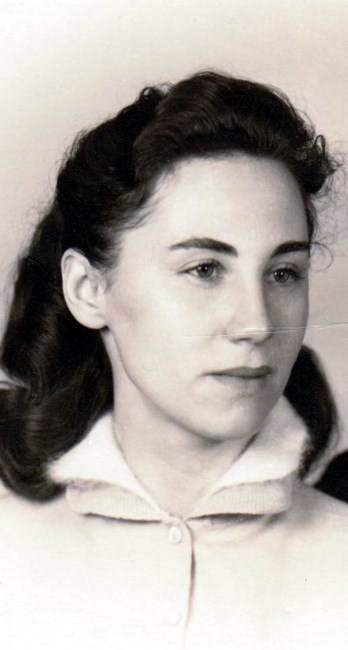
Johanna Maria Kakanis was born June 29, 1932 in Karlsbad, Czechoslovakia. Her mother, Rose Bohm, and father, Anton Hladina, were both Austrian. They knew Karlsbad as the Austrian town it was before the First World War, so their family spoke German. Her parents also had a son, Joseph Hladina. He was born in 1938 and is currently living in New Jersey. Johanna’s mother was a courageous and creative housemaker, and her father was an electrician by trade in Austria and a motorist in the German army. Her little brother Joseph shared their father’s enthusiasm for motorcycles later on in life, by joining an infamous motorcycle club in the United States.
Johanna’s childhood can first be best described as innocent and loving, but then became abruptly harsh on her, as she is a child of the Second World War. Her father was drafted in the war when she was around the age of ten. In 1944, at age twelve, she survived at least seven bombings on her town of Karlsbad. The bombs, from the English, were targeting the train station that was up the mountain, about a mile away, to cut off supplies to the Russians. (There were no smart bombs at the time.) The eighth bomb hit her apartment building in Karlsbad. Fortunately, the family was protected in a bomb shelter during the attack. She was forced to trek to a town called Komodao where her grandmother lived. Johanna walked for three days with her mother and her little brother with nothing but the clothes on their back and a little knapsack. Joseph, who was six at the time, only brought with him a soccer ball and a teddy bear. Their mother has sewn all the money they had into the teddy bear. There is one vivid memory that stayed with both children for the rest of their lives. It happened at a Russian checkpoint where a Russian soldier kicked Joseph’s soccer ball and threatened him at gunpoint not to retrieve it. Their mother shielded him, and they were safe along with the teddy bear that had all their money.
Three days later, they arrived at their grandmother’s house in Komodao. It wasn’t but a few weeks before the Russians confiscated the grandmother’s nice apartment for their own use and put Johanna and her family in a concentration camp where they stayed for a month. Johanna’s mother had an opportunity to get them out of there. She gave her watch to a Russian soldier in exchange for getting them on a cattle train to flee to West Germany. She also gave up other jewelry along the way for survival. Once they arrived to West Germany, Johanna, her mother, brother and grandmother were put on freight trucks headed to the outskirts of Munich in where farms were instructed to take refugees. Upon arrival to the farm in 1945, her mother and little brother were immediately put to work.
Johanna spent her teenage years living on that farm in a small town in the countryside. She attended Maria Theresa High School in Augsburg. Her commute to school was a 3-kilometer walk up a mountain to a train station, a one-hour train ride to Augsburg, and a fifteen minute walk to school. During the winter months those walks were in three feet of snow. Johanna also joined the Girl Scouts as a teenager and has a dear friend of 69 years from the Girl Scouts, Maria Bors (who survives her in New York). Johanna and her family struggled to make ends meet, and they all assumed the father was dead. Miraculously, Anton Hladina found his wife and children on the farm in 1947, and they were reunited. He had been a Prisoner of War in Siberia for three years. He came back weighing 86lbs; a man who stands 6 feet tall. Anton immediately started working outside the farm, and the family was able to prepare themselves for a better future. They obtained sponsorship to go to the United States and arrived on December 6, 1949 at Pier 86 in New York City. Johanna was 17 years old.
Not knowing much English, she had to learn quickly. She also had to work shortly after arriving because immigration laws back then were very strict. Families that arrived in the United States had to support themselves or return to their home country. She went job-hunting in New York City and no Jewish owners would hire her because she spoke German. She finally landed a job at a nursery caring for 10 babies.
She met the love of her life in the early 1950s, Nicolas Joseph Kakanis (1935-2004) of Thessaloniki, Greece, on a boardwalk in Far Rockaway, NY. Nick came to New York with his family when he was eight years old, and started his career with Air Canada around the age of 20 where he worked for 42 years. After working at the nursery, Johanna found a job at a curtain factory. In 1955, Johanna and Nicolas were married in Far Rockaway, New York. Their marriage had the financial struggles that most young immigrant couples had, in addition to the stress that a German-Catholic and a Greek-Orthodox marriage can have during those times. They lived a humble life, having to move to a new apartment every year for three years because the rent went up. Their love and commitment to each other prevailed. They loved and honored each other for their entire lives.
In 1958, Nick was drafted by the U.S. Army for two years and was stationed in Heidelberg, West Germany. Johanna followed her husband in the Army. In 1959, John Joseph Kakanis was born at the U.S Army Hospital in Heidelberg, West Germany. The young family returned to New York after Nick’s service when their son was only 6 months old. Johanna continued to be a homemaker, and Nick went back to working for Air Canada. In 1961, Johanna’s father passed away unexpectedly in New York. His health was seriously deteriorated from living in Siberia.
The husband and wife team worked very hard and saved their money living in budget apartments in Far Rockaway. They had plans for a better future. Johanna and Nick jumped on the opportunity to get out of the cold and moved to Miami in 1968, when Air Canada offered Nick a manager position at Miami International Airport. Their son, John, was 9 years old when they moved to an apartment in Florida. The family went house-hunting every weekend for a year. Johanna and Nick found the home where they would live for the rest of their lives. It was a house in Miami Beach on the water, with room for a boat and an amazing view from the kitchen. Their dream house. Upon purchasing their home in 1969, Johanna joined St. Joseph’s Catholic Parish where she remained a faithful member for 46 years. She was a homemaker until her son was 18 years old and built a life around her family and parish. When John moved out of the home, Johanna decided to go back to the workforce. She worked for the Social Security Administration as a Claims Analyst from 1979 to 1999.
During the 1970s, Johanna’s mother, who had remarried in 1968, moved from New York to Hallandale, FL. Johanna enjoyed having her mother close by. She cared for her mother and step-father in their elderly years in the late 80s and early 90s. She was a devoted daughter and loving caretaker.
Johanna and Nick’s son married in 1985 and had four children: Monica Kakanis (1985), John Paul Kakanis (1987), Nicolas Alexander Kakanis (1991), and Kristina Victoria Kakanis (1995). During the 1980s and 1990s, Johanna enjoyed spending time with her young grandchildren who would visit her frequently from Pembroke Pines, FL. She loved having her grandchildren over and watching them play outside as she worked diligently in the kitchen preparing an excellent, wholesome meal. Johanna was an amazing cook. Her pride and joy was to make sure her family was well-fed and well-mannered. Johanna was a great gardener and shared her love of gardening with her grandchildren too. She also enjoyed taking her grandchildren to the beach, to German restaurants and Greek festivals. When they slept over for the weekend, her grandchildren accompanied her to mass at St. Joseph’s Catholic Church. During difficult times in the late 90s, Johanna and Nicolas welcomed their son and grandchildren into their home and were an essential part of the grandchildren’s upbringing. Both, Nick and Johanna were loving grandparents. Johanna was a devoted mother and grandmother who always put her family first.
Johanna adored her husband of 49 years. When his health rapidly declined in 1999, she was by his side and cared for him selflessly, making sure he was comfortable and happy. She lost her husband six months before their 50th Anniversary in 2004. For the past nearly twelve years, Johanna has missed him dearly. She had a dear friend, Irini Iosiphidis, that was always there for her, especially during that time. Johanna was a devoted and loving wife.
In the last ten years of her life, Johanna was very active in the parish. She was Vice President of St. Joseph’s Women’s Club, participated in fundraisers, and loved playing bingo in the parish hall. She enjoyed an occasional trip to the Seminole Indian Casino too. In 2009, Johanna became a great-grandmother. She cherished seeing her great-granddaughter and recently left her a precious gift as she knew she was being called home soon. Johanna also had a very special friend in her later years who accompanied her often to church and elsewhere and called her everyday: Yolanda Garay.
Johanna continued to be full of good advice to her loved ones. She was pure-hearted and always honest. She wasn’t afraid to speak her mind. She had a quiet strength and never complained about the little things. She was known as a tough woman; a good woman, and a devout Catholic. Johanna’s health really started to fail in 2015. It was a tough year, but her mind was still okay, and she was home most of the time with family all around. She was such a strong woman that all of us grandchildren thought she was invincible. She passed away in the early morning of December 31st, 2015 at St. Catherine’s Rehabilitation Hospital.
Many people came to know Johanna as “Oma.” To her grandchildren, Oma always had the answer. She was the pillar of the Kakanis Family. She took very good care of us grandchildren, especially when we were sick. She always knew how to make us feel better. Oma kept her kitchen stocked with a perfect midnight snack so that when the opportunity aroused, we indulged with her. It was usually a one-on-one with her, which were very fond memories. We enjoyed late night talks with Oma outside on the patio as she smoked her last cigarette before bed. Even with most of us in our twenties, she still kept a watchful eye on our conduct and reminded us to wipe our feet and wash our hands up until very recently. We have very precious memories of our dear Oma. She will be dearly missed. We know she is in heaven with Grandpa watching over us.
Muestre su apoyo
Comparta Un Recuerdo
Comparta
Un Obituario
Obtenga actualizaciones
Servicios
COMPARTA UN OBITUARIOCOMPARTA
- RECIBIR RECORDATORIOS
v.1.18.0