OBITUARIO
Masanobu "Mas" Yamamoto
25 junio, 1927 – 29 octubre, 2021
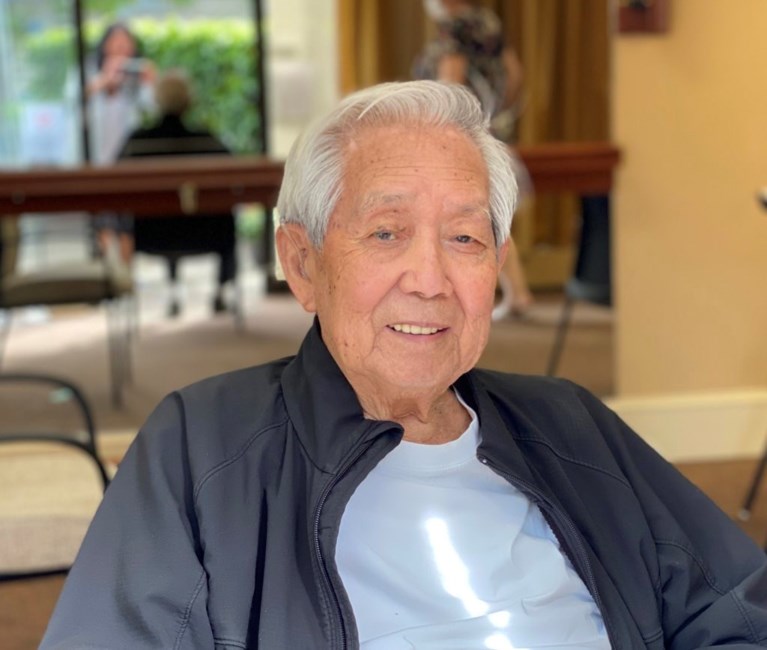
Mas was born in Steveston, British Columbia, a small fishing village at the time, in an area called Vancouver Cannery. As a young teenager, he, his recently widowed mother, and his siblings became known as Enemy Aliens. His family, along with twenty-one thousand other Japanese Canadians were forced to leave their homes with only the belongings they could carry in a suitcase. Lemon Creek Internment Camp, in the Kootenays, was Mas’ home for the next four years. His high school education was curtailed.
Mas’ childhood ended abruptly following his release from the internment camp. He supported his mother and younger siblings by working long days in an orchard in the Okanagan with just a grade 9 education. In 1955 he embarked on a trip to Canada’s arctic where he worked as a first aid attendant on the DEW Line in Canada’s far north, and at the age of 28, opened his first bank account.
A year later, Mas was introduced to the most beautiful woman he had ever met and married Joan Ishikawa. Our mother.
“Mas is trying to outrun his blue-collar past, away from carrying lumber at the sawmill in Revelstoke, away from pounding spikes on the train tracks in Glacier, away from picking apples in the orchard in Oyama, away from being a psychiatric male nurse at Essondale in Coquitlam, away from being an industrial first aid attendant in the Arctic and on the Bridge River dam project. He crosses the finish line in record time. High school diploma in hand he enrols in the University of British Columbia, at the tender age of thirty-two, into the Faculty of Pharmacy.
Leaving the muddied work boots of his past out in the hallway, Mas enters the university lecture hall where the rest of the students are about half his age, but Mas earns top marks. Invigorated by conjugal bliss, energized by marital happiness, he gets his Bachelor of Science in 1962, he gets his Master’s in Pharmacology in 1964, and in 1966 at the age of thirty-nine, he gets his PhD. That’s three university degrees in just seven years. His doctoral thesis? ‘Studies on heart muscle lipases and cyclic nucleotide phosphodiesterase’ – in plain English, Mas was asking, what is the energy source of the heart?
Mas becomes a research scientist for the government and publishes in the top journals of his field. These are the happiest years of his life, because he’s not just a fruitful as a scholar, but as a father. His wife, Joan, gives him a daughter named Naomi, another daughter named Donna and a son named Brian.” Excerpt from Tetsuro Shigematsu’s theatrical work, 1 Hour Photo.
Mas has had to reinvent himself several times, sometimes out of necessity, sometimes because of war, boredom, and family considerations. He didn’t always like who he had to become but he always found the courage to change.
In his retirement, Mas’ passions were travelling, golfing, fishing, ballroom dancing and bowling.
Mas is predeceased by his wife Joan, his sister Emiko and brother Tom. He is survived by his children, Naomi (Fred), Donna (Gerald) and Brian (Brenda), his two grandchildren, Jennifer and Kami, his sisters, Hamako and Midori, brothers, Sam and Tats and 26 nieces and nephews.
In lieu of flowers, please consider doing something special for a friend or family member that perhaps you haven’t seen in a while. That’s what Mas would’ve wanted.
Fond memories and expressions of sympathy may be shared at www.firstmemorialnorthvancouver.com for the Yamamoto family.
Muestre su apoyo
Comparta Un Recuerdo
Comparta
Un Obituario
Obtenga actualizaciones
Servicios
COMPARTA UN OBITUARIOCOMPARTA
- RECIBIR RECORDATORIOS
v.1.18.0