
OBITUARIO
Irma C. Rendina
20 mayo, 1927 – 16 enero, 2025
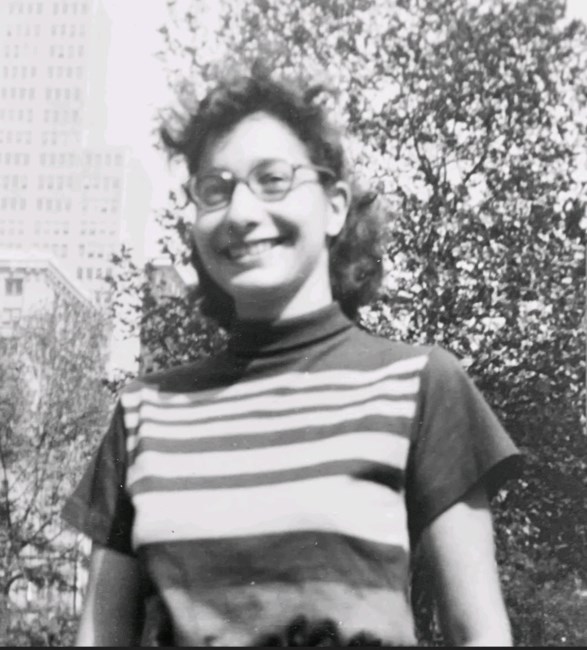
Irma Cyvia Esner Rendina was born at the Boston Lying In Hospital on May 20th 1927, the same day, as she liked to point out, that Charles Lindbergh made his historic flight across the Atlantic. Irma would go on to blaze her own trail as an activist, educator and matriarch, leaving her indelible mark on her four sons, Alan, Steven, David, and Fred; six grandchildren, Michael, Jeremy, Victor, Marshall, Truman and Kiara; and three great-grandchildren, Weaver, Alexander, and Cayden; as well as countless other lives touched by her loving, optimistic spirit, intelligence, humor and tireless energy.
She was the only child of Anna (née Siegel) and Ralph Esner, descendants of Boston-based Jewish immigrants. The family moved to Washington Heights in New York City when Irma was a toddler. Her father worked as a civil engineer for the city’s Department of Docks and her mother worked during the Depression for the WPA’s daycare program and later as a fundraiser for Jewish philanthropies.
Perhaps Irma’s instincts to be the social glue of her family came from her maternal grandparents, Dora (née Belitsky) and Nathan Siegel, who as the first generation in the US, opened their home in Mattapan to dozens of new arrivals. In every corner of that house one could find a relative sleeping, even on chairs pushed together, as they found their way in the new country. Irma remembered visiting that house in the Jewish enclave known as Blue Hill during the summers, learning to cook with Dora where all the “action” was -- around the kitchen’s pot-bellied stove. Her doting grandfather Nathan was a housepainter, and, he told her, named a two-block lane in their neighborhood “Irma Street,” which keeps that name today.
In New York, Irma attended PS 187, and she would travel by trolley and subway with her mother to see children’s performances and to take dance and piano lessons. She remembered a happy childhood, skating and playing jacks or hopscotch in the nearby park and playing with her dog she named Winnie the Pooh. Their household was a busy social environment, where Irma absorbed progressive politics as she put it, by “osmosis.” Her father was a union leader of the Federation of Architects, Engineers, Chemists, and Technicians (FAECT) and the couple supported causes such as the anti-fascist Abraham Lincoln Brigade during the Spanish Civil war in the 1930s.
As World War II was breaking out, Irma auditioned for the renowned High School of Music and Art, where she gained entry as a bassoonist. She had originally been assigned the cello, but requested a wind instrument, and bassoon was available. She thrived academically, even getting her name in the paper for her superlative Regents score in Mathematics. In addition to the orchestra, Irma loved dance, played point guard on the basketball team and wrote for the school newspaper “Overtone.” In 1944, she was proud to interview singer and activist Paul Robeson and pen a front-page article about him.
Tragically, that same year, her father died of a heart attack. Irma graduated Music and Art in the class of 1945 and went on to Brooklyn College graduating with a BA in 1948. In this period, she pursued modern dance, was an artist’s model and performed for a political theater troupe in support of Henry Wallace’s progressive campaign in ’48.
It was that year that she met the love of her life at a progressive picnic. George Rendina was a returning navy veteran, then a college student, who shared her world view and “knew how to dance.” They were married in September of that year, and as George pursued his Masters, PhD and post-doc work, the couple would move to Kansas, Michigan, Maryland and New Jersey as their family grew to four boys. During those years, Irma worked teaching music, folk dancing, nursery school and kindergarten.
In 1961, with the boys in tow, the family embarked on a camping tour of Europe and the Soviet Union in a retrofitted VW microbus. At the time, the Rendinas were among the first American families to travel in the USSR during the Cold War. They went on a similar trip in 1966, and these journeys (to and from by ocean liner) as well as countless other camping and cultural excursions were typical of her lifelong love of travel, adventure and her curiosity for new experiences that lives on in her descendants.
The sixties were turbulent times and Irma made sure her children were aware, bringing them to many civil rights, Ban the Bomb and anti-Viet Nam War demonstrations. While working and raising her boys, Irma also furthered her education, earning her Masters in 1968 from the University of Wisconsin, and ultimately earning her PhD in the field of Family Relations and Child Development from The Ohio State University in 1976. Her published thesis was entitled Father Involvement with First-Born Infants and the Effect of Infant Sex, Developmental Status, and Temperament.
Soon after she became Professor of Child and Infant Development at Ball State University in Muncie, Indiana. All the while she continued her involvement with social justice, feminism and peace activism. In the ‘80s, as part of the Nuclear Freeze movement, she was a member of the Union of Concerned Scientists and organized for United Campuses to Prevent Nuclear War.
Irma and George began vacationing on Cape Cod in the 1960s, camping with their boys, and bought property in Brewster, Massachusetts from family friends in the early ‘70s. They moved to Brewster permanently in 1984. Though George was retired, Irma wasn’t done and continued teaching at Cape Cod Community College for several years. She remained a lifelong activist, volunteering for relief efforts and candidates, and supporting environmental causes like the Association to Preserve Cape Cod. She also continued to enjoy the outdoors, camping, elder hosteling and fishing with George on the boat he named after her, and like him, volunteered with the Cape Cod Salties Sportfishing Club. Irma traveled the world with George in their retirement, including to China, Mexico, Italy and Alaska among many other destinations.
After retirement she was still active in the Book Club and Brewster Garden Club and as she aged into her 90s, she inspired her younger friends to join her in participating in chair yoga, swimming pool aerobics and opera outings at the local cinema. She was devoted to caring for her husband, who died in 2024 at over 100 years old. In the summer of her 97th year Irma still loved to go to the pond at Nickerson Park and even paddled in the water with a “noodle.” She never lost her enthusiasm for participating in life’s simple joys, a movie, a meal, a folk song.
Most of all, Irma continued to nurture her family, delighting in her grandchildren and great-grand-children and reminding her sons at the end of her life to “be good to each other” because that is what really matters.
Muestre su apoyo
Comparta Un Recuerdo
Comparta
Un Obituario
Obtenga actualizaciones
Servicios
COMPARTA UN OBITUARIOCOMPARTA
- RECIBIR RECORDATORIOS
v.1.18.0