OBITUARIO
Aida Elena Arrastia
18 agosto, 1924 – 1 marzo, 2024
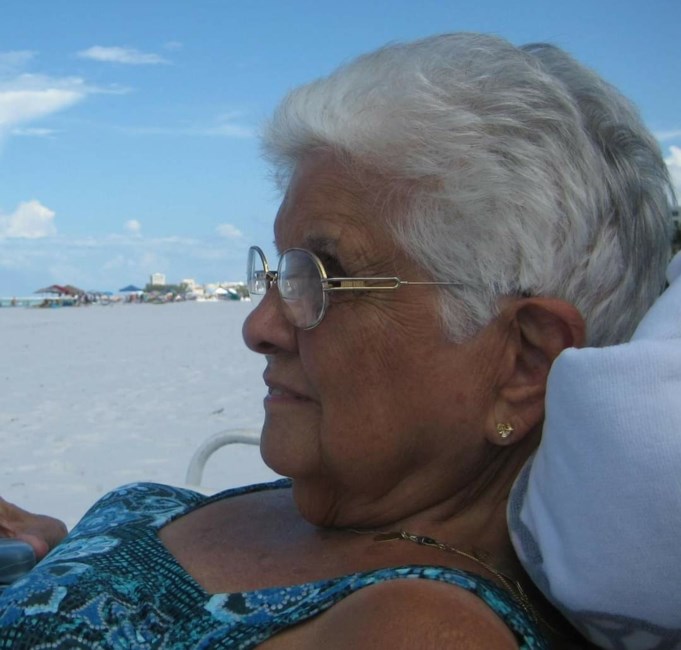
Aida was born on August 18, 1924, in Guara, Havana, Cuba. After coming to the United States on January 23, 1962, Aida and her family settled in Milwaukee, Wisconsin for a decade before moving to Miami, Florida and then to Sebastian, where she resided since 1997. Aida taught in both Cuba and the United States, maintaining life-long friendships with many of her students. She trusted Jesus Christ as her Savior at an early age and followed Him until her death.
Aida was preceded in death on July 14, 2002 by her loving husband of 52 years, Efraim. She also was predeceased by her brother, Rev. Daniel Rodriguez and a sister, Asela Gejo.
Aida is survived by her daughters, Aida R. Cuellar and Lydia E. Villarose (Martin), both of Sebastian; two sons, Efraim Arrastia (Joan Demers), of Cadiz, Kentucky and Armando Arrastia (Marcia), of Frankfort, Kentucky; one sister, Arely Gonnering (Dale), of Beaver Dam, Wisconsin.
Aida enjoyed the blessing of her ten grandchildren: Roberto Efraim Arrastia, Katherine Asela
Arrastia Schultz, Alicia Elena Arrastia Wickus, twins Cristina Elena and Juan Carlos Cuellar, Nicholas Andrew Villarose, Ashley Lynn Baker, Rachel Arrastia Deshler, Carrie Arrastia Kahoun and Anna Arrastia, along with their spouses, and six great grandchildren: Dominic Arrastia, Samantha Wickus, James Wickus, Renata Wickus, Judah Deshler, and Lyla Deshler. Aida had the joy of knowing, and took great delight in, each of her great grandchildren, even though some were born very late in her life.
The Story and Legacy of Aida
Aida’s story cannot be told without including Efraim, the love of her life. Aida and Efraim (“Mami” and “Papi” to us) met as children and we (their children) believe it was love at first sight. Even if it wasn’t so because they were so young, it seemed like that to us. We had no doubt about it and they never once gave us reason to do so.
We also never – ever – heard an argument or loud words between them. When any of us asked how it was we never heard them argue about anything, they would always reply that they discussed everything between themselves in private and always reached an agreement. Of course, Papi, always the jokester and prankster, often had a side comment to make, such as “I have no choice but to agree with her” when, in fact, it was probably Mami who agreed with him most often. That was especially true for five days during every year when Mami was the “old lady” – she could never avoid his quips between August 18th (her birthday) and August 23rd (his birthday).
While still in Cuba, we grew up with a bunch of older kids around. They were not family; they were teenagers from the church youth group. Mami and Papi were very involved with those young people and had an extremely positive influence in many of their lives. To this day, we are still in touch with several of them, and know that they appreciate and love our parents almost as if they had been their own. There were many activities with these youths: a trip or two to Varadero beach in Matanzas, Cuba; boys exploring caves with Papi; cooking pudding (maybe pumpkin and/or bread pudding) for the church; and more. There was one boy who had a difficult family situation. He often managed to be around our house just before dinner time on the pretense of playing with us because he knew that he would be included at the table when it came time to eat. That was Mami and Papi’s life. They lived to serve others in any way they could, and often there were “extra” people around. It was nothing to add people to our table. Both sets of grandparents used to do it all the time and instilled sharing in our parents as one of the most important qualities they could possess. Of course, God was always at our table, and every meal began with a prayer of thanks for all our blessings.
Mami was an elementary school teacher. Most days, if not all days, when students entered her classroom, the corner of the chalkboard would have pictures of little ducks or other baby animals drawn by her using colored chalk. She taught for many years in Cuba, including going out to poor neighborhoods to teach reading to adults, as mandated by the Castro government. Mandated or not, Mami always seemed ready and willing to go help others. Once in a while, one of us was able to tag along. We were not aware of what was going on but were always happy to be with Mami.
Papi was a bookkeeper/accountant in a shipping company that was eventually taken over by the Castro regime. He had the advantage that he had studied in the United States (Toledo University in Ohio) for a couple of years and already spoke English. This gave him the opportunity to greet merchant ships from other countries and meet the ships’ captains.
Mami’s English was “kitchen” English, meaning what she learned in school in Cuba, similar to students in the US studying Spanish for two years. On occasion, Mami and Papi would speak with each other in what we might have thought was code, but we learned later that it was really English. It was their way of communicating with each other in our presence, knowing we would not understand.
Sometime around 1961, they made a decision that was life-altering for all of us. We are sure that the decision to leave Cuba was not an easy one for them to make but, from the time they decided until the day we left, they did everything possible to entertain us kids and ensure our childhood continued as happy, interesting, and fun as it had always been. We were not attending school for a time, so they made up games to play and things to do to keep us busy.
One day, daughter Aida (Aidi) witnessed a touching moment between our parents. She saw Mami and Papi, sitting together in their bedroom, reading the letters they had written to each other during the time Papi attended college in Ohio. They read each one aloud, in chronological order, and tore each one into little pieces as they finished reading it. She asked them why they were doing that, and they replied that they did not want anyone to find and read them because this was private between them.
Early in the morning of January 23, 1962, we left our house in Cuba for the airport. When we arrived, we were escorted inside a rectangular room with glass on both long sides. Through the outside glass wall, we could see the airplane that would take us to freedom. On the other glass wall inside the airport were the relatives who went to see us off. We could not touch or talk to them. We could only see them and wave or press a note against the glass. After hours of “processing” (checking our luggage and items we were carrying), we boarded the plane headed for Miami.
In Miami, we were greeted by Mom’s only brother, uncle Danny, who boarded us in his 3 bedroom, one bath house, which was already fairly full with his wife (tia Mercy), 6 children, and a boy whose parents had sent alone to Miami. We stayed there for about three months, during which time Mom’s sister Asela (tia Ase) and her husband (tio Ariel) arrived with their 3 children. Altogether, we were 6 adults and 14 children. Thanks to God, we had no pets!
Papi (and later tio Ariel) spent a few days at the Krome Detention Center being interviewed by US officials as a security or background search to be sure they were not a threat to the United States. A few days later Papi had a job interview in New York, so he did not stay long in Miami. He was hired and was sent to Milwaukee directly from New York to work.
Those of us who were of school age attended school in portables and were taught by Cuban refugee teachers, all in Spanish, of course, so we did not learn English until we arrived in Milwaukee. When we got out of school, Mami, tia Mercy and tia Ase had snacks (usually jello or vanilla pudding) lined up on the kitchen counter for the 14 children. We stood in line as we entered the house and they handed each of us our snack. A couple of times, the older boys would get at the front of the line, grab their snacks, eat them quickly, and go back to the end of the line for more. When they were successful, it meant that one or two of the little ones did not get a snack, because there was only one for each. Always observant, Mami caught on and put a stop to that quickly. She was always about love and service, but fairness was not far behind.
Eagle Ocean Transport, the company that hired Papi, paid for our airfare to travel to Milwaukee. When we arrived there, we were met by Papi and his boss, who were ready with coats for all of us. (Although it was May, the temperature was still colder than we were used to.) Papi’s boss drove us to our new house in Shorewood, where we were met by a couple of ladies from North Shore Presbyterian Church, which sponsored us. For us, it was like coming home. We entered the second story of a house that was fully furnished. The pantry and refrigerator were stocked with essentials, and there were even some clothes and toys for us. The only thing missing were bunk beds that had been ordered which arrived a day or two later, and a television set which was given to us by the landlords/owners of the duplex, who were holocaust survivors and lived on the first floor of the house.
We attended North Shore Presbyterian Church regularly, where Mami promptly joined the women’s group(s) and Papi became an elder. Our life had been transformed in a good way, and we quickly adjusted to a different culture, much different weather, and a new language. Mami learned English by doing crossword puzzles and reading the newspaper comic strips. She later improved her language skills by watching shows like The Price is Right and Wheel of Fortune.
The rule at home was that we had to speak English in the house, so we would practice and hopefully learn it faster. A penny in a jar was our penance for speaking Spanish, but that did not last long, as daughter Lydia (Lily) was struggling and didn’t want to lose her pennies. Later, after we had learned English, the rule became that we had to speak Spanish at home and the joke was to pay the penny penance when we forgot to do so. As usual, Mami and Papi agreed with each other that it was imperative for us to speak both languages fluently. As a result, our little brother Armando (Mandy), who was only 2 years old, learned both languages at the same time. Somehow, he was able to keep them straight, and knew instinctively which language to use and with whom. Soon we were all getting along with our new language and, when Mandy spoke to Mami in English after playing outside with friends, Mami would tell him to “dímelo en español” (say it to me in Spanish), which he was always able to do without hesitation. He was almost as smart as his oldest sister.
Throughout the years that followed, we established our routines, always centered around family and church. Every Sunday without fail, we would walk to church and back. It was about a 7-block walk that seemed much shorter because Mami and Papi kept us entertained the entire time.
Mami and Papi were instrumental in helping more Cuban families relocate to the area with the help of churches willing to sponsor them. Several times, an individual or a family needed temporary housing until their more permanent residence was secured. That temporary housing was our house. Mami and Papi always shared what little they had with others who needed it. In addition to opening our home, Mami and Papi loaned money (small funds, because they could not afford more), without any expectation that it would be repaid. They were always pleasantly surprised when it was. As the Cuban community in Milwaukee grew, the families would congregate every other Saturday at the Christian Center to enjoy each other’s company and do any number of entertaining activities, always including food, of course!
To make extra money for the family, Mami and Papi began reupholstering furniture. Mami was a fabulous seamstress and Papi had learned to upholster furniture in Cuba. Together, they were a perfect team. Word got around and they were asked to reupholster furniture and make curtains for large luxurious homes on the lake (Lake Michigan). Some curtains were so big that Papi (standing on a ladder at one end of our living room) and Aidi at the landing to the second floor had to hold up the curtain so Mami could crawl on the floor to sew the hem.
We lived a simple life. Many Friday evenings after dinner, Mami and Papi would start singing a few popular Latin songs and many church hymns. Both had beautiful voices and they sang in wonderful harmony. Their singing kept us and visiting friends entertained for hours.
Mami taught her girls to sew their own clothes. Even our brother Efraim (Nuny) learned to sew a little. Papi taught us other life skills, such as balancing a checkbook.
Eventually, we grew up, finished high school, and either went to college or went to work full-time.
In 1973, Mami and Papi moved to Miami with Mandy, via New Wilmington, PA to drop-off Aidi at Westminster College. Lily was attending Carroll College in Waukesha, WI, and Nuny stayed at an apartment in Milwaukee. While getting ready for the move, Mami had fallen on the stairs and broken the “funny” bone in her back. That small injury tortured her for the rest of her life. It was probably the only thing she complained about on a consistent basis.
They spent a few months in an apartment on Flagler Street in Miami until they bought the house at 35 NW 50th Avenue. Mami began teaching Spanish and Bible at La Progresiva Presbyterian School and Papi was hired as an internal auditor for Sun Banks.
As was her “custom,” Mami established a very special relationship with the teachers at the school, but most special to her were the students she taught. Each one thought he or she was her favorite and she let them believe so. The love and caring radiated naturally and effortlessly from her. She attended church services regularly and joined the church choir with Papi’s youngest sister, tia Marta, and their best friend, Celia Pujol.
In 1977, Papi had open heart surgery at Mercy Hospital in Miami. Mami always said that she and Mandy told the doctors that they would give their blood for a transfusion for Papi. They stayed in the waiting room as the surgery progressed, fully expecting to be called to donate, but that never happened. Years later Papi was diagnosed with hepatitis C, which was the final cause of his death. To her last days, Mami always said that his death at 78 was unnecessarily too soon and could have been delayed if only the doctors had taken hers and Mandy’s blood. She always maintained her strong faith and firm belief that God is the final determiner of when a person passes. The only exception seemed to be where Papi was concerned. She spoke of this often in the last few months of her life.
The major pleasures Mami and Papi enjoyed were the many vacations they took. Almost all of these were road trips, which they planned together carefully, deliberately passing through as many states as possible never missing a visit to the capitol building of each one. There were always “tag-a-longs,” usually grandchildren. An added benefit for these “fiñes” (tykes), as Papi always called them, was that they learned the names of many of the state capital cities by visiting the capitol buildings. Mami and Papi would pose them for photos, including lying on the floor below the cupola to take a picture from below. These kids have never forgotten those vacations and treasure those memories with “abuela” and “abuelo” to this day.
In addition to visiting the state capitals, the trips included countless visits to relatives and friends in several states and a trip with grandkids to Niagara Falls. Other vacations were spent at Vanderbilt Beach in Naples, Florida, always with the little “tag-a-longs” and other friends and relatives. Every trip meant something, every visit was special, and all the time spent with Mami and Papi kept all of us wanting more.
When our parents moved from Miami to Sebastian, where Lily and her family already lived, Aidi and her twins moved with them. Mami and Papi enjoyed the activities in which the grandchildren participated, especially the school band and chorus. Band and chorus students would often come over to the house and, as had always been true, anyone who was around at mealtimes was fed. Some of those kids came around often, even daily. Mami and Papi kept their custom and gave them advice, as they did with us throughout our lives, and they got very close to our parents.
They worshipped at the United Church of Sebastian for many years and Mami became close to some of the ladies there. After Papi passed away on July 14, 2002, Mami continued to go to that church. Nonetheless, all her days began with prayer and reading both the Bible and one of several devotionals, such as Our Daily Bread, or The Upper Room (El Aposento Alto). When she could no longer attend church, Nancy Johnson, one of the church ladies, never forgot her. Nancy would call and visit Mami, bring her chocolates or other goodies, and even sent her greeting cards, always addressed to “The Incredible Aida Arrastia.”
That was our mother. In one word: Incredible. Mami was the most incredible woman to anyone who met her, but she was the most incredible wife, mother, grandmother, great-grandmother, or sister anyone could ask for.
The following was written by one of her granddaughters, Cristina. She recently wrote about Mami at work for “Celebrating Women for Women’s History Month and International Women’s Day.” There is no doubt that all Mami’s grandchildren feel the same way.
Grandparents are special treasures that not everyone is blessed to meet. In my case, I got to meet all of them and have them for every stage of my life until now. Some departed sooner than others, but this beautiful woman I’ve had my entire life. On Friday, March 1, 2024, 5 months 17 days shy of her 100th birthday, she was reunited in Heaven with her soulmate and, of course, with God, her constant companion, who she worshipped every day of her life.
My twin brother and I were fortunate enough to attend the same school in Miami at which our grandmother worked. She would take us home after school and help us with our baths and homework while she made dinner. She was a constant fixture in our lives and when we moved to central Florida, we all lived in the same house.
Growing up with my grandparents was fun because we got to see their playful side that perhaps their children didn’t get to see. There was always a story to be shared whether it was a fun pirate adventure or learning about their lives. They were raised to help others and while they didn’t have much, if someone was in need, they helped as they could; this usually meant having friends come over around dinnertime because they were hungry and had no food at home.
She taught me many things, but among them were patience, grace, prayer, cooking, and how to be giving and helpful to others. She touched a lot of lives, and I will miss her voice and smile for the rest of my life. I’ll miss her playfulness and the love that only a grandparent can have for their grandchild. I’m blessed to have had her for as long as I did and will forever be grateful for the love she gave us.
A visitation for Aida will be held Wednesday, March 13, 2024 from 10:00 AM to 12:00 PM at Fountainhead Funeral Home, 7359 Babcock Street SE, Palm Bay, FL 32909. A funeral service will occur Wednesday, March 13, 2024 from 12:00 PM to 1:00 PM, 7359 Babcock Street SE, Palm Bay, FL 32909. A committal service will occur Wednesday, March 13, 2024 at 1:00 PM at Fountainhead Memorial Park, 7303 Babcock Street SE, Palm Bay, FL 32909.
Muestre su apoyo
Comparta Un Recuerdo
Comparta
Un Obituario
Obtenga actualizaciones
Servicios
COMPARTA UN OBITUARIOCOMPARTA
- RECIBIR RECORDATORIOS
v.1.18.0