
OBITUARIO
Genowefa Mularczyk
4 enero, 1926 – 28 julio, 2019
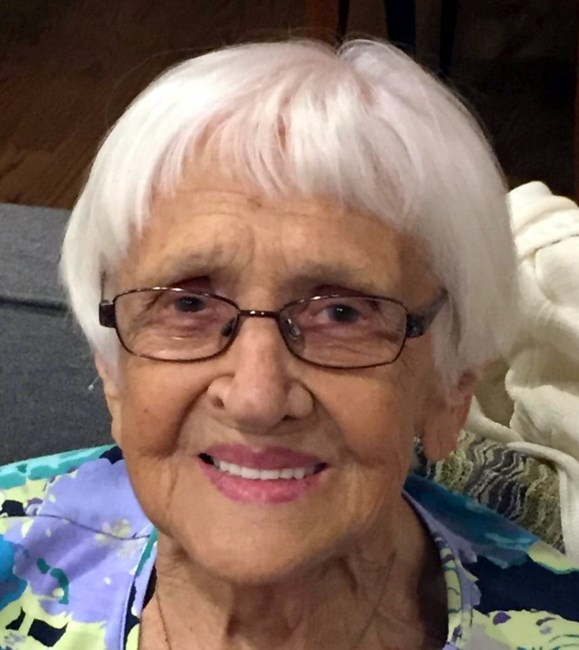
The incredible journey of Genowefa Mularczyk concluded when she went home to be with the Lord on July 28, 2019. She was reunited with Jozef, her husband of 66 years, who had preceded her. Her story is one born of a strong work ethic, perseverance through adversity and a fierce defense of her faith and her family.
Genowefa, who was known to her friends and loved ones as Genia, began her journey on January 4, 1926 in Chicago, Illinois. Five years later, she and her family emigrated to Poland due her father’s health issues, the economic situation here in America and the inheritance of a family farm. So, the family was there when World War II broke out in 1939. History tells us much about the German blitzkrieg, but the Soviets took advantage and invaded from the east as well. It was the Russian troops that occupied their land.
As this land was previously a part of the Ukraine before World War I, the Russians allowed reprisals against the local Polish population. Farms were seized and some families were killed. During the fall of 1939, each night Genia’s father took the family to sleep in the fields in case someone came to harm them in the night.
This continued until February of 1940, when a Ukrainian official accompanied by a Russian soldier came to their home and told them they had two hours to vacate the premises. Because all of their livestock had been taken by previous raiders, Genia’s job each day was to walk to a neighboring farm to get milk for her little sister Emily. As she was leaving on this day however, the Russian soldier shouted “Stop or I’ll shoot!” Thirteen year old Genia responded “Go ahead and shoot me” and kept walking.
The family was placed in a boxcar on a train in the worst of freezing conditions. No food except what had been brought with them, no beds, one potbelly stove to provide heat and a hole in the floor for sanitation. Thus began a 30 day journey east to the middle of Siberia.
They were taken to a labor camp there and put to work. Genia spent the next year and a half cutting down trees for very little food. The conditions were very hard and many people died. This continued until Hitler attacked Russia, forcing them to ally with England, France and the U.S. The English negotiated an amnesty for the Poles who were interred.
Genia’s future husband Josef and his family were also there during this time. While he left along with Genia’s father and older brothers to join a Polish army unit organized by the English, Genia and the rest of her family started a journey that would take them South into Iran. After 9 months there, another sea journey lasting 6 weeks took them to Dar es Salaam in Tanzania. They eventually settled at a refugee camp in Rhodesia (present day Zimbabwe), where they stayed until 1948.
Because the Polish veterans were given sanctuary in England, Genia, her mother Emilia and her siblings Walter and Emily rejoined their father Jan and her brother Jozef in Yorkshire, England. Unfortunately, her oldest brother Jan had passed while serving in the Polish army. This was the first time they had seen their father in 5 years.
Through an exchange of letters, Jozef Mularczyk knew she had arrived in England and began visiting her. Their relationship grew and they were married in October of 1948. A year later, they were blessed with their first child Irene. Their dream was to come to America, Genia as a natural citizen and Jozef for the first time. The American government had promised to treat the Polish Volunteer Army veterans the same as American veterans. So, in 1951 Genia, Josef and Irene arrived in Chicago; a round trip for her of 20 years. All told, she had lived 9 years in Poland, 2 years in Siberia, 5 years in Africa and 4 years in England.
Genia would spend the next 31 years in Chicago. Their family was completed in June of 1952 with the arrival of their son Joseph. She spent her time then raising her children and working for Nabisco. It was during this time the Mularczyks started introducing themselves to their American friends as Jean and Joe.
Jean had never been a fan of the cold, probably due to a certain train trip in her youth (she once woke up with her hair frozen to the wall of the boxcar!). So, in 1982, she and Joe made the move to South Florida, settling near Irene in North Lauderdale. While there, she and Joe were active at the local Polish American club, where many of their friends gathered.
When Irene and her husband left South Florida in 1997, Jean and Joe decided to join them in Brevard County. They settled in Valkaria, South of Melbourne. While there, Jean developed her love of gardening. Her plants thrived under her care.
When Joe passed in 2014, Jean decided the property was too much to care for on her own. After a year in an assisted living facility, she started dividing her time between Brevard County and Chicago.
Jean loved to sing. While attending daily group meetings with other seniors, she would often regale them with a version of “God Bless America” or “Ave Maria”. Have no doubt, Jean is probably singing in the Lord’s Choir as you read this.
Genowefa Mularczyk is survived by her daughter Irene LaTurno, son Dr. Joseph Mularczyk, grandchildren Gregory Podkulski, Michael Podkulski, Lisa Podkulski, Joseph Mularczyk and Hannah Mularczyk, great-grandchildren Dezirae Podkulski, Destiny Podkulski and Trinity Podkulski, great-great-grandchild Hayden Wojahn, sister Emily Wabi, nephews Richard Wabi, Andrew Wabi, Steven Wabi, Marcos Mozdzen, Miguel Mozdzen and niece Mariela Castillo.
Muestre su apoyo
Comparta Un Recuerdo
Comparta
Un Obituario
Obtenga actualizaciones
FAMILIA
John MozdzenFather (deceased)
Emilia (Jendrasciak) MozdzenMother (deceased)
Jozef MularczykHusband (deceased)
Irene La TurnoDaughter
Dr. Joseph MularczykSon
Grandchildren: Gregory Podkulski, Michael Podkulski, Lisa Podkulski, Joseph Mularczyk and Hannah Mularczyk, great-grandchildren Dezirae Podkulski, Destiny Podkulski and Trinity Podkulski, great-great-grandchild Hayden Wojahn, sister Emily Wabi, nephews Richard Wabi, Andrew Wabi, Steven Wabi, Marcos Mozdzen, Miguel Mozdzen and niece Mariela Castillo.
Servicios
COMPARTA UN OBITUARIOCOMPARTA
- RECIBIR RECORDATORIOS
v.1.18.0