
OBITUARIO
Edward Blaine Johnson
30 octubre, 1926 – 12 julio, 2017
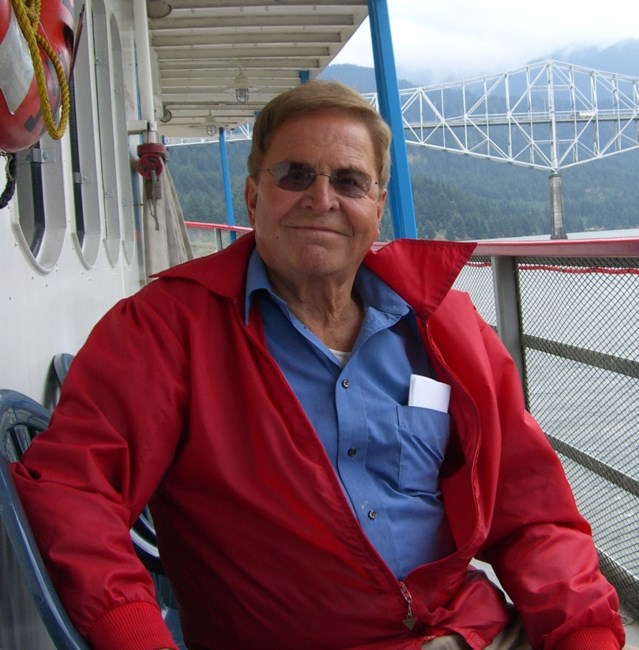
Edward Blaine Johnson was born October 30, 1926 in Kennebec, South Dakota. He passed away on July 12, 2017. He is survived by his wife of 45 years, Valerie; daughter, Tracey Buelt; son, Aaron; grandchildren, Dylan, Brody, Jordyn, and Justice; and brother, Ken. His sister, Doreine Anderson, preceded him in death. A private family service with military honors will be held at Willamette National Cemetery. In lieu of flowers, please consider a donation to the Alzheimer's Association for research. Ed loved his different roles in life: son, brother, husband, father, grand dude, and friend. He had a genuine interest in people he met and always asked open-ended questions that couldn't be answered with a simple “yes” or “no”. One example: “What’s your five year plan?” He was a deep thinker with a wide range of interests. Ed grew up on a cattle and wheat farm in South Dakota. His parents were Norwegian immigrants who raised him with a strong set of values. His mother was a schoolteacher and insisted he get a good education. He received graduate and postgraduate degrees in science from the University of Missouri. After doing what his mother told him, Ed enlisted in the Army Air Force. His goal was to be a pilot, but that desire wouldn’t be realized until a few years later. Ed didn’t like taking orders and though his military service took him to France and Germany, probably stirring his love for travel, he joked about military intelligence being an oxymoron. After being discharged from the service, Ed did get a private pilot’s license. He loved to fly small planes and also jumping out of them. He helped pay for college by spending summers working as a smoke jumper in Missoula, Montana. He was hired as an extra for the film Red Skies of Montana. He was very proud of his film career. Ed loved the outdoors and enjoyed his first job, after military service, as a field biologist. When offered a promotion to supervise a habitat program, he reluctantly accepted because it was a desk job, but it paid more. The desk job eventually led to an offer to work in Washington, D.C. for Senator Francis Case from South Dakota. As a staff member, Ed was in a rarified atmosphere. John Kennedy was President. For a young man from the mid west it was a culture shock. Heeding his mother’s advice about morality and ethics, Ed never succumbed to the temptations around him. He enjoyed his years in Washington. Ed was working for the Senate Public Works Committee and after Senator Case died in 1962, he applied for a transfer to the Department of Interior. A year later he accepted a position at their regional office in Seattle. Ed and Valerie met on July 4, 1970 on Alki Beach in Seattle. Fireworks exploded in the sky and on the beach that evening. Valerie knew she had met her match when their first date was to see a boxing match. Ed may have known she was the one for him when she wore a yellow dress that night. Ed’s glass was never half full. It was overflowing. He had a sunny, optimistic personality and loved the color yellow. He was slow to anger (except when using his computer) and quick to forgive. In 1971 Ed moved to Portland to work for the Corps of Engineers, and he and Valerie were married. His career took a back seat to marriage, fatherhood, and being a grand dude (his young grandchildren never called him “grandpa”). When he retired, Ed became a renaissance man. He spent time fishing, golfing, and sharpening his knives in the kitchen. He loved to cook, sometimes with a bit too much spice, but it was an extension of his creativity. He volunteered regularly at Oregon Public Broadcasting as a sous chef for cooking shows. Ed believed in giving back. After Valerie recovered from two bone marrow transplants at Oregon Health & Science University, he volunteered as a tour guide there. He enjoyed the arts – music, live theatre, opera (some of them), and ballet. He volunteered at Broadway Rose Theatre for many years. He was a talented artist and filled the family home and garden with his watercolors, oil paintings, wood carvings, and sculpture. A frugal man, Ed learned how to make large rocks by taking a sculpture class. Valerie wanted some for her garden so he made ones she could lift and move from one spot to another. Pleased by her reaction, he decided to make a giant cactus. He went to class after hours and used their entire supply of material to make an eight-foot Saguaro cactus. The instructor was not amused and told Ed to go and buy more material before returning to class. Always an avid reader, Ed was thrilled to have a radio program, Profiles, that was broadcast on OPB. He interviewed authors and celebrities who came to Portland to promote their books and appearances. He never used the standard questions sent by agents. He did his own research and developed open-ended questions. Mitch Albom, author of Tuesdays with Morrie, was one of many people who told him he’d never had an interview like the one he had with Ed. Ed interviewed people formally and informally. He learned a few phrases in several different languages so he could start a conversation with strangers everywhere he and Valerie traveled. This often got him into trouble because of his mispronouncing words. In the last few months of his life, Ed enjoyed reminiscing about places he had traveled, people he had met, and the family he loved. These memories always involved humor, laughter, and a few tears. Ed’s faith in God was the compass that guided his life. He lived. He laughed. He loved. I have fought the good fight. I have finished the race. I have kept the faith. II Timothy 4:7
Muestre su apoyo
Comparta Un Recuerdo
Comparta
Un Obituario
Obtenga actualizaciones
Servicios
COMPARTA UN OBITUARIOCOMPARTA
- RECIBIR RECORDATORIOS
v.1.18.0