
OBITUARIO
Harold L. Tyler
24 febrero, 1922 – 11 marzo, 2016
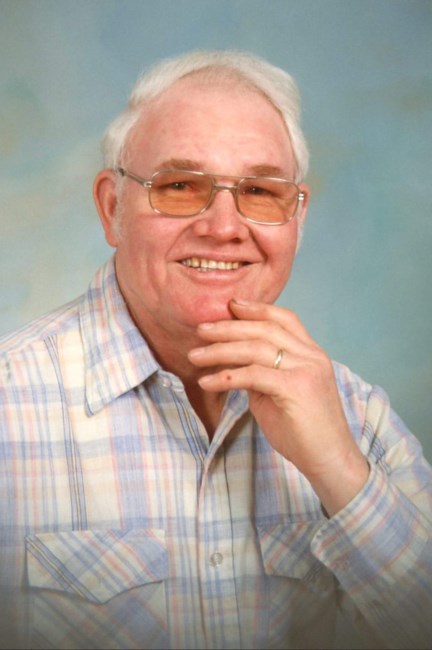
EARLY DAYS
Harold Tyler was born at home in 1922, the middle child of 8. His oldest brother was 12 years older, Elmer, and the youngest, 11 years younger, Del. His mother was great grandma Grace who lived to be 98, and got married on her 16th birthday, Nov 21, thus starting a family tradition of wedding dates.
His family came out west from Colorado, heading for the Willamette Valley, but could not afford the toll road over Mt. Hood, so they settled near Rowena, near The Dalles, where his dad worked for an orchardist, pruning apricots, etc. Then the West Extension Irrigation District started, so he went into farming.
Harold went to Boardman schools, from first grade through high school. His father died when he was 12. He had been doing dry land wheat in Pendleton OR, when a horse epidemic broke out. He was asked to drive a CAT pulling a combine at about age 17. After high school, he went to work in the shipyards in Portland in 1941, and took a blueprint reading class, and worked night shift.
WORLD WAR II
He enlisted in WWII so he would be able to pick the service he preferred, which was Navy. There, upon learning about his experience, he was put in the CBs (Construction Battalion) to operate heavy equipment. But before deployment to the war zone, he collided with another outfielder in a baseball game, and suffered significant injuries to his eye, risking its loss. A specialist was able to remove a bone chip behind the eye, and it subsequently healed. Later, while on the island where he was to work on an airstrip, his hand was run over by a tread, and a knuckle injured. So he had two injuries before starting to serve. He operated various pieces of heavy equipment.
While a Seabee (CB) he was on a island in the south seas. One moonlit night, Japanese bomber(s) came through; he saw them coming, and quickly got behind a large mahogany log, from where saw the bomb bay doors open, and saw 2 bombs fall. The first fell on the other side of the log where he was 30 seconds ago, the second a hundred yards away where it killed 4 men. He was left wondering why or how he was left alive without even the slightest wound. The following day, another bomber dropped bombs killing another two men. Their loss was keenly felt.
He served in the islands of Guadalcanal, Saipan, Okinawa, and Mauritania, and others, building airstrips with the 87th Sea Bee Battalion, nicknamed the Earthmovers. After working 12 hours one day, he was ordered to bring up AA ammunition until 6am the next morning.
On one beach landing, due to a mix-up, the Seabees landed first - fortunately the 400 Japanese defenders had all committed suicide; the Seabees put up a sign reading, “Welcome Marines.” Since he was able to operate landing craft, he had orders in his pocket to be in the front lines attacking mainland Japan at the time the war ended
He recalled an incident where another CAT driver on the beach was taken under fire from a pillbox; and rather than retreat, the driver lifted the scoop of his very large CAT as protection and advanced on the pillbox, ground it up, and later a dozen dead Japanese soldiers were unearthed. He was awarded the Silver Star for his bravery.
HOUSE AND HOME
Harold sent his military pay of $66 a month home to his mother who put it in the bank. He used that money to help buy a three story house near Lloyd Center. He lived there, and several brothers and sister, as well as boarders.
Harold met Lucille at First Baptist Church, in downtown Portland at the soda vending machine. They took the streetcar to softball games he played in. After their marriage on November 21, 1948, they house-sat for a lady vacationing in California for three months at a time, for a total of six months, at about 61ST and Sandy. Then they rented a second story flat in Sellwood, from where Lucille took a street car to Good Samaritan hospital in NW Portland.
He owned a ¾ acre lot that he bought for $1500 on Kellogg street, upon sale, the proceeds went into the house on NE 71st. Following Sellwood, they rented a 3 bedroom house at NE 15th and Skidmore. Then
they bought a house on NE 71st between 1950 and 1955, and adopted their three children, Sharon, Marvin, and Paul. They bought 5 acres in Gresham in 1965 where he built their two level house starting in ‘67. He had a shop and a garden, an occasional beef, fruit trees, blueberry and blackberry bushes.
They invested money Lucille inherited from her parents in a house on SE 92nd, and rented it for a number of years, and then sold it to their son.
In later years, portions of the Gresham property were sold off. A house on NE Pacific was bought, and before long, sunroom/laundry/sewing rooms were added and the garaged divided by a wall to allow for a shop. At age 80 he helped his son in law with countertop, plumbing, and other repairs at a rental house being refurbished for sale. At other times he trimmed boards and doors on his table saw for rental properties.
He was ever famous for his waffles that he made from scratch on Saturday mornings when his grandkids visited.
CAREER
After the war, Harold became an apprentice carpenter in a 4 year program. He was number 20 on the list, when an employer singled him out and asked him if he was looking for work, over the stares of others in line. His early job was building 14 houses in ne Portland on 34-36th streets near Alberta, with 4 union carpenters. In two years time, he was the foreman, then superintendent within another 6-8 months, finding himself the only one who could read blue prints.
He worked on the PSU library. The son in law of the construction company had taken over, and Harold was forced to build to a too-low bid, and forced out. He quit.
Then he built a school addition job in Gladstone. He went to work for HA Andersen for 6 years.
He did a Fred Meyer remodel on Killingsworth on a funny lot; then a two-story parking lot job.
In 1961, he built two Standard Insurance buildings, demolition and new construction.
He built the Paper Mill in Gardiner on the Oregon Coast, near sand dunes where his kids played, living in a rented a house at a lake. Another project was a nine-story steel structure, one of seven buildings; one with 300 pilings. Two other people were fired, and Harold took over their jobs, then a 3rd person was fired.
He built high-rise apartments for Donald Drake Construction. They raised the standard for superintendents to require 2 years of college, which Harold did not have, so he finished a few jobs, then while on another job, the owner came back to tell him that he now saw the value of experience over education, which wasn’t everything. Harold worked on 37 schools. He retired in 1987.
He had jury duty for 30 days, at the time of JFK killing in’63.
They had timeshare at Rockaway Beach which they enjoyed for many years; from 1983-2011. They took walks on the beach and put puzzles together on rainy days. They visited other places around the USA, and had a wonderful time touring the Holy Lands and the journeys of The Apostle Paul.
They drove good second hand cars, never new.
He built a lot of furniture pieces in his shop: end tables, stereo cabinet, shop drawer cabinet.
SPIRITUAL JOURNEY
Harold did not grow up in a Christian home; he came to faith either in Sunday School or at First Baptist in Portland after the war Earlier in life, a pastor serving three churches and pulling a trailer behind his car, used to pick up kids from the projects and take them to Sunday school. Harold was among the kids. Later, someone from the boarding house invited Harold to First Baptist in downtown Portland.
Harold and Lucille attended Grant Park Baptist for 12 years, after they came back from Ontario, where Harold was superintendant of the Sunday School which grew under his leadership. In 1960, they began to attend and remained faithful members of Glisan Street Baptist Church. He served terms as treasurer and deacon. They worked on projects at Lake Retreat and Camp Bighorn, ie, building cabins; they towed a travel trailer behind a pickup. He served on the board of the Oregon Baptist Retirement Home for about 7 years.
Harold was a Christian man, who served his church, worked with skill and integrity, stood his ground, and…. slept through many a sermon (and ball game on TV)! He lived faithfully and lovingly with his wife for 67 years, was orderly in his affairs, and did not fritter away his time and money. He was interested in bringing others to know the Lord he served. He did not fall prey to the various vices typical in the construction trade. He liked to tell stories about his life and adventures, having had more than the usual number of close calls, and near misses in his time. He overcame obstacles and misfortunes of the early loss of his father, and difficult stepdad. He watched a friend lose a lot of money gambling one time, and never fell into that habit. Harold persevered to the end, which is to say, he finished well, which one author (also a carpenter from Oregon) said, not many men do.
In retirement years, he fell off a ladder in church, causing multiple injuries. He recovered, but unfortunately fell off another ladder at home checking on a hallway ceiling grille. In spite of these incidents, he lived to a good old age of 94.
He is survived by…..Del, Hilma, and Ernie. His wife, Lucille, his children Sharon, Marvin, and Paul, grandchildren, Asha, Joshua, Kristina, Rachel, Ruth, Derek, Kurt, and several great children.
His siblings included: Elmer, Lucille, Ernie, Lawrence, Hazel, Hilma and Del.
He Traded His Tools for a Crown!!!
Arrangements under the direction of Lincoln Memorial Funeral Home, Portland, OR.
Muestre su apoyo
Comparta Un Recuerdo
Comparta
Un Obituario
Obtenga actualizaciones
Servicios
COMPARTA UN OBITUARIOCOMPARTA
- RECIBIR RECORDATORIOS
v.1.18.0