
OBITUARIO
Norma J. Day
1 marzo, 1928 – 27 mayo, 2013
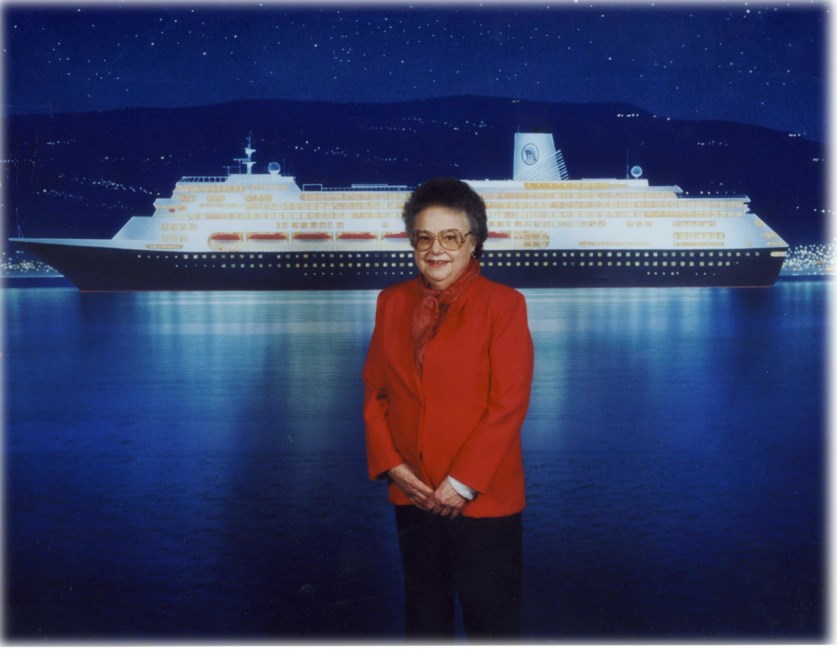
Norma Day was a regular volunteer at the Cherry Blossom Loaves and Fishes kitchen in SE Portland. She had been volunteering there since the center opened back in 1997. I met Norma around a year ago when I began working in the Leaves and Fishes kitchen as a service learning assignment for school. A big reason why I still volunteer there is because of my adoration for the seniors, but especially working with this quirky little lady. There’s just something about her voice, her walk and her short stature that emits happiness around her. She’s always got a story to tell or her opinion of the latest movie or her review of the latest American Idol contestants. When she doesn’t make it in to Leaves & Fishes, her presence is missed by all the volunteers and staff.
Norma was born Norma Jean Kimbrel in Perry, Oklahoma on March 1st, 1928 to parents Frank and Lou Kimbrel. She was the middle child of three; a brother and a sister. Her mother was a telegraph operator and was a very smart woman of French descent who grew up in New Mexico. “Mother would carry a gun because she was afraid of black people… it was just how it was back then.” Her father, who was of English descent, and having just a third grade education, worked as a section boss for the Santa Fe Railroad. “I also remember that my father made home brew and my mother made homemade root beer and when mother was working; I would bake apricot pie for my dad because he loved my apricot pie.”
Norma recalled that there would be weeks at a time when her father’s work would take him out of town and her mother would often go with him. During those times, the children stayed with family or friends. “Sometimes I stayed with my aunt and uncle in Redrock, Oklahoma and my uncle would let me ride in his ice truck while he delivered blocks of ice in the neighborhood.
Childhood Memories:
Norma’s earliest recollection was when she was three years old and she was playing on a little riding toy in their house and bumped into a large tub full of boiling water that her mother had just filled. She remembers being scalded by the hot water and that her skin turned red. “Back then, we had no indoor plumbing…we heated our water with the wood stove…the water was really hot! And we had no bathrooms either, just an outhouse out back…”
Oklahoma Weather
Every other neighbor had a tornado cellar and Norma’s parents would share their cellar with the neighbors when the Tornados would hit town. “I remember one tornado—it tore up the whole railroad track in Tonkawa…father repaired it.” Another memory she had of Oklahoma was the big hail storms that would come in; “once I was out in the back playing in the tin garage, when all of a sudden we heard thumping… I thought it was the boys throwing rocks at the tin garage… but it wasn’t… it was the hail storm… the biggest hail I’ve ever seen! When I ran to the house, one hit me on the head and I had a lump there!”
The Great Depression
Unlike many Americans of that time in history, Norma’s family was virtually unaffected by the Depression. “I do remember that the poor people who worked for the WPA were given coveralls to wear. I was just a child then, but I remember seeing these men cleaning and sweeping the streets…my husband’s experience was different than mine—when he was 6 or 7 he had to wear those WPA coveralls and put to work.”
Ponca City, Oklahoma
Norma’s family moved to Ponca City, Oklahoma where she attended middle school and became friends with a Native American boy named Walter White Crow. She remembers going to Pow Wows and other celebrations and never feeling awkward or uncomfortable around the “Indians.” “My skin was a little darker and my hair was black so I fit right in—it was fun memories… we also helped each other with homework.” Once in awhile they would bring in these shows and the entire town would go see them and I remember seeing this Dance-a-thon held in a big tent. Red Skeleton was one of the contestants. People would bet on which couple they thought would win—it was real fun because we didn’t get much in our town. Another show we looked forward to was when the circus came to town. We’d all walk down to the train station and watch the elephants walk off the train and up the road—it was very exciting.”
Touched by Hollywood:
Roy Rogers had his Hundred- and – one Ranch there in Ponca City and Norma remembers that they would film movies right there on the ranch property. As for other entertainment, she recalled, “We didn’t have a big theater in our town but my mother did take us to see King Kong when it came out. I screamed because that big gorilla looked like it was coming right at me. I was so scared by this big monkey! I was real sensitive back then.”
Our First Car
“Father had bought a Model-T and I remember how he’d have to get out and crank it in the front to get it running. When we traveled to Kansas City, it would take us one hour to drive 19 miles!”
World War II
By the age of 15, WWII had begun, the men went off to war and it seemed everyone had left Oklahoma. Norma left school and found a job as a telephone operator at a local telephone company. This job was difficult for little Norma; because of her short stature she found it hard to reach the high connectors on the switchboard so she would stand all day instead of using the stool. This way she could reach the full length of the board, but it made for a long and tiring day.
The Girl Next Door
Norma’s parents lived next door to a divorced woman by the name of Mrs. Day. She had a son, Ralph, who lived with his father in Portland, Oregon for many years. When he was 15, he came to visit his mother and that’s when he met Norma, “the girl next door” and they became friends and soon started dating. They married a year later and began making plans to move back to Oregon where he would return to his job at the shipyards. Ralph signed up for the military, but because of a vision problem, he was not assigned to active duty.
Once back in Portland, Norma and Ralph moved into the University Housing Project near St. Johns. Ralph immediately got old job back at the Swan Island shipyard as a welder and Norma found herself looking for work as well.
Kaiser Shipyards
Armed with only two weeks of training, Norma quickly found herself working alongside other women (and some men too) as a welder at the same shipyard her husband was working at. Norma recalls that the work was hard; “It was hard to be on my back and weld… that was the worst part of the job.” She was a true Rosie the Riveter and states she carried her union boiler-maker’s card for years even though she only worked at the shipyards for a year. Norma talks humbly about her work as a welder, but you can sense how very proud she must have been to have had such a significant part in the war effort, especially as a woman of that era.
And Baby Makes Three
Norma left the shipyards after one year when she found out she became pregnant with her first child. Just after the bomb was dropped on Hiroshima, the war was over, but not for Ralph and Norma. Just three months after their baby was born, Ralph was drafted and had to leave for boot camp right away. Ralph was assigned to active duty in Japan to help “clean up the mess,” as Norma recalls. Norma and Ralph sublet their University apartment to Norma’s sister, who had also moved to Oregon. Ralph went off to boot camp in California and Norma, with baby in tow, moved back to Oklahoma to stay with her mother because she needed help with the baby.
Once Ralph was stationed in Aberdeen, Minnesota for training, Norma and the baby took a train there so they could be together. They lived in a one bedroom apartment and Norma found a job in a meat market while a lady friend watched the baby. Norma’s job was to stand at the counter and sell the meat to the customers—no eventful memories came of this job. “When Ralph was called to active duty in Japan, I took the baby and went back to my mothers in Oklahoma. Once I was back in Oklahoma, I got a job at the Gins Marie Hotel cleaning rooms. I didn’t work there for more than seven months when my husband came back from the services and we looked forward to moving back to Oregon.”
War Memories:
Norma’s life reflects the roles women played during the war years and their responsibilities of keeping America going while the men were off to war. She did her part by working at the shipyards, building ships for the war and her mother was busy sewing uniforms for the service men. Although Ralph’s experience in the war was his own, when I asked Norma what she remembered the most about that time in history, she reflected on how the war affected Ralph, and in turn, affected her life as well. “Ralph said it was real dangerous going over there (Japan) after the Atomic bomb was dropped. People were mad at Americans—Ralph didn’t walk much about what he saw, but he did tell me about the Japanese children scavenging in garbage cans for scraps of food because they were hungry.” Once Ralph was home, Norma recalled, “He would have these awful nightmares and sometimes knock me out of bed while he was having these bad dreams… you know, I didn’t know what to do.”
Our First Appliance:
While still living at the University Homes, Norma and Ralph bought their first refrigerator on Norma’s credit. “I was working at the ice-cream shop at Montgomery Wards and started a credit account. In those days, we were so poor we went out and picked beans to make extra money—but we never asked for welfare.” This is a true reflection of the Greatest Generation’s attitudes of pride, perseverance and hard work. “I remember, one of the neighbors at the housing project was moving to another state and were selling the whole household of furniture for $300 dollars. This seemed like a great deal but since we had little money, I called my mother to borrow the $300. We never borrowed money from anyone, so we made sure to pay it back right away.”
Memories of the flood in Vanport City on May 30th, 1948
“That day, we were walking over to our friend’s house in Vanport for dinner. We all knew the river was rising and sirens and stuff would occasionally go off, but we weren’t too worried. No sooner did we get there when the sirens started going off again. With the ham still cooking in the oven, our friend reached for one thing… his guitar! My husband put our 3 year old son, Jim, on his shoulders as we hurried out of there. We walked up to higher ground and stood on a bridge and I’ll never forget watching all the houses just float away (down the river). Our friend’s home was destroyed so they came and stayed with us until they got a new place to live. A few weeks later, after they settled with us, they got a call that some of their belongings were found. When they got to the area, there was the stove with the ham still inside it!”
Our First Home Purchase
In the 50s, Ralph was hired on at the Oregon Steel Company, where he stayed until he retired. Soon after his new job began, they bought their first home in the Kenton District in North Portland. During this time, Norma was still working at the ice-cream shop but decided to apply for a waitress job at the Multnomah Hotel located in downtown Portland.
The Multnomah Hotel—Portland, Oregon
“I was getting so lonesome for something to do and after having two children; I decided I would go out and get a job. My husband said I wasn’t going to find one, but I said ‘Oh yes I am! (He was just teasing me). I began looking in the paper when I found an ad for the Multnomah Hotel in their pharmacy. I figured, “oh what the heck,” I filled out the application and wrote in that I had four years of waitress experience (a big fib). I got a phone call a few days later for an interview and I went down there and talked to them. They asked me to come back at 5:00 pm the next day to start! Well, they put me to work waiting tables right away and the hostess knew I wasn’t experienced. Luckily she put me back at the help counter until I advanced to the front counter. I remember, this one day, a man came in and ordered coffee but when I reached for the creamer it splattered all over his face! Of course, I started wiping his face with a napkin and felt so bad. He was very nice about it. I found out later he was one of the big bosses at the hotel (oops). He was very nice about it and would come back in occasionally and tease me that he’d never had a bath like that before! Of all the jobs I’ve ever had, my favorite memories are working at the Multnomah Hotel—I really enjoyed it there. The hotel staff really got excited when the President of the United States, Dwight D. Eisenhower, was planning on staying there for one night. The FBI was there a month before, checking everyone out and working on security for the hotel. The hotel cleared a whole floor just for the President and his wife, Mamie. They completely redecorated a suite with new burgundy colored satin wallpaper, matching rugs and furniture—because that was Mamie’s favorite color. I remember they allowed all the waitresses to go upstairs and look at the room days before the President arrived—it was so beautiful. That was the only time I saw a room at the hotel the whole time I worked there. I remember meeting Elvis Presley and getting his autograph on a Stir-up Room menu. Judy Garland once stayed there while performing at the Portland Theater. After each performance she would come back to the hotel and order six slices of toast and three bowls of soup. I also remember other stars that came to the hotel; Jack Benny, Harry James, and Tempest Storm (who managed to get her horse she used in her show, in the hotel elevator). I waited on the little boy who played in the Lassie movie—we sat and talked at the counter in the coffee shop while his parents had a drink in the Stir-Up Room.” Norma remembers that downtown Portland was THE place to be. “I loved seeing movies at The Hollywood, shopping at Woolworths, or getting a hot turkey or pork sandwich at Newberry’s.”
Settling in David Douglas
While still working at the Multnomah Hotel, Norma and her husband managed to save enough money for a down payment on a larger home that would accommodate their growing family in the David Douglas area. All four of their children; Jim, Bill, Michael and Cindy, attended David Douglas High School, keeping Norma busy as a parent helper at the concession stands at sporting events, sewing costumes for the dance team and being an occasional Girl Scout, Boy Scout or Brownie leader for her kids. At this time, the family still traveled by bus to get places. Public Transportation was the usual form of getting around for most folks because cars were an unaffordable extravagance. After eight years, they finally bought their first car—a Plymouth.
Columbus Day Storm of 1962
“I remember my husband was in Eastern Oregon hunting that weekend with his friends, when suddenly the storm hit us here in town! The shingles on our roof just started flying off and blowing all over the place. I had a six-month old baby I was still feeding with a bottle when we lost our electricity. I didn’t know what to do because I didn’t know how to light the lantern or use the kerosene. Ralph was the one who always took care of that. Luckily my husband headed back right away once he heard about the storm hitting. It took him literally hours to get home because many roads were blocked and traffic was horrific. As soon as he got home, seeing that all the neighbors were without powers, he cut up a fallen tree in our backyard and filled his car up with the wood and drove to each house on the block handing out wood.”
Saying Goodbye
Norma’s parents remained in Oklahoma their whole life. They did briefly live in Oregon, but moved back to Oklahoma where they lived out the rest of their lives there. Norma would visit when she could, but it was hard while raising four children. Norma’s brother still lived close by their parents and he took the role of helping his parents when needed. Norma’s father died of emphysema at age 61 and mother long after that and passed away when she was 83. Ralph retired at age 59 and just a few years later; Ralph’s health began to get worse. On the day of one of their grandchild’s birthday parties, Norma woke in the morning at noticed Ralph sleeping in “his chair” and when she tried to wake him, he was gone. He died of congestive heart failure at the age of 62. “I still have his chair in my living room and keep it to remind me of him.” Norma devoted many years to volunteering at non-profit agencies. She volunteered at Snow-Cap in SE Portland for almost 10 years, helping low-income families. Since 1997 she has been a faithful volunteer at Leaves and Fishes; cutting and wrapping desserts, packing hot meals, washing dishes, setting tables and serving lunches. Her volunteering keeps her active and she has made many friends along the way.
Final Thoughts
Norma eventually gave the large house to her daughter, who by this time had a family of her own. Norma moved into the daughter’s smaller house just four blocks away. She lived alone there for many years and enjoyed her freedom and independence there. She said she didn’t want to be a burden on her family and planned to move into an assisted living community or retirement home when the time comes. She likes being social and looks forward to that life transition when the time comes. She was always very involved in her grandchildren’s lives and loved to attend sport events whenever she could. Norma remained active with her friends at the senior center and enjoyed going to the movies and traveling; this included a trip to the coast, as well as a cruise.
Of all the events Norma reflected upon throughout her life history, I was most impressed by her flair for telling stories. Over the years, memories fade and it can be a struggle to try to recall details but Norma was gracious to me through this whole process and I am grateful to have had the opportunity to get to know her so closely. Norma is an invaluable treasure; offering a unique voice of past events. The wonderful recollections of her life reflect that of a woman who worked hard alongside her husband to buy a home and raise a family. She is a woman who experienced some of the greatest historical events in our nation’s history—exhibiting patriotism by working at the shipyards and devotion to her family by saving her tips for a down payment on their home.
She exhibited an attitude of perseverance when faced with many painful and traumatic events, such as the loss of her sister in the 1950s, the sudden death of her 32 year old son from suicide, and then of course the loss of her husband after over 45 years of marriage.
Before this project, I really only knew Norma as a dedicated Loaves and Fishes volunteer with a flair for telling stories. Now, after gathering these bits and pieces of her life, I see the bigger picture of what it was like for a woman growing up during a depression, a war, and the largest baby boom in American history among so many other historical events. Norma’s dedication to volunteerism for so many years exemplifies the family and community values of this “Greatest Generation” – a generation we may never see again but can only aspire to be like a generation that all other generations should embrace. I’m glad to have had the chance to know her and hope that others will recognize and understand the significant contributions she has made to her family, work, and community.
Norma Jean Day passed away peacefully surrounded by family on May 27th, 2013. She was a friend to all and will be dearly missed. Norma was predeceased by her loving husband, Ralph Day, and son, Bill Day. She is survived by her eldest daughter, Cindy (Dan) Correll of Portland, Oregon, son, Michael (Tracie) Day of Portland, Oregon, son, James Day of Portland, Oregon, 10 grandchildren and 4 great grandchildren.
Muestre su apoyo
Comparta Un Recuerdo
Comparta
Un Obituario
Obtenga actualizaciones
Servicios
COMPARTA UN OBITUARIOCOMPARTA
- RECIBIR RECORDATORIOS
v.1.18.0