OBITUARIO
Dr. Roger Charles Louis Guillemin
11 enero, 1924 – 21 febrero, 2024
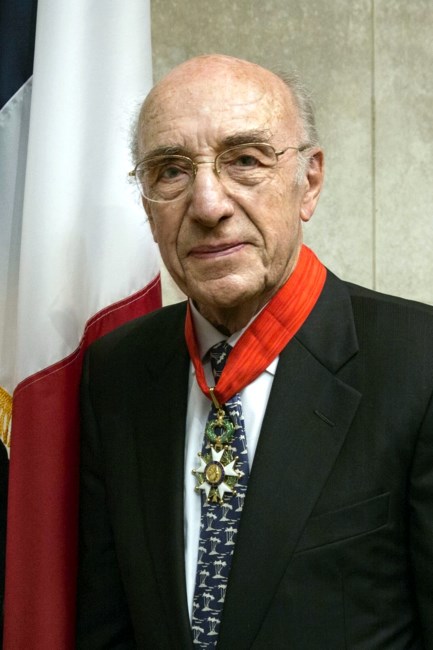
He began life on January 11, 1924, in Dijon, France, as the eldest of two boys. His father, Raymond, was a tool and die maker in the family's metal working facility. He was also an accomplished violinist, a poet, a songwriter, and a celebrated boxer. His mother, Blanche, encouraged the study of art, biology, foreign languages, and mathematics. His younger brother, Roland, an engineer, became the foreman of a motor manufacturing company in Dijon.
In 1940 when Roger was 16, the German army entered Dijon. He was detained several times for suspicion of being in the Resistance, but his fluency in the German language helped him out of these difficulties. In Besançon, he ran a camp for Parisian children rescued by the Red Cross and, as part of his work with the Underground, facilitated the escape of citizens into Switzerland. He suffered head wounds by an exploding shell when the American tanks skirmished with the rear guard of the German garrison at the camp.
In 1949, Roger obtained his medical degree at the Faculté de Médecine in Lyon, France. He was practicing medicine as a village doctor when he heard the endocrinologist Hans Selye would be lecturing in Paris. Roger attended a lecture on 'stress and the diseases of adaptation' given by Selye. Inspired by the lecture and the magnetism of Selye, he asked him for the opportunity to work in his laboratory. Roger was granted a modest fellowship to work for one year in Selye's laboratory in Montréal, Canada. This was extended to four years and in 1953, he received his Ph.D. in physiology from the University of Montréal.
While in Canada, he contracted tuberculosis meningitis and was hospitalized. Streptomycin, an experimental drug available only in the States, would be his only hope for a cure. His nurse, Lucienne Billard, crossed the border and obtained this new medication. After he recovered from his illness, Roger married Lucienne in 1952, in Montréal.
In 1953, he was invited to join the Department of Physiology at Baylor University, College of Medicine, in Houston, Texas. In addition to teaching, he continued the research he started in Montréal through scholarship funds from the John and Mary R. Markle Foundation and with the support of Hebbel Hoff, the Chairman of Physiology at Baylor University.
In 1960, the Collège de France invited Roger to set up a laboratory and department of experimental endocrinology in Paris. Hebbel Hoff requested that Roger maintain a joint appointment with his research laboratory at Baylor, which he did before moving his family to France. The research environment in France was not what had been promised and in 1963, he returned to Baylor in Houston with his family. Two years later, in 1965, he became an American citizen.
The Houston laboratory environment became quite vibrant as new discoveries were met with additional funding. With the published success coming from the lab, it was 1969 when Jonas Salk invited Roger to set up a research laboratory at the Salk Institute in La Jolla, California. Roger accepted and in 1970, moved his family and most of the Baylor team to California. It was during this period of research that new methods were being created which would lead to the 1977 Nobel Prize in Medicine, which he shared with two scientists, Andrew Schally and Rosalyn Yalow.
Considered the 'father of neuroendocrinology,' Roger and his team discovered the connection and roles of the pituitary and hypothalamus via hormonal regulation and release. They isolated and discovered somatostatin, endorphins, and neuropeptides such as CRF (corticotropin-releasing factor), ACTH (adrenocorticotropic hormone), and other cellular and hormonal growth factors such as TRH, (thyrotropin-releasing hormone), LRF (luteinizing-releasing factor), FGF (fibroblast growth factor), GRF (growth hormone-releasing factor), GnRH (gonadotropin-releasing hormone), as well as Inhibins and Activins.
In addition to the great honor of the 1977 Nobel Prize, Guillemin was the recipient of numerous awards in medicine, science and physiology throughout his career. These awards include The Gairdner International Award in 1974, the Lasker Award in Basic Sciences in 1975, the Passano Award in the Medical Sciences in 1976 and the Presidents National Medal of Science presented by President Jimmy Carter in 1977. His native France recognized his contributions to health and science naming him a Commander in the Légion d'Honneur, the country’s highest order of merit in 2015.
After his retirement from the Salk Institute in 1989, Roger continued his research as a Distinguished Scientist and later as Director of The Whittier Institute for Diabetes and Endocrinology in La Jolla until 1997. Roger served as the Salk Institutes' interim president from October 2007 to February 2009. Since its inception, the Salk Institute drew brilliant people from the world over and Roger and Lucienne often hosted French writers, musicians, artists, philosophers, and scientists who came through La Jolla.
As a Renaissance man, Roger was in search of knowledge in a wide range of fields. He was an avid reader in French and English and could recite passages in ancient Greek learned in his youth. He was knowledgeable about and loved fine food and wines. He brought a quality of 'joie de vivre' to all aspects of his life.
For years, he traveled extensively for science, but also for art to remote Oceanic islands for his art collection. Roger developed a keen interest in the art of the Sepik River region and in Pre-Columbian art.
In the 60s, he began using oil paints and created abstract compositions and self-portraits. In the early 80s, he started experimenting with computer art programs which were still in their infancy and produced computer paintings on fine papers using early Iris and Epsom printers. His new subject matter was the enchanting landscape and ever-changing skies of Northern New Mexico. His works have been exhibited worldwide and can be found in private and public collections.
When Roger and Lucienne attended a scientific conference in Santa Fé, New Mexico, the stark, distant horizons, the dramatic sunsets and the living presence of ancient cultures captured their hearts. They bought a few acres of land in the mountain village of Truchas and returned year after year to spend relaxing summer months with family and friends.
When asked what his philosophy in life was, he simply replied, “Help people. I really wanted to be a physician… [and] I knew all my efforts would be to help people.”
Roger was pre-deceased by his wife, Lucienne, who passed away in 2021 at the age of 100. He is survived by his six children, Chantal Guillemin, François Guillemin, Claire Guillemin, Hélène Guillemin Weiss, Elisabeth Guillemin, and Cece Chambless; by his four grandchildren, Omar Guillemin, Sebastien Guillemin, (Kierin Guillemin pre-deceased), Daniel Weiss, and Dylan Chambless-Specht; by his two great-grandchildren, Aksel Weiss Solskinnsbakk, and River Specht; by his niece, Martine Guillemin. and his nephew, Jean Guillemin, in Dijon, France, and their extended family. He will be greatly missed.
Roger’s Celebration of Life will be held at the Salk Institute. Share your memory of Roger at http://www.dignitymemorial.com/
Muestre su apoyo
Comparta Un Recuerdo
Comparta
Un Obituario
Obtenga actualizaciones
Servicios
COMPARTA UN OBITUARIOCOMPARTA
- RECIBIR RECORDATORIOS
v.1.18.0