
OBITUARIO
Benjamin Ferdinand Matter
6 enero, 1926 – 16 diciembre, 2022
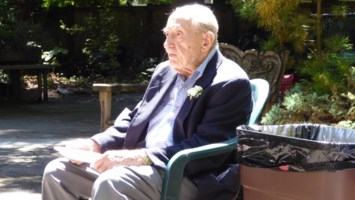
Ben was born on the family farm in Fairview Township, Hand County, South Dakota, early on January 6, 1926, 1:10 a.m., the second son of Ferdinand Fredrich Martin Matter and Lydia Marie Wilhelmine Graese Matter. He was baptized in the congregation, St. Michael’s, started by his paternal grandfather, who was a Lutheran pastor. Three months after his birth, his father died due to untreated diabetes. He was raised by his mother, paternal grandmother, and extended family, for he had several aunts and uncles from both his father’s and his mother’s sides. The farm raised cattle and hogs, and made use of several closely located parcels of land owned by various family members. With all the extended family’s help, the farm survived the Great Depression, the Dust Bowl, and other natural calamities of the 1930’s. During third grade, he began wearing thick-lensed glasses for the correction of his astigmatism. Often, he lived away from the farm with one of his relatives for extended periods of time. When at home, he had his farm chores to do. In 1940, he was confirmed in the faith at St. Michael’s.
Ben was educated in various one room school houses near the farm. For ninth through twelfth grades, he attended the nearest high school to the farm, located in the county seat of Hand County: Miller, SD. He stayed in a dormitory while attending high school. During this time, he showed an interest in working with electricity. Upon graduation, he worked on the farm and did not serve in the military during World War II. He wired the barn for electricity using iron wiring, as copper was sequestered for the war effort. Another project was to make a trailer out of the back end of a defunct Chevy truck. He became a do-it-yourself (DIY) type of person.
In the late 1940’s, Ben made a trip to Seattle to visit one of his aunts and uncles: Lydia and Rev. Ernest Zellmer. (All his paternal aunts who survived well into adulthood became second wives to Lutheran pastors.) Rev. Zellmer served at Zion American Lutheran Church in Seattle (formerly Evangelische Lutherische Zions Gemeinde, now called Gift of Grace Lutheran). Ben did not return to South Dakota except on vacations. He met Ethel Lillian Fenhaus, a member of Zion; they married in 1953 at Zion, the Rev. Dr. John Kuethe officiated.
During their courtship, Ben learned the electrical trade. He studied via the two-year apprenticeship program of the International Brotherhood of Electrical Workers (IBEW), Local 46, and became a journeyman wireman. During that time, the early 1950’s, he failed a physical exam, was classed “4F” and, unlike what had happened to many of his classmates, was not called to military service in the Korean Conflict. Upon becoming a union member and after a couple short term jobs, he started working for the Seattle School District at its Maintenance Department in its Electric Shop, on Dexter Avenue. He also helped in the construction and wiring of Zion’s new church building before the congregation moved in 1951 from downtown Seattle (8th & Stewart) to the Wallingford neighborhood (N. 40th & Meridian).
After their wedding, Ben and Ethel lived in an apartment in Capitol Hill, until her father died and her mother suffered a stroke during an operation. While they lived with her mother and cared for her in the house where Ethel was raised in the Magnolia neighborhood, their only son was born, a child damaged in the process of being born; the son was named Joel. They also bought property eight blocks away, across from a playfield Ethel often used as a child. After a house was framed and bricked on that property, he spent three years during after-work hours doing most of the tasks to make it a home: wiring, plumbing, sheet rock, tiling, and roofing. Once the house was livable and passed all inspections, moved in.
After Ethel’s mother died in 1961, the family of three continued to live in this house. They worshipped at Zion. Ben and Ethel were in the choir; much later Joel joined them. Ben taught Sunday School, served on the church council several times, and was president of the congregation a couple of times. He taped (reel-to-reel) the church services for later listening by members who could not attend in person. He and Ethel often made evangelism calls to people who had visited Zion within the previous few months. Whenever some work needed to be done at church, he would make himself available get a task done.
Outside of church, sometimes he would teach classes in the IBEW apprenticeship program. He learned Morse code well enough to earn the privilege to be a ham operator, and put together the equipment, including stringing an antenna over the house, to send and receive messages, to DX around the country.
In the 1960’s and 1970’s, whenever two-week vacations were taken (with two exceptions to Disneyland and two other exceptions; an explanatory note: two weeks was the maximum vacation time Ben was allowed per year, unpaid) the family invariable stopped in Miller, SD, no matter which route was taken, where his mother and Aunt Emily lived after the family farm was sold. His older brother and family also lived in Miller. These car trips could include visits to Rochester, Minn. and the Mayo Clinic for a battery of tests for his damaged child, Salt Lake City, Denver, Minneapolis, Yellowstone National Park, or Lake Louise and Banff in Canada, but the ultimate destination was Miller, SD. Even on a trip to Expo 67 in Montreal, Quebec, Canada, New York City, and Washington, D.C., there were stops in Miller both going to and coming back from. Visits to other family members were fit into the tight schedules of these trips. After Aunt Emily died, and especially after his mother died, any trip to Miller, SD, was for the occasional high school reunion or a tour that his cousin Paul Weiblen arranged in 2007.
On Memorial Day weekend in 1965 (back when Memorial Day and some other U.S. holidays stayed on the day of the month and were not fixed on a specific Monday; it was on Monday that year), the family joined with another family, who were members of Zion, to visit Holden Village. That family’s relative, Werner Janssen, was the business manager there. Ben, Ethel, and the son were enchanted with the place. When Werner found out that my father was an electrician, he lined up some jobs for him to tackle. In return, there was a price break on the cost of the visit. The family continued to visit Holden through the years, almost always short three-day weekend visits that did not use up vacation time (after he retired, the visits would be longer), and Ben would bring his tools with him and gladly volunteer his time on some project. He would tell relatives and friends about the place and, when they did come to visit Holden, found that how he described the place to them was exactly what they encountered there.
Ben helped Joel with school projects – planning and assembling them – and, when his son was an adult, built an inkle loom based on a plan in a book and changed it so that it was left-handed. Sometimes he would show and explain how to do the construction and assemblage and let his son do some of the work, but most often he did not say anything as he worked and completed the job himself. Also, when his son was learning to play the French horn, occasionally he would bring out his own horn – a mellophone, which he played in high school – and play along with his son during his practice times. In addition, Ben cut Joel’s hair on a regular basis until adulthood, often complaining how Joel’s hair acted one way on one side of his head while behaving a different way on the other side.
Ben and Ethel occasionally played a round of nine-hole golf at Jackson Golf Course during the summer months. More rarely would they play a full 18 holes at Jackson or at another golf course in the greater Seattle area. As they grew older, they drifted away from the game.
There were several Sunday afternoons when Ben would drive the family around. Sometimes it was around the city, sometimes it was around Puget Sound. Annually Ethel wanted to go to Mt. Rainier National Park. On those occasions, she and her son would walk around in the park while he slept in the car. When the two returned, he would wake up and drive the family back home. Sometimes the family would go to see friends in Bellevue or Bellingham. On a Sunday in May 1980 after church, Ethel wanted to go to see Mt. St. Helens. Going south on I-5, after a few miles south of Olympia, there were cars stopped on the shoulder of the interstate with people out of their cars looking in a particular direction. When the family looked in the same direction, they saw Mt. St. Helens erupting. This trip continued to where I-5 was closed off south of Chehalis, then took a road east, heading toward Morton. Passing farms with contented cattle eating with the erupting volcano in the background, Ben wisely decided to turn around and head back after seeing dust-covered cars coming from someplace unseeable to the east. Afternoon drives like these became fewer as fuel prices increased.
After 31 years of service to the Seattle School District, Ben retired from his position as foreman of the electric shop. He was in his mid-fifties. Once he was rested, he went back to work, at Ethel’s insistence, taking jobs through the union. Some of these were short-term jobs, others were long-term. He retired at age 65 from Cascade Machinery and Electric, a long-term job.
When Ethel joined Kingsplayers, a volunteer group that sang and put on annual musicals, Ben helped out. He sang in the choir, and built sets for the musicals, though did not have any roles in them. He stayed behind the scenes while his wife sang and danced.
Occasionally, Ben and Ethel took trips by themselves after his retirement, always on tours. There was a visit to the southern western U.S. (Arizona, New Mexico, Texas, and Louisiana), the Mississippi River, the Caribbean Sea and the Panama Canal, and Europe.
In 1998, the family left Gift of Grace Lutheran Church and joined Queen Anne Lutheran Church (QALC). Ben helped out with electrical projects over the years at QALC, including installing motion sensor detection switches and lights. Often these tasks required cutting holes into finished walls to get at the wiring inside. For this his son gave him the moniker “Holey Man” (say it out loud). Once the new sound system was installed as part of the sanctuary renovation and organ installation, he recorded the second service – now as a computer file – for people who were shut in to listen on their own schedule.
When Ethel became weakened due to a form of Parkinson’s Disease, Ben spent almost all his time caring for her. When this task became too difficult, he got a nurse to come in the house three days a week to assist him. He made sure that Ethel arrived at all doctor and dentist appointments. When she stopped breathing for a protracted spell, he took her to the hospital. He was with her when she died, just before she was to be released from hospital care.
After Ethel died, Ben continued to worship at QALC, taping services, and doing tasks at church when called upon. He helped with the Lutheran World Relief in-gatherings twice a year as a traffic director. He would putter around the house fixing meals, washing his own clothes, mowing the lawn, and pulling up weeds that would grow up in the lawn. There were long-term past times he would indulge in from the time he was married. First: bowling on Monday nights when there was a church bowling league, at University Lanes and later at Leilani Lanes, then senior leagues on Monday during the day at Kenmore Lanes. Second, he would watch TV in the evenings; after retirement the TV was always on.
Ben was healthy and strong though not robust. He often had problems with his back. In the 1950’s and 1960’s, he would often go to Mukilteo to see a relative of Ethel’s who was an osteopath and have her work on his back. Years later, he would do some stretches to relieve back pressure. He never developed a habit of walking, jogging, or other form of exercise, as such activity bothered his back. In this millennium, he had a couple of heart attacks. He also suffered a mild stroke. After each of these incidents he would bounce back and continue to do what he had been prior to these health events, including driving. One time, while he was at Holden Village for a work week (when the village transitions either from winter to summer – as it was this time - or from summer to winter), he experienced an attack of shingles. He continued to work while that was afflicting him, and toughed it out until work week was over. Joel likened him to a Timex watch, since he would “take a licking and keep on ticking.”
In 2018, almost three weeks after his 92nd birthday, Ben tripped up the two stairs to the front porch of the house and landed hard on his nose with the screen door, leaving a big gash that required stitches to close up and stop the bleeding. At that time there seemed to be no further health issues. Not too long before the stitches were to come out, he suffered a massive stroke with bleeding on his brain. When he was brought in to the Swedish Hospital ER in Ballard, some of his levels were so off the charts the medical team attending him were surprised he was still alive. He was stabilized then sent to Swedish Cherry Hill (the former Sisters of Providence hospital). While there it was discovered that his ability to swallow after he chewed his food was compromised, that his esophagus did not take the food to his stomach, but that it came back up. In addition, a diverticulum was discovered in his upper esophagus, a pouch whereby food could get lodged, then come out to cause choking. The doctors gave him a choice: either receive hospice care for the remainder of his days, or have a feeding tube implanted through a hole in his belly to his stomach and require skilled nursing care while that was in place. He chose the feeding tube. This was in spite of a document he signed years before that stated that no special procedures should be taken to preserve his life, of which the doctors had a copy and ignored.
When it came time to leave the hospital, Joel helped Ben to choose Skyline for his skilled nursing care. While he would have preferred The Hearthstone, the Lutheran retirement and health care facility in Seattle, it was allied with UW Medicine, while he had been receiving health care for much of his life from the Swedish hospital system and Skyline had a Swedish doctor on site (this situation changed three years later). Also, Skyline was cheaper than The Hearthstone, though not by much. It was also located much closer to Swedish Hospital on First Hill, just four blocks away. Skyline is the Presbyterian retirement and health care facility in Seattle, and a newer facility than The Hearthstone.
Ben tried hard to recover, to bounce back like he had before in his previous health events. This time he could not. After six months his progress plateaued and never got better. Several times his feeding tube needed to be replaced. Throughout all his time there, he was grateful for all the things the staff did for him, he was gracious and did not complain to the staff, though he often made his son make requests when his needs were not met.
Skyline offered Ben many opportunities for activity. There were short daily exercise sessions in the morning. He spent some of his time at Skyline attending sessions, some of which were provided by retired UW professors who were also Skyline residents. There were concerts by UW music students. He went to the weekly Bingo sessions. There were book reading sessions (reading books was something he did not do before his massive stroke; books about Seattle and the Pacific Northwest interested him) and sessions where short stories were read aloud. He attended sing-alongs hosted by David Lepse, who was interim choir director and organist at QALC for a couple years. When there were bus excursions to other parts of town, he would join the sightseeing tours. He often wanted to be ready for these sessions and meals an hour in advance. He also watched a lot of television. While at Skyline, Ben received his 70-year pin from the International Brotherhood of Electrical Workers, Local 46.
Ben survived the pandemic without catching the disease though he tested positive twice, and endured a couple cases of melanoma on the back of his neck and on top of his head. On September 1, 2021, he suffered a fall. Prior to that fall he used his walker to move in and around the facility; after that, he stayed in his wheelchair exclusively and had to be pushed to where he wanted to go. After Thanksgiving 2022, his rate of decline increased. In the second week of December, he exhibited much discomfort during overnight feedings. On Wednesday, Dec. 14, it was decided to cease the feedings, but keep him comfortable. On Friday, Dec. 16, 7:15 a.m., he died as a staff person was trying to wake him.
Memorials for Ben Matter may be sent to Queen Anne Lutheran Church, Lutheran World Relief, or Holden Village. For details, please call 206-284-1960.
Fond memories and expressions of sympathy may be shared at www.Evergreen-Washelli.com for the Matter family.
Muestre su apoyo
Comparta Un Recuerdo
Comparta
Un Obituario
Obtenga actualizaciones
Servicios
COMPARTA UN OBITUARIOCOMPARTA
- RECIBIR RECORDATORIOS
v.1.18.0