
OBITUARIO
Bertha Knight Landes
19 octubre, 1868 – 29 noviembre, 1943
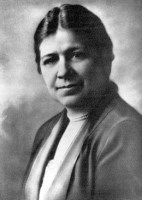
Seattle's one and only female mayor and the first woman to head the government of any large American city. Bertha Knight was born in Ware, Massachusetts, to Cordelia Cutter and Charles Sanford Knight. In 1873, the family moved to Worchester. Miss Knight met her future husband, Henry Landes, while attending Indiana University, where in 1891, she earned a degree in history and political science. After three years of teaching at Worchester's Classical High School, she married Henry, and in 1895, they moved to Seattle, where Henry would work as professor of geology at the University of Washington. They adopted one child and had two children of their own. Bertha, a devoted wife and mother of three, considered the community just another extension of her home, so it seemed perfectly natural for her to get very involved in civic matters. She held positions of leadership in several women's organizations, including the Women's University Club, the League of Women Voters, and president of the Women's Century Club. In 1921, as president of the Seattle Federation of Women's Clubs, Landes organized a weeklong manufacturers' exhibit staffed by more than 1,000 clubwomen, which bolstered the spirits of the business community during a severe recession and led to her appointment as the only woman on a five-member commission to study unemployment in the city. When commenting about his wife's decision to run for City Council in 1922, Henry stated, "...in principle, there's no difference between running one home and a hundred thousand." By 1926, Seattle had suffered from several years of scandals and widespread corruption in its government. Landes ran for Mayor early that year on a platform that stressed "municipal housekeeping," calling on citizens to turn in bootleggers and offering $1 per year to those who would report reckless drivers. On March 9, 1926, Landes was elected mayor of Seattle, becoming the first woman to govern a large American city. During her honest administration, regulations for Seattle dance halls and cabarets were enforced, only qualified professionals were appointed to head city departments, and the city's financial house was put in order. Despite her success in office, Landes lost her bid for re-election in 1928 under the then-popular sentiment that a city of stature should be led by a man. Perhaps it's ironic, then, that her male successor, Frank E. Edwards*, was recalled in 1931 by angry voters.
*Also mentioned in "Doughboy" info.
Muestre su apoyo
Comparta Un Recuerdo
Comparta
Un Obituario
Obtenga actualizaciones
Servicios
COMPARTA UN OBITUARIOCOMPARTA
- RECIBIR RECORDATORIOS
v.1.18.0