OBITUARIO
Raúl A. Villamia
30 noviembre, 1925 – 2 diciembre, 2020
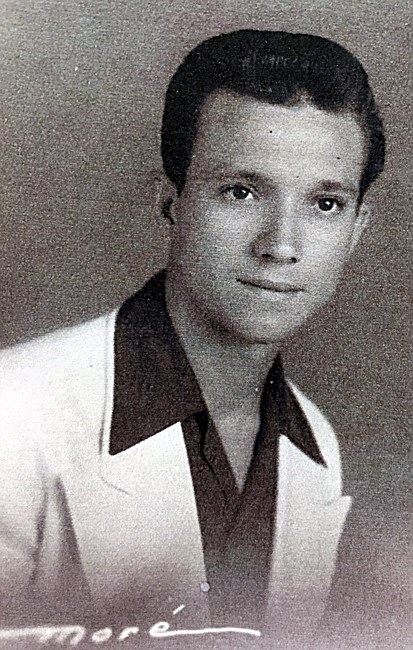
Raul Andres Villamia, 95, batted his first home run in Heaven on December 2nd, 2020. From the time he could walk, he had a baseball in his hand. Born in the Cerro section of Habana Cuba on November 30th, 1925, he grew up playing street stickball, but soon became part of youth and amateur teams. After pitching a double-header for the Sociedad del Pilar team that was playing at the University of Habana field in 1947, he was approached by Washington Senators scout Joe Cambria with a professional minor league contract offer to play in the U.S. And so began a minor league career that took him to Big Spring TX (Broncs), Miami FL (Tourists), Bridgeport CT (Bees), Deland FL (Red Hats), Alexander City AL (Millers), Dublin GA (Green Socks), Keokuk IA (Kernels), Portsmouth VA (Merrimacs), Tallahassee FL (Rebels), and Tampa FL (Smokers and Tarpons).
While playing with Deland in 1950, he visited Tampa for the first time and was enamored by the culture of Ybor City so reminiscent of his native Cuba. During the two years he played with Deland, he’d come to Tampa often. In 1953 he was contracted to play for Dublin again, but a salary dispute resulted in his requesting to be a free agent, and since he’d established friendships in Tampa, he came back to the place he liked most. He rented a space in the upstairs rooming house over the Ritz Theatre on 7th Avenue in Ybor and got a job at the Corral, Wodiska & Co. cigar factory while considering his next baseball-playing options. He kept in shape by playing on the Circulo Cubano and Centro Asturiano mutual-aid-society teams in Tampa’s Inter-social League.
It was while walking every morning to the factory that he noticed across the street a ravishing green-eyed young lady waiting for the bus in front of Cuervo’s Restaurant on 7th Avenue and 18th Street. Finally summoning the courage to walk on her side of the avenue to see her up close, he was instantly smitten, telling her that she had the most beautiful eyes in the world. Within six months of his first seeing her, they were married. Daughter Rhonda Jean arrived thirteen months later. Second daughter Denise Elaine made her entrance in 1960.
Raul was the sixth of seven children. His parents Miguel Villamia Saa and Balbina Lagos were from Galicia Spain. Their children Miguel, Barbara, Fernando, Irene, Mario, Raul and Marta were all born in Habana. Raul was the last surviving sibling after losing Irene in 2016.
Though baseball was Raul’s first love, in 1955 he was “drafted” into Fidel Castro’s revolutionary movement by his brother Mario, a political activist from the time he was 16 years old. Less than one month after Fulgencio Batista’s March 1952 coup, Mario founded the first U.S. anti-Batista organization (Accion Civica Cubana) in New York City, his place of residence since 1946. When Castro came to the States in 1955 to establish branches of his “Movimiento Revolucionario 26 de Julio” (a/k/a M267) to raise funds for training and arming the rebel forces, New York City was the first of six cities he’d visit. Mario was instrumental in making the arrangements for Castro’s stay and identifying a location for him to address the Cubans and Latin Americans supporting the desired change in Cuba’s government.
Once Mario learned from Castro that he’d be going to Tampa to establish a branch, he
“volunteered” his brother Raul as someone who could help in that endeavor. At the same time, Victoriano Manteiga, the founder of our nation’s only trilingual newspaper La Gaceta, had also been contacted by a mutual friend of Castro’s, sculptor Jose Manuel Fidalgo, to elicit his help in forming an M267 in Tampa. Manteiga was personally named by Castro as President of the revolutionary organization, and Raul as its Secretary.
Raul was a founding leader of the Tampa M267 from November 1955 to January 1961 when diplomatic relations between Cuba and the U.S. ceased. During that period, he also served as president, delegate, and Tampa’s first Cuban consul under the Castro regime. Raul loved his Cuban homeland, but also loved his adopted country of America, becoming a U.S. citizen in 1957.
December 1957 began his 30-year career with the City of Tampa Traffic Operations Section. He worked his way up to supervisor and retired in 1988. One of the first things he did upon retiring was travel to Spain with his brother Fernando to see his parents’ birthplace. He went on a subsequent trip there with his two sisters Irene and Marta. In 2006, he made his third and final Iberian trip with his daughters Rhonda and Denise, and grandson Javan Galindez.
Raul enjoyed traveling. In 1980 he made his first trip to Cuba since last visiting it in 1960. Rhonda accompanied him on this trip during tumultuous times in the island nation…when the Peruvian Embassy was occupied by those seeking asylum, a couple weeks prior to the Mariel Boatlift operation. In the summer of 1998, his grandson Wynter Galindez was part of a pioneer group of ten Duke University students making the school’s first study abroad trip to Cuba since the Revolution, and in 2010 Raul, Rhonda, and his grandsons visited Cuba together. Raul’s final trip to Cuba was in 2015, accompanied by his two daughters. On each of these visits, he was able to see some of his former M267 colleagues.
After Castro declared himself Communist, and the embargo began, Raul no longer supported the regime, but neither did he become involved in any counter-revolutionary activities. He had devoted six years of his life to helping put into power the man touted to be Cuba’s savior. Like many others who had sacrificed much in this endeavor, Raul was disillusioned, so that part of his life was put to rest, and left dormant for decades.
Free from the time constraints of leading the M267, Raul dedicated himself to his family. He was a quiet unassuming man…a person of few words, but an astute observer. Though only having a basic education, he could converse on just about any subject. He was an avid reader who daily combed the newspaper from cover to cover, soaking information in like a sponge. He was pragmatic, unpretentious and a realist, often sharing his usually fact-based opinion and not sugar-coating anything. What you saw was what you got with Raul.
He had a strong work ethic. Aside from his daytime municipal position, he for a number of years worked evenings at the Tampa Dog Track. Any endeavor he undertook, he always carried out meticulously. When he did a job, it was a job well done, be it at his vocation, while doing household repairs, home improvement projects, or cleaning his car.
After his playing years ended, his love of baseball continued to be demonstrated by his
coaching various Tampa youth teams, including West Tampa and Wellswood leagues.
He was always impeccably dressed. Even when casually attired, his jeans sported an iron-pressed crease, his shirt crisp. He particularly enjoyed wearing the traditional Cuban guayabera. He loved to dance. He loved to recite the poem “La Rosa Blanca” by Cuba’s apostle Jose Marti, something which he continued to do up until the day of his death. He was fond of animals, especially dogs. In Cuba he also had sheep, pigs, and chickens. He had a tender heart for hurt or abandoned animals, at times adopting them.
He was most content being at home with his family. In later years, Raul annually traveled to New York City, where his daughters had relocated, and he would spend months there visiting them and his grandsons.
He became a devoted Duke Blue Devils men’s basketball fan after his grandson Wynter was made student manager of the team in 1997. Attending the 1999 NCAA Final Four at Tropicana Field in St. Petersburg FL to cheer Duke on, was a highlight. He, Rhonda and Javan were able to participate in many team-related activities the days leading up to the games. Raul got to meet the players, Coach Mike Krzyzewski, and attend the final game’s after-party. It was truly a memorable weekend for Raul.
While on one of his visits to New York City, the September 11th, 2001 attacks took place. He witnessed the collapse of the Twin Towers from Rhonda’s Queens rooftop. In a life-altering instant, almost 3,000 people were gone. It shattered families and profoundly affected not only local residents, first responders and volunteers, but the world at large. It became a time of shared bonding for Raul and his daughters, who were actively involved in the relief efforts at the WTC site. Raul was able to see the devastation first hand. So many lives suddenly extinguished, with so many stories left untold.
Rhonda had for decades wanted Raul to preserve the details of his revolutionary years, due to its historic significance to the family. He was the last of Tampa’s M267 founding members…and if he didn’t preserve those memories, they would perish with him. Finally in 2004, Raul was ready to write his memoirs, the manuscript of which was completed last year, and for which a publisher is being sought. His story includes not only his experience, but that of his brother Mario, and two others in Castro’s inner circle who supported the Revolution while living in the U.S.
Interestingly, the bookends of his life were tied to some significant dates of the Cuban Revolution. On Raul’s November 30th birthdate, in 1956, there was the Santiago de Cuba uprising led by Frank Pais, which was organized to deflect Batista’s forces’ attention from the landing site of the “Granma” expedition bringing Castro and the rebels to Cuba. The yacht was to have arrived at Playa Las Coloradas, northeast of Cabo Cruz and south of Niquero on this date. But it arrived on December 2nd , signaling the start of the Revolution. So though he was not a political person, his life’s entry and departure dates aligned with significant milestones in Cuba’s revolutionary history. In his final decade, he was in favor of normalizing relations between our two countries, from a humanitarian standpoint.
Raul had four loves in his life: baseball, his bride Nora, Cuba, and the U.S. Though he and Nora were divorced, they shared an amicable and close relationship till the day she died on February 24th, 2017, a date which coincidently is also a milestone in Cuba’s history…the Grito de Baire, which started the Cuban War of Independence in 1895 led by Jose Marti. Raul never re-married because the room in his heart had always had only one occupant.
Raul is survived by his daughters Rhonda and Denise Villamia, grandsons Wynter (Melissa Rose) and Javan Galindez, great-grand-children Luna Rose and Rio Oz Galindez, nieces Natacha Villamia Sochat, Arlene Villamia Drimal, Deborah Villamia, Liz Villamia Slattery, Maria Villamia, and nephew Michael Villamia, along with many grand-nieces and grand-nephews.
He is now reunited with Nora and is in the presence of our Lord Jesus, playing baseball for eternity on Heaven’s celestial diamond.
A Celebration of Life service will take place 11 a.m. Saturday, December 12th at Blount & Curry Funeral Home at Garden of Memories, 4207 E. Lake Avenue. Interment to follow in Garden of Memories Cemetery. The family will receive friends Saturday from 10 a.m. until service time at the funeral home In an effort to be socially responsible due to Covid19, we are limiting the number in attendance to only those who have pre-registered. Please RSVP to the following email if you plan to attend: [email protected]. Again, in consideration of the pandemic, we are also restricting attendance to one person per household, and no children. Masks are mandatory. The service will also be streamed live on Facebook via the following link: https://tinyurl.com/yxe3decx .
Under normal circumstances, a reception after the interment would have been planned, but due to Covid, there will be none.
In lieu of flowers, the family would appreciate a perennial or evergreen plant of your choosing to be included in a memorial garden on the family’s property.
Muestre su apoyo
Comparta Un Recuerdo
Comparta
Un Obituario
Obtenga actualizaciones
Servicios
COMPARTA UN OBITUARIOCOMPARTA
- RECIBIR RECORDATORIOS
v.1.18.0