
OBITUARIO
Gwen Braden
21 julio, 1926 – 23 marzo, 2023
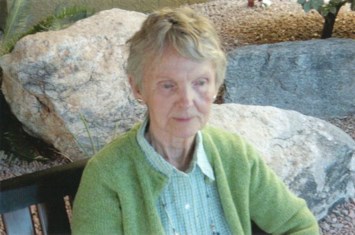
Gwen was born July 21, 1926 in Independence, Kansas, to Mildred and Warren Grant. Her father, crippled in childhood by polio, served as district attorney, Kansas state representative, and judge. Her mother, not a particularly warm person, was an expert seamstress and, in her own way, an artist. The story goes that she designed and then built their house with her own two hands and “the help of the town drunk.” As a small child, Gwen was Queen of the Independence festival of Neewollah (Halloween spelled backwards), with costumes made by her mother.
Gwen loved to read, though her mother thought it was a waste of time, and, because her mother insisted, played the piano. Even though she never really wanted to play, she grew into an accomplished pianist. Gwen always said that as a child she wished she could play the triangle instead.
During the war, she joined a group that made bandages to send overseas.
After high school, Gwen went first to Stephens College in Columbia, Missouri--at the time a two-year women’s college--then, reluctantly complying with her mother’s wishes, attended Julliard in New York for two years. She eventually landed in Kansas City, where she worked briefly at a home for unwed mothers. In Kansas City, she joined the singles club—the Spin-Bacs—at Westport Presbyterian, and there met Garland Braden, a WWII veteran who loved to sing. She married him in 1950, and in 1951 gave birth to their first child, a son. Garland’s work at TWA brought the family to New York, where, in 1954, Connie was born. Another job, this time at Ford, took them to Detroit, where, in 1957 Gwen gave birth to twins Andy and Libby.
In Detroit, Gwen played piano and organ at church for a year or two. Having encouraged all the children to take up musical instruments, she accompanied them when they had solos to play. She accompanied her husband too, especially when he sang Schubert lieder, as he often did. There was always music in the house.
Gwen wanted her children to develop their talents and build meaningful lives. This they did and continue to do. Libby, an artist from early childhood, remembers the art books her mother brought home from the library (for her own interest as well as for Libby’s). Though not a practicing artist herself, Gwen sensed the importance of dedication and discipline, encouraging her daughter to give it her all and to strive for originality and integrity. Libby remembers being encouraged to develop a basic skill in working from observation which she could draw on throughout her life, and this Libby did.
She took Connie regularly to the Detroit Public Library, where her little girl could indulge freely her love of reading. Later, when Connie became a yoga teacher Gwen was delighted, and happy too when Connie rather late in life began to draw and later still began practicing Zen Buddhism.
When Andy was a child and wanted to play baseball, he was supported, and when as an adult he joined the Tucson Symphony, for 25 years Gwen held season tickets so she could hear him play.
Deeply saddened and distressed by her estrangement from her oldest son, she was always happy to hear he was doing well, and when he again took up the baritone horn, the instrument he had played in childhood, it made her happy.
While raising four children Gwen sewed, knitted, gardened, and studied history at a branch of the University of Michigan, where she earned a Bachelor’s degree. Her interest in history never left her. Her special interest was the history of religion. An excellent teacher, she taught Sunday school at both Congregational and Unitarian churches, and took the job seriously. Throughout her life hers was an open-minded exploration of religion. She studied in particular the work of Paul Tillich and Bishop John Shelby Spong; in her later years she took up meditation and read books about Zen Buddhism, including many by Thich Nhat Hanh.
Always interested in politics and world affairs, she read the New York Times for an estimated 70 years. She took great joy in the election of Barack Obama.
After Garland was diagnosed with Parkinson’s disease, Gwen moved with him and the twins, who were still in high school, to Overland Park, a suburb of Kansas City, in part to be closer to her parents. She spent a decade caring for Garland, and when in his last two years she could no longer do so by herself, she spent all day every day with him at the nursing home. After he died in 1984, she cared for her aged parents. After the deaths of husband and parents, she languished for a while in Overland Park, though she did volunteer at the nursing home and was one of the first volunteers at the Olathe Hospital Hospice. Eventually, she moved to Tucson where Andy had a position playing clarinet in the Tucson Symphony. In Tucson she expanded into a new life as an ardent and valued volunteer. She worked for a while as a Stephen Minister through St. Andrew’s Presbyterian Church, and for many years at both the Arizona Historical Society Museum, and the Tucson Museum of Art. Representing the Art Museum, she gave presentations about art to underserved children in elementary schools on the South Side. She also was a long-time volunteer at the Tucson Medical Center, where she visited patients and helped those without family and friends return home after their hospital stay. She also knitted caps for premies.
Gwen was kind, self-effacing, loved to laugh, and was genuinely concerned for the happiness of others.
She loved to travel, visiting Japan, Great Britain, Italy, and Mexico.
Gwen’s career as a volunteer came to an end when after a lifetime of near perfect health she developed Meniere’s disease and suffered from constant dizziness and fainting spells. She moved into an apartment complex for seniors and gave up her car. She was, however, still for many years able to read and study, knit and sew quilts, and go out to movies with Andy. Covid lockdown was difficult and isolating—residents were confined to their apartments, food was delivered to them at irregular times in plastic, and Andy could not visit. This coincided with hearing and vision loss, and eventually some memory loss too.
When the residents could finally return to the dining room, Gwen ate two meals a day with her friend Jane. The dining room was understaffed, inefficient, loud and chaotic. Both Gwen and Jane had lost much of their hearing, so there couldn’t have been much in-depth conversation. But at every meal Jane would take the yellow and red paper cover off her tea bag and slide it across the table to Gwen. Gwen would quietly put it in her purse, carry it back to her kitchen and place it in a glass vase. This ritual gave them much satisfaction.
Throughout her time in Tucson, Gwen and Andy became very close. His sisters, who have lived in New York and Houston for many years, thank him wholeheartedly for his devoted care of their mother. After she fell and broke her hip in 2022, he found a small assisted living home, where she received tender and loving and skillful care by women who have been called to do this work. Many, many heartfelt thanks to the women of Grandma’s Angel, Myrna, Patsy, and Issy. Words cannot convey how grateful we are. Many thanks too to Dr. Martz and the nurses at Grace Hospice.
Gwen’s ashes will be buried next to Garland’s in Sharon Cemetery in the small town of Drexel, Missouri, where he grew up.
Connie wrote this:
Plum Blossoms
If the cells of the body replace themselves once every seven years, the body of my mother has renewed itself nine times since I lived and grew inside it, since the time she birthed me into this gentle life. It’s true, this life has so far been rather gentle with me. My mother’s body is now very old. Dizzy every moment of the day, she sometimes falls down unconscious, and wakes up on her floor with no idea how long she’s been down, but like the old plum tree of Eihei Dogen’s “Plum Blossoms,” my mother still blossoms, like this: she welcomes a woman crippled by sadness to the lunch table, she buys a Beatrix Potter book, she listens ardently to lectures about the Gnostics, loves her new shoes.
“ . . . old branches are nothing but plum blossoms.”
A dream from long ago: my mother and I play music together, she on piano, I on flute, improvising freely and joyously outside a pizza place. Another: we sit across from each other in a restaurant at a small table beside a window and together watch the blossoming, in front of a five-story parking garage, of a white flower seven stories tall,
Or this one, from even longer ago: I’m lying on the sofa in the house I grew up in when a voice says, “Why don’t you pray to God as a woman?” I’m shot into a pastoral landscape where a vague cartoon goddess stands behind an altar. Suddenly, I’m overwhelmed with love for my mother, this love is vast and complex—it’s too much, I can’t take it, it’s too much! I shoot back onto the sofa. . . .
“When the old plum tree suddenly opens, the world of blossoming
flowers arises. . . . There is a single blossom that opens five blossoms.
At this moment of a single blossom, there are three, four, and five
blossoms, hundreds, thousands, myriads, billions of blossoms—
countless blossoms. . . .”
Muestre su apoyo
Comparta Un Recuerdo
Comparta
Un Obituario
Obtenga actualizaciones
Servicios
COMPARTA UN OBITUARIOCOMPARTA
- RECIBIR RECORDATORIOS
v.1.18.0