OBITUARY
Bruce Vernon Martin
22 June, 1937 – 16 November, 2025
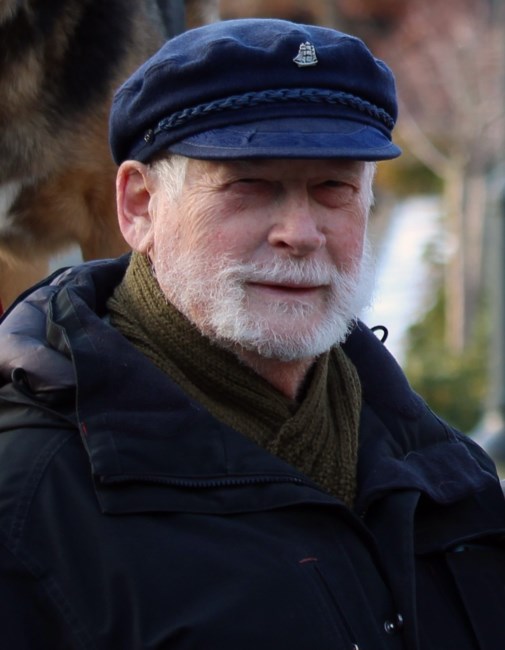
Bruce Martin took his last breath following a brief stay at Saanich Peninsula Hospital, where he received excellent, compassionate care from ER and hospice nurses, and Dr. Maher and Dr. Brothers.
An exceptional storyteller with a quick wit, Bruce was born into a working-class family in Toronto, Ontario. At 13, he revealed his talent for building and fixing all manner of things, beginning with disassembling and rebuilding transistor radios and establishing a radio repair shop at home a year later.
A young child during World War II, Bruce was enamoured with aviation and devoured books about the war and fighter pilots – a passion that never left him. As a young air cadet, he was crestfallen when he failed the colour blindness test required to be a pilot. But he still found ways to be around aircraft, skipping a year of high school to work for Orenda Engines across from the Victory Aircraft factory where his father toiled on the Avro Arrow production line. When the jetliner was cancelled and the planes destroyed by Prime Minister Diefenbaker in 1959, Bruce was devastated.
By then, he was studying radio and television arts at Ryerson Polytechnic, after which he became a mentor and valued member of several radio and television crews throughout Ontario, often working alongside his lifelong friend, Mike Du Boulay. He went from graveyard shifts at CFRB Radio in Toronto to CKCO-TV Kitchener and the CNE as a sound engineer. With a letter of introduction to news magnate Roy Thomson, Bruce and Mike sailed to England on the Italian liner Homeric in 1962. A train took them to their destination in Glasgow: Thomson Television International, where they worked on readying used TV cameras while living in Kirkhill House, which was slated to train African technicians to work in the industry.
Bruce returned to Ontario in 1963, continuing his broadcast career and resuming various activities, motorcycles and car rallies among them. An avid outdoorsman, he spent time camping, fishing, canoeing and scuba diving in the Great Lakes, becoming a NAUI diving instructor and secretary-treasurer for the Canadian Sub-Aqua Club. He dove on shipwrecks for the Royal Ontario Museum, and in later years, shared memories of travelling through the racially divided states to scuba dive in the Florida Keys.
In 1968, while working for the U of T’s television wing at Scarborough College, he took a trip to Tofino on Vancouver Island. His first taste of Dungeness crab – cooked below Wickaninnish Inn by the wild, roaring surf – prompted him to move west in 1969 with Trudy Moritz, his soon-to-be wife, and their beloved dachshund Taber.
During a short stint at CBC in Vancouver, he met Len Mack and his wife Penny and they became diving and sailing friends. Bruce and Trudy then moved to Victoria, where he worked as a diver at Sealand and bonded with Haida – once balancing on the Orca’s back, marvelling at his tremendous power and lamenting his captivity.
CHEK TV hired Bruce in the early 1970s, where he was a director/producer. Leslie Cox, his script assistant, and Mark Perry, the cameraman he hired, also became lifelong friends. During that time, he and Trudy lived aboard their Rowson 30’ sailboat, cruising the B.C. coast and gathering a further constellation of friends along the way. They were folks who learned their trades on the job, often literally living by the turn of the tide: log salvagers Sam Lamont [Anne Clemence]; groundbreaking whale researcher, Graeme Ellis; and shipwright John Weir [Anne]. In 1974, Bruce and Trudy brought their newborn son, Michael, into the world, now an Air Canada captain.
In the late ‘70s, Bruce left CHEK and got a job as a deckhand on B.C. Ferries. Because of his nautical knowledge and skills, he could often be found steering the ship on the bridge. During those years, he built Lèv, a 42’ Stan Huntingford cutter – relying on boat building books and the knowledge of friends.
While studying art history at the University of Victoria in the early ‘80s, he and Trudy separated. He worked as a sound engineer at Expo ’86 in Vancouver and started an appliance repair business in Victoria. In 1993, he married Catherine Lang, and a year later, their son Sam was born. During this phase of life, he built and flew model airplanes with artist Glenn Matthews and earned his ham radio licence [call sign VA7 SGM]. He also fell in love with Hawaii’s gentle beauty and culture in the 2000s, where he taught Catherine and Sam to snorkel.
Bruce lived much longer than expected. Following a quadruple bypass in 1984, and six bypasses in 1994, he went on to have eight stents over the following decades. The family is most grateful for the medical care he received from his GPs – Bud Faulkner, Phil Huggett and Jay Aiken, and several cardiologists, most recently Dr. Simon Robinson.
Predeceased by his parents and ex-wife, he leaves his wife Catherine, sisters Dorothy Morrison and Dianne Lightowler, sons Sam and Michael (Dai) and granddaughters Trudy and Mitzi Martin.
He was a loving husband and an exceptional father, albeit sometimes formidable. While the immensity of his loss cannot be exaggerated, the same is true of the strength that Bruce inspired. That long golden horizon now holds him steadfast.
A date for a celebration of life will be forthcoming.
In lieu of flowers, donations can be made to the Saanich Peninsula Hospital and Healthcare Foundation or the Victoria Women’s Transition House.
Welcome to the Saanich Peninsula Hospital & Healthcare Foundation - Saanich Peninsula Hospital & Healthcare Foundation Home | Victoria Women's Transition House - Shelter for Abused Women
Show your support
Add a Memory
Share Obituary
Get Reminders
Services
SHARE OBITUARYSHARE
- GET REMINDERS
v.1.18.0