
AVIS DE DÉCÈS
Joseph Call Sign: "Red Baron Six" A Luger
17 juin 1928 – 12 décembre 2016
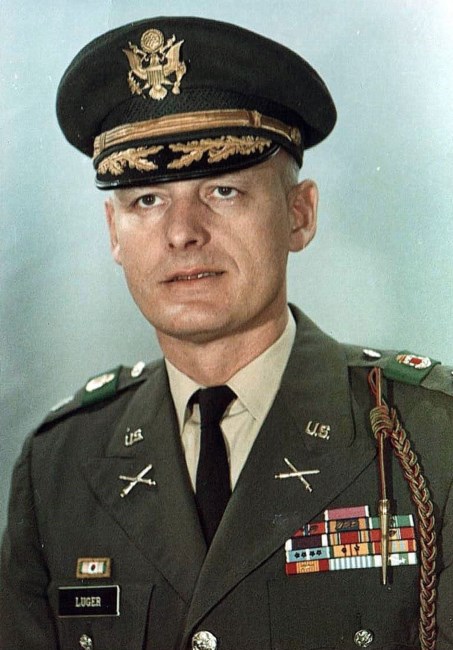
June 17, 1928 – December 12, 2016
On December 12, 2016, Colonel Joseph A. Luger (U.S. Army, Retired) completed his last tour of duty after a 2-year battle with pulmonary and respiratory disease. He is survived by his daughters Jeanne Luger Pulscak (Michael) and Joanne C. Luger (Dan Villanueva), three granddaughters, former spouse Mary Malone Luger and many loving cousins, nephews, and their families.
During his active duty, Joseph Luger was awarded 19 medals and citations including 2 Bronze Stars (1 for Valor), 4 Air Medals, the Legion of Merit Medal, 4 Commendation Medals and the Purple Heart. In 1975, he retired from active military service, and went on to serve for 20 years as a civilian consultant to the US Army, during which time he was awarded 5 Army Commendations, the Superior Civilian Service Medal, and the Meritorious Civilian Service Award.
Joseph (Joe) Luger was born June 17, 1928 in Minneapolis, Minnesota. From an early age, Joe had a deep and abiding love for his family from whom he found inner strength. By the age of ten, he was taught how to fly by his Uncle James Piersol, who at the time was an aviation editor for the Detroit News and New York Times. Joe attended St. Thomas Military Academy during his youth. By the age of 16, as a Junior Aviation Cadet, Joe was flying T-34’s, C-45’s as well as experiencing a little “stick time” in a B29.
He was an extraordinary student who excelled in the sciences, mathematics, and physics. In 1946, upon graduation, magnum cum laude, he entered the U.S. Military Academy at West Point. The academic rigor of West Point, his degree in engineering, and his selected branch (Field Artillery), provided the foundation for an extraordinary military career. He held the highest regard and respect for West Point, its traditions, and especially the members of the Class of 1951.
Joe believed that the achievements of the Class of 51 should be measured by the challenges they faced upon graduation. It was an era of unprecedented change in the affairs between nations. The advent of nuclear weapons, Joe wrote, “became the sine qua non (the indispensable factor) of international power, influence, and diplomacy”. The Class of 51 did not provoke, seek, or invite the sequence of global events that thrust many graduates into this “nuclear cauldron”. Joe wrote, “that members of the class…many in key positions looked nuclear war starkly in the face. They never flinched. Without reservation they exhibited the perseverance, determination, strength of will, sense of duty, and moral courage instilled at West Point.” To this mission each made a great sacrifice.
Joe Luger’s military career spanned 6 decades of leadership. From forward positions on battlefields in Korea and Vietnam to Cold War high-alert assignments, his knowledge, command ability, and expertise in strategy, discipline, and tactics, were invaluable to the success of the units he led.
In Korea 1952, the newly minted West Point graduate, then 2nd Lieutenant Luger, served 13 months as a Heavy Weapons Platoon Leader along the trip lines at Alligator Jaws, Triangle, Old Baldy, 1062, and Pork Chop hills. During Joe’s last 3 months of duty Joe chose a promotion to Field Observer with C Battery, 49th Field Artillery Bn, in time for the retaking of Alligator Jaws.
In Vietnam, it was Lieutenant Colonel Luger who commanded the 2nd Battalion, 13th Airmobile Artillery, also known historically and with great pride as the Red Dragon Clan. During his command between March 1969 and April 1970, he was known by the Field Force G3 as a “master slight-of-hand tactician”. His development of tactical innovations and excellence in airmobile artillery was proven in some of the fiercest artillery and infantry battles of the war. Under his command the 2nd Bn/13th Arty became known as “Ewell’s Fire Brigade”, by the II Field Force Infantry (Commanded by Lieutenant General Julian Ewell).
Joe Luger’s Cold War postings where during many high-alert crossroads when the possibility of nuclear confrontation appeared on the horizon.
In 1959-60 he became a nuclear battery commander in Europe which Joe later wrote was “cut loose” to operate independently a month-at-a time moving every few days along the Czech border in Germany. Joe, already regarded as master tactician said it “was the best three years” of his military career.
In 1962, he played several critical, far-reaching roles as the Nuclear Weapons Officer, Battle Team #1 at the U.S. Alternate National Military Command Center, during the Cuban Missile Crisis. In 1963, coincident with North Korea’s displeasure with the Soviet’s back-down from the Cuban Missile Crisis, and its build-up of 700,000 troops, then Major Luger was assigned as Asst. Corps Artillery S-3 and Staff Aviation Officer I Corps (Gp) Arty. Camp St. Barbara, North Korea. He had command of operations and training of the Corps Fire Direction Center supporting 8 battalions, including a Targeting Bn, four 8-inch Bns and two (Honest John and Sergeant) missile Bns.
From 1965-66 Joe attended the Command General Staff College in Fort Leavenworth, Kansas graduating with honors. In late 1966 Joe and his family moved to Alexandria, Virginia. He was assigned to the Pentagon as a Material Command, Staff Officer for the Army’s Force Development, Plans, and Programs
Directorate.
In 1970-72 Joe Luger’s promotion to the rank of Colonel coincided with his command of 5th Battalion, 32nd Arty, 1st Infantry Division Augsburg, Germany – another front-line Cold War command, in a high state of readiness. Among other achievements, Colonel Luger’s command was given a one-of-a-kind award in 1971 for being the only unit in USAEUR history to achieve a flawless record and score in the rigorous four-day Inspector General’s Nuclear Technical Proficiency Inspection.
Colonel Joseph Luger retired from military duty in 1975, after serving for 2 years as Department Director of Tactical Data Systems for the U.S. Army Computer Systems Command and 2 years as the Chief Operational Support, Force Development, and Experimentation Artillery Test Manager for the Army’s Operational Test Agency.
From 1976 to 1996 Colonel Luger (U. S. Army, Retired), continued his service as a civilian consultant, in the role of a nuclear weapons analyst, expert, and specialist. Who better to advise the Army on critical matters of nuclear defense? Joe was an ideal choice, a brilliant former commander experienced on the battlefields of two major wars, and a highly knowledgeable, experienced forward area commander who performed remarkably on the front-lines of so many Cold War confrontations.
One of Joe’s first roles was as a Nuclear Weapons Safety Officer at HQ Department of the Army for his West Point Classmate General Shy Meyer who was ADCSOPS and later would become Chief of Staff of the Army. Over the years, he also served as an operations and nuclear policy expert to the U.S. Army advising on internal Army operations as well as various treaties and initiatives such as the Open Skies Treaty, Non-Proliferation, and Space Policy.
Through arguably the most perilous era in U.S. history, from the raising of the Berlin Wall in 1948 to its fall in 1989 and the demise of the Soviet Union in the 1990’s – Joe Luger, the West Point Class of 1951 and countless others evolved, maintained, leveraged, yet reigned-in the precarious power of nuclear weapons, protecting America its people and the free countries of the world.
During retirement ceremonies honoring Joe Luger in 1996, then General Joseph Garret, Assistant Deputy Chief of Staff U.S. Army said, that Joseph Luger’s efforts had “directly and indirectly touched the lives of countless Americans and influenced our nation’s security through six decades. He is a true patriot whose selfless services put our country’s needs above his own at all times.”
Upon retirement from civilian service Joe spent much of his time with his family particularly his 3 young granddaughters who he loved dearly and in whom he had much pride. He also loved to fly. Perhaps emulating his Uncle James who taught Joe how to fly early in his youth, Joe Luger (call sign: Red Baron 6) enjoyed doing the same for others. During his active service, he achieved his designation as a commercial pilot by the FAA and as an Instructor Pilot. He continued in his retirement to teach and instruct others to fly, qualifying them for FAA licenses and ratings. In 2006 Joe volunteered his time to the Alexandria Police Department providing support analyzing criminal cases and back-office financial operations.
Joseph Luger, will be remembered and missed always by his family, friends and loved ones, his West Point classmates, soldiers under his various commands, his superior officers, and military leadership.
Montrez votre soutien
Envoyez Vos
Condoléances
Partager
L'avis De Décès
Obtenir les mises à jour
Prestations de Service
Partager l'avis de décèsPARTAGER
- RECEVOIR DES RAPPELS
v.1.18.0