
AVIS DE DÉCÈS
John Elmer Baker Jr.
4 juillet 1933 – 13 août 2016
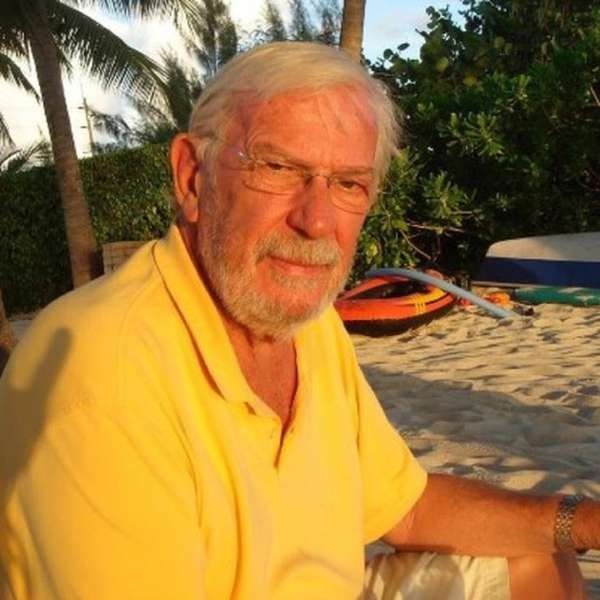
In his autobiographical writings, broadcast journalist John E. Baker Jr. described his career, from the early days of television to his time as a senior executive at the fledgling CNN, as one adventure after another doing things no one had tried before – like launching a 24-hour cable news network.
Baker accepted Ted Turner’s offer to come work for him in Atlanta in 1980 and became vice president of operations at CNN. He retired in 1993, played golf, wrote novels and had friends over to his Morningside home for poker, food and stories of days gone by. He died at home Aug. 13 of liver cancer. He was 83. H.M. Patterson & Son Spring Hill handled the arrangements.
In an obituary write-up, former CNN anchor Lou Waters described Baker as “a friend, a story teller, a chef, a poker player, a bourbon sipper, a baseball aficionado, a mentor, a golfer, a cigar smoker, a music lover, a loving husband of Liz Mercure for 27 years, a proud father of Michael.
Baker had married twice previously before meeting Mercure, a video journalist, at CNN in 1982. “He changed so many lives by being a good leader, a kind, gentle man who just loved television,” she said. “He lived and breathed TV news and believed in putting the best product on the air.”
“Everybody just liked to be around him, to hang around with him,” Mercure said. “In his later years, he’d sit on our front deck every day and smoke cigars. Neighbors would stop by, and he’d tell war stories. … He was just the best husband you could hope for.”
Though he could be gruff at times, Baker was a caring individual, said Fulton County Superior Court Judge Jerry Baxter.
“There was a kid, I think he was 8 or 9, with learning disabilities, who was having a tough time reading,” Baxter said. “His parents knew John, and John said, ‘Let me try to help.’
“He got this young boy to be his editor – to read what John had written and talk to him about it. The young man read and read and read over and over again John’s writings, and his parents think John was instrumental in their son learning how to read. John of course didn’t need an editor, but he did that as a kindness to the family and the boy. … Now the young man is successful and doing well in life.”
Baker was born on the Fourth of July, 1933, and grew up an only child on a 40-acre truck farm about 20 miles north of Houston, Texas.
“Damn near the very birthing of it,” he wrote in an unpublished autobiography, he got nipped by the television bug.
Dick Gottlieb, a TV personality from Houston, visited his school and gave the “most uplifting speech I’d ever heard, delivered in a rumbling voice full of confidence and encouragement. He made us feel we could all be part of the beginning of an era of television.”
Baker was hooked. He enrolled in the University of Houston and was an announcer at the school’s new educational television station, KUHT/Channel 8. His first job on the outside came in 1954 as cameraman for a cooking show at a local CBS affiliate, KGUL/Channel 11. Among the luminaries he got to work with was Ed Sullivan, in Houston to film a commercial for a Lincoln-Mercury dealer.
Baker went on to be a young Dan Rather’s first director at KGUL, then directed and produced TV news in Baltimore, New York, Detroit, Philadelphia and Washington, D.C. He won numerous Emmys – and, according to Waters, bragged that in 40 years of TV new, he never missed a paycheck.
His time at CNN became a 2009 book, “Chicken Noodle News: A CNN Whodunit.” In it, he relates a conversation with Reese Schonfeld, CNN’s first president:
Schonfeld: “It’s been two weeks, what can you tell me?”
Baker: “More than half of the people you’ve hired don’t know what they’re doing. I’m not sure they could do the right thing if shown how.”
Schonfeld: “So that says it, you’re leaving us?”
Baker: “No, I’ve decided to stay.”
Schonfeld: “After what you told me, why would you stay?”
Baker: “Because I think it’s going to work.”
At the beginning of his autobiography, “Battling for the American Dream,” Baker wrote, “I look back now and think surely it was best to not know what risks I’d take, what a fool I’d be, or how I’d be fooled – what losses. Best not even to see what fine pleasures were ahead, what achievements, what things won, the sheer excitement and hilarity – how I got humor being part of a professional family, and my own family. Many years later, one becomes all one has learned from trials and experience, the mix of it all
Montrez votre soutien
Envoyez Vos
Condoléances
Partager
L'avis De Décès
Obtenir les mises à jour
Prestations de Service
Partager l'avis de décèsPARTAGER
- RECEVOIR DES RAPPELS
v.1.18.0