AVIS DE DÉCÈS
Hafez Farmayan
7 octobre 1927 – 4 juillet 2015
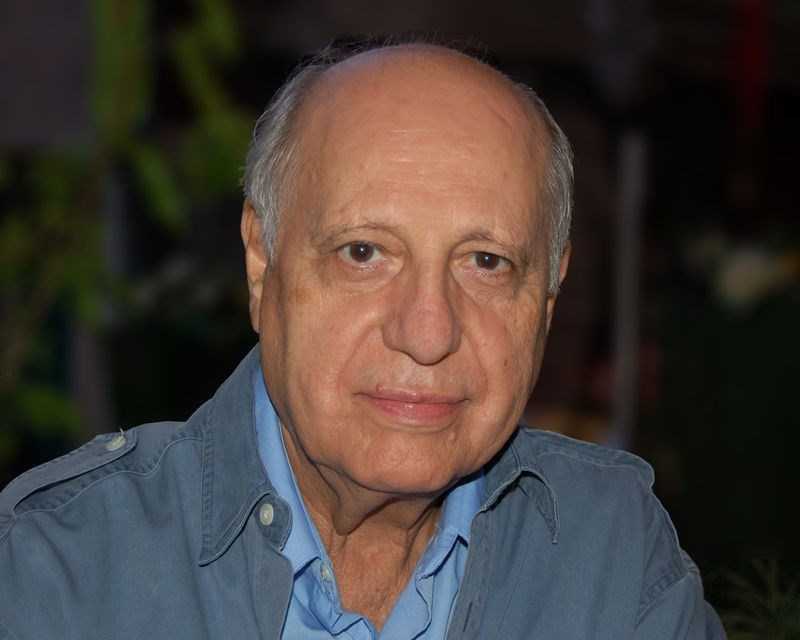
Hafez Farmayan, Professor Emeritus of History and Middle Eastern Studies at the University of Texas, died on July 4, 2015, of pulmonary and cardiac failure, in Austin. He was 87 and had lived in Austin for nearly fifty years. Professor Farmayan was born on October 7, 1927, in Tehran, Iran, the seventeenth son of Abdol Hossein Mirza Farman Farma, a prominent statesman, well known for his active political life in early twentieth-century Iran. His mother, Fatimeh Alinaghi, was born in Shiraz, where Farman Farma had once been governor. At the time of Professor Farmayan's birth, his father was retired from public service and solely occupied with philanthropic pursuits and the upbringing and education of his many children.
Professor Farmayan received both a traditional and a modern, Western-style education with emphasis on Persian language and Persian literary classics, geography, mathematics, and history. At 17, in accordance with his father's wishes and following in the footsteps of his brothers and sister, Professor Farmayan planned to leave Iran to pursue higher education in the West. In the summer of 1944 with Europe in the turmoil of World War II, Professor Farmayan decided to study in the United States. On a journey that lasted several months, he travelled through southeastern Iran and Afghanistan to India, where he boarded an American troop ship in Bombay that eventually brought him to California. He spent a year studying English at the Montezuma Mountain School in Los Gatos and was admitted to Stanford University in 1946. Like many young Iranians, Professor Farmayan intended to study engineering. However, a course in Western Civilization at Stanford ignited a life-long passion for history and changed his path.
In 1949, Professor Farmayan earned a B.A. in history from Stanford University. That same year he married Jo Ann Hambrick of Greeley, Colorado, an artist and recent graduate of the Chicago Art Institute. The two had met a year earlier when he went to Greeley to visit his sister, herself a recent arrival in this country for study and by chance, Jo Ann's roommate. The next year, Professor Farmayan earned his M.A. in history, also from Stanford, and he and Jo Ann moved to Washington, D.C.—she to teach art and to supervise the art program for the D.C. public school system, and he to earn his Ph.D. in history from Georgetown University. Upon completion of his PhD in 1954, the couple moved to Iran, where Professor Farmayan planned to begin teaching at the University of Tehran.
Not long after arriving, he received a fellowship to study public administration from the Point Four Program, an initiative founded by President Truman to provide economic and technical assistance to developing countries. Professor Farmayan returned to the United States in 1957 to earn a doctorate in public administration from the University of Southern California. With second doctorate in hand, he returned to Iran to teach public administration at the University of Tehran and to serve as director of the university's new Library and Research Program of the Institute of Public Administration. Despite the excitement of the new field of public administration, history remained his primary interest and Professor Farmayan eventually joined the Department of History at the University of Tehran in 1959. There, he founded the Center for Middle Eastern Studies and helped establish several academic journals and academic presses.
Professor Farmayan's areas of interest were modern Islamic history, nineteenth-century Iran and the political history of modern Europe. He was a pioneer in the nineteenth-century social history of Iran and was instrumental in revealing that era to be a time of historic literary and artistic growth and a time that allowed the foundations of a modern Iranian nation-state to take form. Professor Farmayan wrote several books published by the University of Tehran Press, including a textbook on modern Europe called Europe in the Age of Revolution. Inspired by the example of the former Prime Minister Mohammad Mossadeq, he became an active participant in the growing intellectual movement of 1960s Iran, and in his classes he emphasized the importance of cultural identity and independent thought. However, amidst the development of the University of Tehran, Professor Farmayan and many of his colleagues experienced an increased governmental interference in their work under the Pahlavi regime. He perceived this involvement as an intrusion and gradually became disenchanted with academic life in Iran.
Professor Farmayan received a number of offers to teach in the United States, and eventually he accepted visiting professorships at Columbia University and the University of Utah. In 1967, at the invitation of the University of Texas, he came to Austin to teach and assist in the development of the Center for Middle Eastern Studies. He taught history at the University of Texas for 33 years, and during that time, he made significant contributions to the field of Qajar studies, which focuses on the period of Iranian history between 1796 and 1925. He was among the first scholars to challenge the view held by the Pahlavi government that the Qajar period was backward, corrupt, and inept. His publications demonstrated that the process of reform in Iran, culminating in the promulgation of a constitution and establishment of a parliament was, in fact, firmly rooted in that era. However, for Professor Farmayan personally, his most important work was his teaching. He introduced countless students to the history of the Middle East and inspired some dozen Ph.D. scholars in his field. He retired in 2003, and, after the death of Jo Ann in 2005, withdrew to a quiet life of study. He is survived by his daughter, Mahan, and son, Salar Walter (Salty) and daughter-in-law, Carol, and grandchildren, Persis and Aidan.
Montrez votre soutien
Envoyez Vos
Condoléances
Partager
L'avis De Décès
Obtenir les mises à jour
Prestations de Service
Partager l'avis de décèsPARTAGER
- RECEVOIR DES RAPPELS
v.1.18.0