
AVIS DE DÉCÈS
Mary Elizabeth Springman Lively
14 juillet 1911 – 24 juin 2016
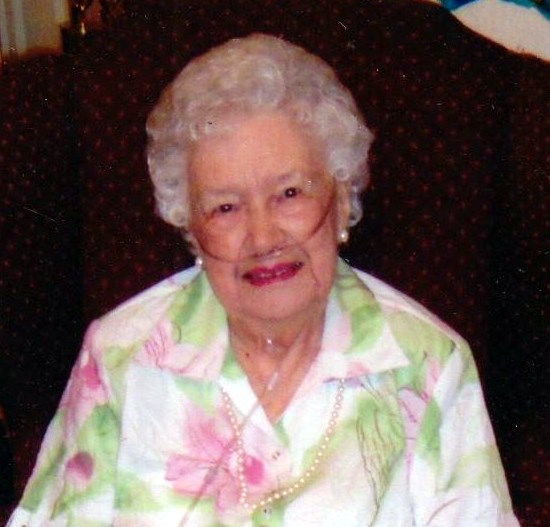
She grew up mainly in Houston, Texas, but had frequent extended visits with her maternal grandmother in Salmon, Texas and her paternal grandparents in Alton, Illinois, as well as one extended visit with her maternal aunt and uncle in West Monroe, Louisiana.
She attended Reagan and Jeff Davis High Schools in Houston. She was married to Roby Earl Lively by a Methodist minister in Waskom, Texas on November 29, 1935, after which she was a homemaker. They had six daughters. She was a Baptist for all of her adult life.
She passed from earth to heaven on June 24, 2016, at 11:55 p.m. She is predeceased by her husband; her mother and father; and her brothers, Eugene Earl Wells, Warren Arthur Wells, and Phillip Adrian Wells.
She is survived by her sister, Carolyn Edith Lee of Galena Park, Texas; her daughters, Mary Suzanne Syptak [son-in-law Matthew] of Austin, Kathryn Gail Lively, of Austin, Robyn Lynne Lively, of Austin, Carol Joan Record [son-in-law Jim] of Arvada, Colorado, Laurel Jean Campbell [son-in-law Tom] of Indialantic, Florida, and Elizabeth Andrea Bruton [son-in-law Rex] of Manchaca, Texas; and numerous grandchildren and great-grandchildren.
The family wishes to thank the staff at Senior Care at West Oaks for the tender loving care our mother received there.
Funeral services will be conducted at 10:00 am in the morning on Tuesday, the 28th of June 2016, in the Colonial Chapel of Cook-Walden Funeral Home, 6100 North Lamar Boulevard, Austin, Texas. Interment will follow in Guiceland Cemetery in Grapeland, Texas at 4:00 pm.
Elizabeth Lively – Eulogy
One of the characteristics of my mom is that she clung to life and recognized it as the gift from the Lord that it is. You will all by now have taken note of the extraordinary age mother attained, but you might not know that she was in a hurry to start life, too. She was born at the family farm near Salmon, Texas. The only phone in the tiny community was at Mr. Bob Smith’s grocery store. When her mother went into labor, someone was dispatched to the store to call the doctor from nearby Grapeland to come and deliver the baby, but by the time the doctor arrived, my mother’s grandmother, who was herself a very experienced midwife, had already delivered her own grandchild, because that baby, my Mother, couldn’t wait to get into this world.
Mother’s dad was the general manager of his family’s lumber company based in Illinois, but with timber interests in Texas, Washington, and Oregon. Her mother was a stenographer in various corporations. They divorced when Mother was still very young. Mother described her childhood as a pillar-to-post existence. Her most stable environments were the unpainted country farmhouse of her maternal grandmother, which came with an outhouse, and the frugal and stoic household of her upwardly-mobile German paternal grandparents in Illinois. There was a stark dichotomy between the two, but Mother was expected to adjust. Her own mother was ambivalent about religion, but her German father and grandparents were extremely observant Catholics, and because of their influence her mother agreed to let her be baptized in the Catholic Church at the age of 3½. After her parents divorced, she was frequently boarded at relations’ homes, neighbors’ homes, and one extended stay at a Catholic boarding school in Oklahoma, where she was a day student. She once told me that those nuns were the kindest people she ever knew. There was also one extended stay with an aunt in Louisiana. Once her step-father came into the picture, moving around became even more a way of life, and her mother and step-father had a volatile relationship. It was a way of life that instilled in Mother some unhappiness and insecurity. Her way of dealing with it was to be the super-good kid, the responsible, straight-laced girl who never caused trouble. But that insecurity she experienced as a child translated into a determination that her own children would all have a stable and secure childhood, and she made good on that promise to herself. She was a loving and devoted mother. She cooked, cleaned and sewed until she was bone-weary, and made a home for her husband and daughters in which it never occurred to us that anything really bad could happen to us. Such was her determination. I mean she was in the PTA for 25 years, for goodness sake! She was an excellent home manager, making a dollar stretch a long way. We never had many luxuries, but we always had everything we really needed, and that was mostly due to the balancing act Mother performed between our income and all the needs of her six children and husband and home. Rarely did that income go for anything special for Mother.
She taught me about Jesus. As a matter of fact, I can’t remember a time when I didn’t know who Jesus is. But Mother also gave me my first lesson in physics. After struggling to get a jar open, I took it to her, and she told me to hold the lid under the hot water tap for bit. Sure enough that metal lid heated up and came right off with a twist. My education didn’t stop there, either. I was expected to go to college. There was never any discussion on the topic, and as far as I can tell that decision was made for me years before I was conceived. I didn’t know that you could opt out. My parents sent or at least assisted in sending 6 people to college. That was on a single income, and I wouldn’t even say it was an upper middle class income. It was a lower middle class income, if we’re honest about it. Try doing that today! Mother was a driving force in that area, too.
In her growing-up years, reading was a great escape. She made good use of her library card. She told me that when she was a girl, her mother would occasionally allow her to escape over the garden wall to hide out from her young siblings for some solitude and reading. Other than housekeeping and babysitting for her parents, she started working in her first real job at age 16 in the hardware department of a general store. But she was conditioned by her mother to become a secretary, as her mother was. To that end, she attended a full course at Massey Business College in Houston, and was very successful there. Unfortunately, that was all happening at about the time of the Great Depression. So she continued at home and took whatever job she could because jobs were scarce. One story I heard for the first time within the last 7 or 8 years occurred during that period of her life. She was 18 and working in a small store with a soda-fountain that her step-father had purchased. It was one of many short-lived enterprises. It was normal that during the evenings when the nearby picture show would let out, that all the teenagers leaving the movies would come to this little store and have sodas and sundaes, or if they didn’t have money for that, just to hang around and talk. On one particular evening, when it was Mother’s night to close up, the place had a few kids there, when a pair of men burst in brandishing pistols and demanded that she empty the till and give them all the money. One was a grown man, but the other was just a kid like herself, and he was so scared that he was shaking all over, and waving the gun around because of his shaking. Mother said that she remembered thinking he was going to kill someone by accident because he was shaking so hard. There was only five dollars in the register, and that didn’t satisfy the robbers. She coolly told them that the reason there was so little cash was that one of the store’s suppliers had come in earlier with a check from the store that was returned for insufficient funds. (Evidently this was a somewhat regular occurrence with her step-dad’s various enterprises.) She told the robbers she had been forced to make good on that check on the spot so that was why the cash had been cleared out earlier in the evening. Then the men took the five dollars and cleared out. Immediately the police were called and came around. At that point Mother explained what had happened, and of course there were several witnesses to back her up. But what she never told anyone that evening was that she had placed a piece of paper wrapped around a stack of folding money, the whole day’s intake of cash and checks, behind some canned goods on a high shelf on the wall behind the cash register, that she had put up there earlier in the evening for safe-keeping, which was a regular business practice for them, that is, her family, who owned the store. The story she had given the robbers about redeeming a bad check really had occurred, but on the day before. That was why it came so quickly to her mind as a credible reason for having no cash on hand. In the face of danger, my mother had grit. As a matter of fact there are only two things I can remember my mother being afraid of: being noticed or bragged on and dirt in her house.
When Mother and Daddy got engaged, Daddy was working at Henderson High School, and Mother was having another of her sojourns at her grandmother’s home in Salmon. They had planned to marry during the school’s Christmas break, but on impulse decided to get married on November 29th during the Thanksgiving break instead. There was one wrinkle -- Daddy didn’t want to announce to his employer, the school district, that he was married until the end of the semester [I forget why], and if they got married in the same county, their nuptials would be printed in the local paper. So they went to Carthage in the next county over, obtained a marriage license, and started driving east to get well away from Henderson. After they’d been driving awhile they started wondering where they were, so they stopped and asked a couple of kids playing by the side of the road, and lo and behold, they were already in Louisiana. So they had to turn around and go back across the state line into Texas. They stopped at the first town this side of the state line, which was Waskom, and were married in the parlor of the Methodist minister’s parsonage. The minister even had to provide the witnesses. They successfully kept their marriage a secret until the Christmas break, which meant they couldn’t live together for most of December. But at Christmas they started real married life in a furnished apartment in Henderson. That was 1935, right in the middle of the Great Depression.
Mother’s life could be described as that of a typical housewife of her era, but she did have some landmark experiences. On the 4th of July in 1916, that was the year mother turned 5, the very first Miss America Pageant was held on Galveston Beach. Mother’s mom took her to see it, and they stayed at the Galvez Hotel, which was also turning 5 years old that year, and which had a skywalk over the street along the beach road. Mother said she was more impressed with that walkway than with the beauty contestants. Mother could vividly remember the first airplane she ever saw at about age 11 during WWI.
She saw three different United States Presidents: in 1919 President Wilson and his wife riding in a Cadillac with the top down in a parade in St. Louis; President Franklin Roosevelt giving a stump speech from the back of a train in St. Louis when he was campaigning for President; and on the day before he died, President Kennedy in his motorcade passed very near our home in Houston, Texas. I happened to be present for that one, too. In 1933 she attended the Chicago World’s Fair with her aunt and a girlfriend. She and Daddy had a trip to Hawaii as a gift from their daughters for their 50th wedding anniversary, and later Mother went with a group on a trip where they visited France, Germany, and Switzerland. That trip was arranged through a sister-city exchange program between Tyler, Texas and Metz, France. It is a great blessing that she was able to take that trip before she lost so much of her vision.
During WWII Mother and Daddy moved into a neighborhood in Pasadena, Texas. Mother and some of the other ladies from that neighborhood became life-long friends, and along the way took some trips and had some hilarious times together.
Mother led a long life, and as she passed into that phase of life when abilities become limited, when new incapacities present themselves, and when sadly most of the old friends have preceded one into eternity, Mother’s grasp on life was still tenacious. Many times in the latter years I have seen her force herself to eat food that was not tempting and when she had no appetite because she knew it was nutritious and because it was not in her character to give up to the inevitable or give in to anything as flimsy as personal preference. As I said at the beginning, Mother recognized that life is precious and that it is a gift from God, not to be squandered, but to be lived with integrity and self-sacrifice uppermost. And finally because of her faith in Jesus, she never feared death but soldiered on toward it as a sweet release. But during all those later years of living life that were not very enjoyable, she never said “Lord, why am I still here?” nor did she ever say, “I wish I were dead.” What she said instead was that she didn’t have the right to decide when to die because that was in the Lord’s time, not her time. She said that her faith in God is her biggest strength, and that kept her happy and content.
At the passing of any individual, I think it is a disservice to the deceased to talk about him or her as if the person had no faults. Mother certainly had her faults, and because of those imperfections alongside all her good qualities, she was able to experience the fullness of what it means to be human. Out of that experience of being human, with its foibles and failings, she developed not only high goals for her children, but also mercy when they did not always achieve. She set high standards of behavior, but extended grace when we could not live up to them all the time. I won’t speak for anyone else, but I know that I have been the recipient of her mercy and grace and of being enfolded in her forgiveness many times. I know from Scripture that anyone who is a follower of Jesus is by definition a saint. But when you think about how that term is used culturally, to mean someone who eschews sinful living, who tries always to do what is right, who serves others, who counts herself as very little, but God as her everything, in my experience, notwithstanding her faults, Mary Elizabeth Lively comes the closest to that of anyone I have ever known.
One last thought: As I drove here [to the funeral home] on Sunday for a meeting, I heard on the radio Frank Sinatra singing the recurring line -- “If you should survive to a 105, think of all the joy you’ll derive from being alive. And here is the best part, you have a head start, if you are among the very young at heart.” I thought that was such an appropriate thing to hear on that day of all days.
Montrez votre soutien
Envoyez Vos
Condoléances
Partager
L'avis De Décès
Obtenir les mises à jour
Prestations de Service
Partager l'avis de décèsPARTAGER
- RECEVOIR DES RAPPELS
v.1.18.0