
AVIS DE DÉCÈS
Sue Ellen Harrigan
22 novembre 1949 – 18 novembre 2025
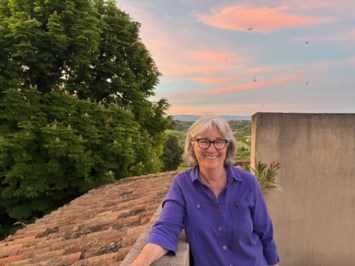
Sue Ellen Harrigan died on November 18 at 5:13 pm as a result of a brain hemorrhage ten days earlier. She took her last breath in an ICU room that had been rescued from hospital sterility with dim lighting, family photos and a portable music player. Her three daughters—Marjorie, Dorothy and Charlotte— were with her at the end, along with her husband Steve, her sister Nance Lewis, and her niece Laura Lewis. Frank Sinatra was also there, crooning Sue Ellen's favorite song, "Fly Me to the Moon," through the music player at the very moment she passed away beneath her great-grandmother's quilt.
She was 75, four days away from her 76th birthday. She was born in Snyder, Texas, famous as the place where J. Wright Mooar once shot a white buffalo, and near where the Comanche war chief Quanah Parker surrendered after the Red River War and led his people out of Texas. She graduated from Snyder High School in the late 1960's, a time when young people everywhere—in big cities and in small towns like Snyder —were chafing at the restrictive postwar mores of their parents' generation. Sue Ellen was restive as well, as she made clear with the pseudonym she chose for her column in the high school newspaper: Sonya Stifled.
She was a natural beauty who was drafted by the local Lion's Club into serving as a kind of heartthrob mascot. They sang "Let Me Call You Sweetheart" to her at the beginning of every meeting while she winced inwardly and smiled politely. She rejected her father's suggestion that she go to business college and become something practical like a stenographer. Instead, she charted a course for the heathen hive of Austin and attended—well, sort of—the University of Texas. She dropped out after a short-lived marriage to a hippie astrologer and aspiring novelist, moved for a while to Corpus Christi where she tried and failed to learn to surf, and tended bar at a famous seafood restaurant called Ship Ahoy. After enough of that, she returned to Austin, re-enrolled at UT, and graduated with an English degree. She married her second husband, Stephen Harrigan, in 1975. He was yet another aspiring novelist (there were a lot of them around in those days) with a paying gig as a yardman. Their marriage lasted. They were together until the end—for fifty years and two months.
She worked as a waitress, bookstore clerk, and—though her skills as a disciplinarian were suspect—as a detention monitor at an Austin elementary school. After her first child Marjorie Rose was born, she couldn't bear seeing her daughter cry when she was dropped off at day care. That's when Sue Ellen declared she would be a fulltime mother despite the fact that the family would have only the erratic and meager income of Steve's freelance magazine work. It was a time when the women's movement was at high tide, and stay-at-home moms were sometimes regarded as traitors to the cause. But Sue Ellen didn't care what other people thought or what history decreed she should be. She established a stable, nurturing, loving residence with home-cooked family dinners every night. Because of her, that house was a constant beacon of warmth and welcome.
She had grown up in a little town where drive-in theaters and the local library were the centers of excitement, and all her life she was a devoted moviegoer and voracious reader. There were certain books, like The Pursuit of Love by Nancy Mitford, and Middlemarch by George Eliot, that she read every year. She belonged to a lot of organizations, formal and informal: Open Forum, the Tuesday Club, several monthly book clubs, the Philosophical Society of Texas, and an investment club that—due to a lack of spectacular financial gains— morphed into a let's-just-hangout club. She loved all of her friends, and was especially committed to a Monday morning breakfast group that had been meeting for almost forty years.
Speaking of her friends: they could never quite figure her out. Neither could her husband or her children. Her views about politics, religion, and human behavior were all over the place. She had a genius for contradicting herself, sometimes within a single sentence. Her opinions were so idiosyncratic that Dorothy decided they must have come from a limited-readership publication called Sue Ellen Magazine.
Her character, though, was rock steady. People trusted her and counted on her, and she never failed them. Her family was the expanding center of her world. She had six grandchildren. They knew her as Grand Meow—a mysterious but wonderful name bestowed upon her by her eldest grandson Mason when he was a toddler and saw a cat under her bed.
As a wife, mother and grandmother, she made her own luck. She created a world nobody wanted to stray from. Her children and grandchildren all lived within nine miles of her house. She saw multiple members of her busy family every day.
As she grew older, she still read multiple newspapers and websites, crowed over her high scores at Words with Friends, ate oatmeal and half of a whole wheat English muffin for most breakfasts, with the exception of a weekly cinnamon roll from Upper Crust Bakery. She didn't care what kind of white wine she drank at parties, as long as there were ice cubes in it. She liked hamburgers from Top Notch and In-N-Out. She didn't like driving in the rain or on highway overpasses, and she had to leave the room during any TV show depicting a child in danger. Her daughter Charlotte, a landscape designer, had planted her front yard with native plants and grasses. In her last weeks on earth that's where Sue Ellen seemed most content, sitting in a chair outside doing nothing as the sun went down, just watching the butterflies circling among the artemisia and blue mistflowers.
Her legacy, like her life, is quiet but strong. She is survived by, remembered by, a family that includes Steve, their three daughters and their stalwart husbands—Marjorie and Rodney Randolph, Dorothy and Mike Guerrero, and Charlotte and Zach Ernst. Her devastated grandchildren are Mason Randolph, Travis Randolph, Maisie Guerrero, Rosemary (Romy) Guerrero, James (Sonny) Ernst, and Gladys Ernst. She came from a family of five children, and had previously lost a brother, Jack Line, and a sister, JoAnn Cotton. Her surviving siblings are Nance Lewis, who lives with her husband Ralph Lewis in Wichita Falls, and Todd Line of Houston. She had many nieces and nephews, all of whom she dearly loved.
The Harrigan family would like to say a final thank you to another family: the doctors, nurses, respiratory therapists, lab techs, radiologists, and cafeteria and maintenance staff at Seton Hospital and—especially—at the Neurocritical Care Unit of Dell Seton Medical Center. The compassion and warmth they displayed while caring for Sue Ellen and her grieving family was the highest expression of the healing arts.
Funeral services will be at Good Shepherd Episcopal Church (3201 Windsor Rd) on Tuesday, Dec. 2, at 10:30 a.m., followed by interment of her ashes and a reception, with a performance of some of her favorite songs by Mr Thrill, at the Texas State Cemetery, 909 Navasota Street. It will be easy for her friends to locate her resting place. The outstretched arm of the statue of Stephen F. Austin on a nearby hill is gesturing right toward it.
Montrez votre soutien
Envoyez Vos
Condoléances
Partager
L'avis De Décès
Obtenir les mises à jour
Prestations de Service
Partager l'avis de décèsPARTAGER
- RECEVOIR DES RAPPELS
v.1.18.0