
AVIS DE DÉCÈS
Johanna A. "Hanni" Odbert
27 mars 1921 – 11 novembre 2011
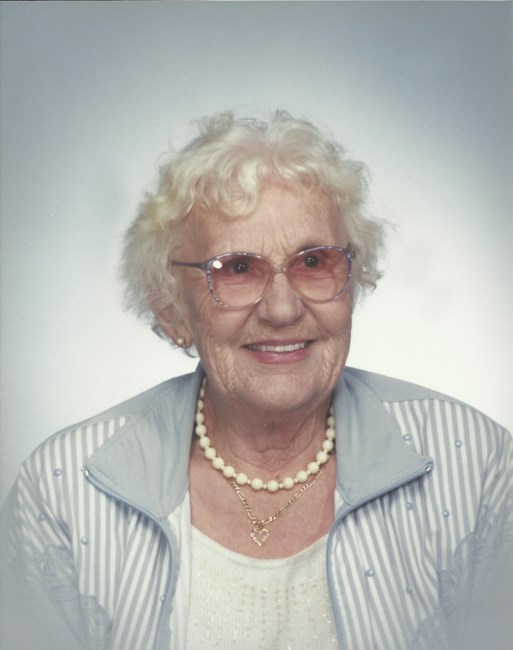
Survivors include her son, Arthur K. Odbert; daughters, Barbel “Babs” Lizotte and Janet B. Gammon and her husband, William T. Gammon; brother, Karl-Heinz Siebert; and 8 grandchildren, James R. Calvert Jr. and his wife, Jori Calvert, Alice J. Dinsmore, Heidi R. Calvert, Michael A. Calvert and his wife, Linda Calvert, Daniel K. Odbert, Christopher M. Odbert, George T. Gammon and Paul A. Gammon.
Let me introduce you to one of the most fascinating women who ever walked this Earth. She was caring, stubborn, and always let you know exactly what was on her mind, which is quite a combination. Although she was an American citizen for nearly 50 years, my grandmother, or Oma in German, was not born in the United States of America. She was actually born in Kaseburg, Germany, a small village on an Island in the Baltic Sea in what was then the Pomeranian region of Germany on March 27, 1921. The story of what brought her from that small village to Riverview, Florida 85 years later is a very interesting one.
Born Johanna Auguste Siebert, my grandmother and her eight sisters and brothers went to school in a one-room schoolhouse in the village through the eighth grade. When school ended they helped their parents with the vegetable garden, fruit trees, chickens and other animals that everyone in the village kept to supplement their diet. The land that her family owned was passed down for many generations and had been a significant source of food for the family. It was a beautiful island, with very few cars; in fact she remembers only the doctor and mailman having cars on the island. The larger town across the channel, Swinemunde, was a major shipping channel for Germany prior to WWII. Her father made his living maintaining the channel for shipping and assuring that the shoreline was stable.
After Oma graduated the eighth grade in Kaseburg, she was confirmed in the Lutheran Church, and then left home to work. During the next few years she worked various places, gave birth to my Aunt Babs and joined the German Air Force in 1943. During this time period women in the German Air Force only worked in offices and were not trained to shoot or even to protect themselves. While in the Air Force, Oma had several assignments including the weather station in DeJong, France, where she deciphered Morse code. About 3 months before the end of the war, the Russians invaded Germany while she was stationed in Pomerania about 30 miles from Kaseburg. All the women were told to try to get home or somewhere else safe away from eastern Germany. She returned to Kaseburg and was discharged from the Air Force. In May of 1945, the war was over and the Russians occupied her village, raping women and taking whatever they pleased. All the women slept in the fields to try to hide from the soldiers. The Russians occupied the Baltic region of Germany for about six months before it was given to Poland. My Oma’s family’s land was also taken. The Polish soldiers then came to occupy the village and took everything the Russians left behind. The villagers were forced to work for the Polish soldiers and their families for only food in return for their labor. They were not given any money or anything to take home, and there were no stores that would take German money.
Due to the conditions in Kasseburg my grandmother and a friend of hers decided to escape with their four children, my Aunt Babs who was four, and her friend’s three children who ranged in ages from four to seven. My grandmother and her friend told the Polish border guards that they needed to take their children to the doctor on the main land. One of the guards muttered “Good Luck” under his breath. My grandmother felt very lucky because they escaped through the woods and no one tried to stop them. They walked across a board on the channel to cross the border from Poland back into Russian occupied East Germany.
Due to the severe shortage in housing, my grandmother and her friend were sent to a quarantine camp in Berlin after arriving in Russian occupied East Germany until they could find a sponsor who would give them a place to live. Since Oma knew that one of her sisters was living in Landsberg, Germany, she wrote her to try to get a place to live for herself and her daughter. During her stay at the camp she recalled that all the women and children lived together in a large barracks with numerous beds that were managed by the French, English and Americans in alternating weeks.
“We could always tell when the Americans were managing the barracks because there would be chocolate and milk for the children and special treats for the women like coffee and sugar.” Occasionally the farmers in the area would ask for workers and the women who wanted work for them were able to during the day for spending money and food. Due to the breakdown of the government and the mail system it took nearly six months to get a letter back from her sister saying that she could come live with her in Landsberg.
When she received the letter from her sister, they traveled to Landsberg in the cattle car of a train, which stopped every few hours to allow them to relieve themselves in the woods at the side of the tracks. She told me that there were no seats or anything of comfort. It was filthy and everyone was huddled in the cattle car in hope that where they were headed would bring stability back into their lives.
Arriving in Landsberg, she and Babs moved in with my Great Aunt Alice and her son Karl. While they lived there, my grandmother worked for the Americans, first as a maid, and then later in the dining hall of the American Air Force Base, where she met Arthur M. Odbert, an American soldier who was one of the cooks. This gentleman was destined to be my Opa, which is German for grandfather. After her sister married an American and moved to the United States, my grandmother kept the apartment in Landsberg and married my Opa. My mother, Janet and her brother, Art, were both born in Landsberg.
My grandfather stayed in the Air Force and was transferred from Landsberg to Italy for two years. From there, the family moved to America for the first time, to Smyrna Air Force Base in Tennessee for about two years. When Opa received orders back to Europe, to Bentwaters-Woodbridge Army/Air Force Base in England, my grandmother and aunt had not lived in America long enough to obtain their citizenship, so they decided that they would stay behind on my Great-grandfather’s farm in Gettysburg, Pennsylvania. After studying for about six months, my grandmother and aunt passed the citizenship tests and were sworn in as American citizens in Gettysburg, Pennsylvania in 1959. They joined my grandfather in England later that year.
After three years in England, my grandfather was transferred to MacDill Air Force Base in Tampa, Florida in 1961. My grandparents lived in south Tampa until 1983 when they moved to Gibsonton, Florida where my grandmother still lives today. My Opa died when I was only five and my brother only two in the year 1990. She said that this was the saddest day of her life, and when I asked her what the most important thing in her life had been she said, “ marrying my husband Arthur M. Odbert.” She told me that this was the turning point of her entire life and that without him she has no idea where she would be today.
When asked about the most extraordinary things she has witnessed during her lifetime, she could not pinpoint just one event. She told me she saw things from Neal Armstrong landing on the moon to the assassination of John F. Kennedy, both the erecting and fall of the Berlin wall, the invention of computers and the internet; televisions, automobiles, refrigerators and other items moving from a novelty for the very rich to something in every home. Oma said that she had many wonderful memories including her life with Opa, the birth of her three children and eight grandchildren. I wish she could be here to share the upcoming events in our family including the birth of her first great grandchild.
My Oma touched many people throughout her extraordinary life. I know that she has always inspired me to do my very best at everything. I only wish that I could write a book on all the things she has witnessed and been through. She was one of the most important people in my life and the day that she left my family and me behind was one of the saddest days of all of our lives.
Arrangements under the direction of Hillsboro Memorial Funeral Home, Brandon, FL.
Montrez votre soutien
Envoyez Vos
Condoléances
Partager
L'avis De Décès
Obtenir les mises à jour
Prestations de Service
Partager l'avis de décèsPARTAGER
- RECEVOIR DES RAPPELS
v.1.18.0