
AVIS DE DÉCÈS
Mrs. Odessa Dolly Mercier Mercier Ferris
13 février 1920 – 17 décembre 2013
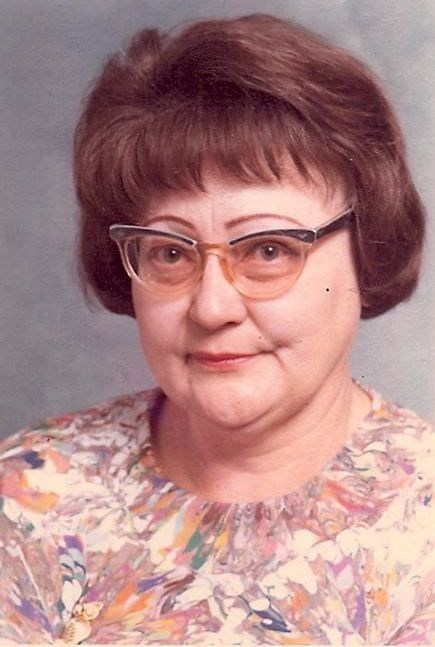
Odessa M. Ferris
“You offer me no choice!” exclaimed the parent. “To the contrary!” retorted Odessa Ferris, School Chairwoman at the time, “Highland Hall is offering you and your daughter two choices: She can either wear a brassiere to school, or stay at home and forgo her education at this Institution”.
This anecdote displays my mother's character at her best: sharp, and never hesitating to call a spade a spade.
She was not one to mince her words. She was not always tactful; she often felt impelled to tell people what she saw
as the truth whether they wanted to hear it or not. Regardless, throughout her life as an educator and in all her various roles, her wisdom, integrity and unwillingness to compromise attracted a loyal circle of respectful friends, students and
colleagues. Many of these people have expressed to us how crossing paths with our mother, Odessa Ferris, enriched
their lives. She was an unusual woman, and fittingly, she began her life in an unusual way.
Odessa’s biological parents, Laurence Norman and Leta Boyer, were both extremely young when Odessa was conceived. Though the future looked bright for the couple, they were barely into their 20’s, at that time they were not financially established enough to begin a family. Leta’s older sister, Carrie, presented a possible solution. She offered to take the “mother-to-be” into her home, care for her during the pregnancy, and also care for the infant afterward so Leta could
return to work with her husband – the understanding being Carrie would return the baby to its real parents when they became financially solvent. This arrangement was accepted, and soon after, in 1920, a girl child was born to Leta Norman, “Odessa ……”, or Dolly – for short. It took five years before Dolly’s biological parents felt financially secure
enough to bring her home. During that time the little girl came to know and accept as parents, Carrie Boyer and her husband, Chester Mercier, actually her aunt and uncle. Carrie was in quite an opposite financial situation from her younger sister, Leta. At an early age, Carrie realized that, as a woman, her ticket to independence and freedom lay in acquiring wealth. So, she became a successful businesswoman, developing a reputation for being extremely shrewd and organized when it came to her business dealings. Carrie’s husband, Chester, heir to the Mercier department store chain known throughout the South, was a very wealthy and unusual man in his own right. However, where Carrie could be described as standoffish and aloof, Chester displayed an uncanny ability to make anyone feel at ease. He was disarming and charming,
and had a gift for bringing out the best in people. The contrasting personalities of Carrie and Chester, coldness and shrewdness on the one hand and warmth and generosity on the other, were thoroughly absorbed by little Odessa during her first five years living in the Mercier household. She would reveal these qualities often throughout her life.
By 1925, Laurence and Leta (the biological parents) were finally ready to bring Dolly home to live with them. However, Carrie and Chester had by now bonded with the vivacious little black haired girl and didn't want to part with her.
A showdown ensued, and in the midst of a heated debate, Carrie, (a staunch Christian Scientist) said, “Let’s let the Lord decide.” With both couples present, Dolly was posed the following question by Carrie in a very syrupy voice, “Dolly, who would you rather live with: Leta and Laurence, or me?” To which Dolly replied exuberantly, “I want to live with you, aunt Carrie!” Like a prophet with hands raised to the heavens, Carrie then declared authoritatively,"The Lord has spoken!!!” Chester and Carrie legally adopted Dolly, and the subject of where and in whose custody she should be raised was never broached again. With the custody question solved, now the Merciers were faced with a new challenge: how to keep little Dolly constructively occupied, supervised and out of mischief. She attended grade school and even took private singing, piano and dance lessons, but the parents found the little girl had boundless energy and a curiosity which, if not tempered, could lead her down unwanted paths, sometimes even dangerous ones.
Once, while riding her tricycle in the street in front of the house, Dolly had a near miss with a delivery truck. Though she rolled right under it, by some miracle she avoided all the truck’s moving wheels. The driver, thinking he had killed the little girl that seemingly had come out of nowhere, brought his vehicle to a screeching halt. In a panic, he quickly scrambled out of the cab to look underneath his vehicle. Who should he see but little Dolly peering quizzically at him from under the
truck’s opposite side and asking innocently, “What are you looking for?” The driver, sheet white and thinking he was
staring at a ghost, said nothing, climbed back in his vehicle, and drove off in a daze.
Another time Dolly decided to tease a small alligator that her father Chester had caught and tied to the back porch railing
of their New Orleans home. She began tickling its snout with a piece of straw pulled from a broom. The gator rushed at
her, hissing and spitting in its inimitable way, broke through its tether and further advanced on the horrified girl – a definite lesson incause and effect. Though Dolly could get into all types of mischief, the Merciers considered her a blessing in
their lives; she was funny, smart, witty, and just a joy to have around. However, as Dolly approached her tenth year, attention was turned towards her formal education, and nothing but the best schooling would do for the Merciers. That meant shipping their little girl off to some of the nation's best all girl Jr. High and College Prep Boarding Schools.
Junior High took Dolly to Principia in Illinois. While there, Dolly continued with her music, taking piano lessons off campus with a very nice old man. Twice a year he held recitals for his students, and Dolly was set to play at one of them. The morning of the recital she called the teacher to say she was sick and would not be able to attend. Unwilling to take no for
an answer, the teacher suggested she come anyway, enjoy the music and food, and support the other
students. Dolly agreed, showed up as promised, and began mingling and laughing with all her friends. However, not
long after the recital began, the teacher called Dolly's name and announced the piece she would be playing; feeling cornered, shocked, and very angry, she set her jaw and played her prepared piece superbly. High School took Dolly to Hollywood, California to attend the prestigious Marlborough School for girls. She excelled academically, made many friends, and involved herself with campus organizations and clubs. Odessa very much enjoyed her High School experience and felt her four years at Marlborough came to a close all too quickly; she would always attribute her preparedness for life, her scholarship, her work ethic, and her professionalism to her time at that wonderful
institution.
In 1939, while getting her bearings after high school, and having as yet no professional direction, Dolly joined and busied herself with the “Civil Defense League”, an organization that touted the “Victory Garden” as a way for families to economize yet eat healthily during America's increasing involvement with the war. Her primary duty was to promote the virtues and benefits of growing a “Backyard Garden”, and she accomplished this by giving speeches and showing movies at myriads of local women's clubs. Besides looking absolutely stunning in her Service Corps uniform, she was a very effective and popular presenter for the organization. Dolly had an excellent sense of timing and a strong vocal delivery that could hold an audience spellbound. Further more, she loved performing in front of people. This led to a decision to pursue acting, and in 1940, Dolly took her considerable raw talents to the famed Pasadena Playhouse where, for the next two years, they would be honed and shaped through acting and speech seminars as well as live performances. Dolly maintained her keyboard technique by taking lessons with Marguerite Darch and playing for numerous ballet classes at a music and dance studio across the street from the Playhouse. In exchange for playing, she was given a private room of her own with a piano on which to teach. It was here, working with her piano students, Odessa began to realize her true calling: teaching. She
remembered that when she first began learning the piano at eight years old, she would come home from her lessons and begin teaching what she had learned that day to one of her little neighbor friends. Odessa found the teaching process a natural extension of herself; she felt she could present pedagogical material in a manner accessible to almost anyone.
Not only did Odessa find her true calling at the music and dance studio, she also met her future husband. Horace Ferris was a young physicist working for the Jet Propulsion Laboratory. Stately and tall, looking a bit like Jimmy Stewart, Horace, a fine pianist, needed a place to practice the piano. His apartment was small and had no room for an instrument, so he ended up renting the practice space next door to Odessa's. Impressed with what she heard, Odessa wondered who the very advanced player was. It was suggested by another teacher in the building that Odessa introduce herself to the young man (Horace), which she did. They soon began playing duets together and eventually dated.
Their first date was a disaster. Horace could not drive a car; he had not yet learned how. So, their first official encounter was a rendezvous on foot. Odessa arrived at the appointed meeting place early and was a bit miffed Horace was not already there. Anxiously awaiting him, her attention turned suddenly towards a commotion up the street. People on the sidewalk were staring, pointing, gesturing, and talking about something- someone; a tall man, his head above the crowd, advancing with large bold steps while whistling at the top of his lungs a symphonic theme, which he conducted with huge gesticulations of both arms, oblivious to all else – here came Horace. Odessa almost covered her face from embarrassment and was tempted to run away, but she says there was a strength and integrity about Horace that intrigued her. She stayed put, went through with the date and very quickly found that despite Horace’s
eccentricity, the tall, brilliant, soft spoken, sensitive and thoughtful young man had the key to her heart. So, when Horace eventually asked, Odessa said, “YES!”
Marriage was life-changing for Odessa. Apparently she faced quite a domestic learning curve; it’s been said that when it came to cooking, she could burn water. However, somehow Odessa was able to tackle these new skills enthusiastically. She bore Horace two sons, developed a very busy private studio of voice and piano students, and still found time to broaden her scope as a music instructor by joining the MTAC (Music Teacher's Association of California). She became a
very well respected instructor within its ranks. Every year Odessa held a holiday recital for her students. The first half presented Tchaikovsky's Nutcracker Suite, with a different student dressed in a corresponding costume performing each piece. Then, after an intermission, Odessa and Horace would perform Oscar Wilde's, “The Selfish Giant”; Odessa narrated the story while Horace provided all the incidental music on piano. Their performance always brought the house down, and often left many audience members in tears.
Yet another reason marriage was life changing for Odessa was that through Horace she was introduced to Rudolf Steiner and Anthroposophy. She found the material illuminating; it helped her make sense of the world around her and her purpose within it. Also, as a teacher, Odessa was quite intrigued with Steiner's approach to education which took into consideration the whole human being: Physical, Mental and Spiritual. She wondered how she might incorporate some of the Austrian philosopher’s ideas into her own work.
This led to her involvement with the local Anthroposophical society. Here, Odessa met Alstan Lipincott, a staunch member of the Los Angeles branch, and a strong advocate of Waldorf education. Alstan had started a Waldorf School in the San Fernando Valley named Highland Hall. With a kindergarten bursting at the seams and a well-established elementary school, the institution was actively seeking capable and qualified teachers. Knowing Odessa's keen interest in Steiner's approach to education, Alstan invited Odessa to bring her musical and teaching talents to Highland Hall. Attracted to Alstan's purity of spirit and selfless idealism, Odessa accepted the invitation and began work at the school in the Fall of 1962.
Beginning with a music appreciation and singing class, Odessa gradually developed her music program in the lower grades organizing three choirs: third and fourth, fifth and six, and seventh and eighth. She came to know and understand the young voice well and carefully selected repertoire that addressed the vocal abilities of each age group. In addition to her teaching duties at the school, Odessa managed to complete the Waldorf teacher training course, while still maintaining her sizeable private piano and voice studio. She never allowed her duties at Highland Hall to take the place of her private teaching; she merely fulfilled both roles – often teaching late into the night on school days and most the day on Saturday. Adjusting to Odessa's boundless energy and relentless pace, her husband and sons acquired proficient kitchen skills, for often her teaching ran through family mealtimes. It is said, “All work and no play makes jack a dull boy!” Odessa wasn't dull, not by any means; she found time to play, and she did that by shopping. Odessa absolutely loved catalog shopping. Her family stared in awe at the wide variety of global goods she introduced into the household, all delivered by a friendly UPS man who came to know the Ferris address by heart. She brought all sorts of interesting things into the house via catalogs: plants, vases, and masses of exotic food items such as cheese balls, gourmet smoked salmon and bacon, sardines and herring from Norway, rice, dried fruit, popcorn, popover mix, imported mohair scarves, fuller brush items, flashlight pens, assorted confections, and of course, contributions to her ever growing owl collection.
A count of the owl collection was made in the early 70’s; at that time they numbered in excess of 450 figurines of different colors, styles, and sizes. Owls were also an essential fashion accessory for Odessa; it was said that if a Highland Hall student ever caught Odessa without some type of owl on her person that student would immediately be paid a quarter.
In 1969, Highland Hall's fifth grade teacher resigned unexpectedly due to illness. The School offered Odessa the class, and she accepted; here was an opportunity to put into practice the theory and skills she had gained through completing the Waldorf Teacher Training. Knowing that Greek history, a favorite subject of her Marlborough days, was part of the fifth grade
curriculum, Odessa was excited to share her knowledge and passion. As a result, the usual four week block turned into an entire year. At their eighth grade graduation, the appreciative class presented Odessa with a handmade Greek frieze over 12 feet long; for years it hung across support beams of her outside patio.
In 1974 Odessa was invited to be Chairperson of the school – an office that was regularly rotated among the faculty. She excelled in this position. Her erudition, sophistication, and honest ethical approach served her well as she went about executing her duties. As chairwoman, Odessa always asserted that every piece of business that crossed her desk, whether it was a paper that needed signing, a contract, a reprimand, or a check, received her full attention and mindfulness.
When presented with a particularly difficult situation, Odessa would form a mental picture of what she was attending to and offer up a prayer asking for the best possible outcome. When reflecting on her term as chairwoman, Odessa always felt confident she accomplished much good for the school.
The 80’s brought many changes to the Ferris family. Odessa retired from Highland Hall but continued to teach piano and voice privately. She saw both sons marry and gradually over the rest of the decade became grandmother to four. In an effort to reconnect with her husband Horace, also retired, she signed them up with 221 B Bakerstreet, a fan club for the writings of Sir Arthur Conan Doyle about the illustrious detective Sherlock Holmes. When attending meetings both Odessa
and Horace donned their matching “Deerstalker” hats, just like the one sported by the beloved character. The two also took a trip to Europe, which included a stop in London where they visited the apartment of the famous sleuth. Unfortunately, Odessa’s visions of retirement did not turn out as she had hoped. In 1985 Horace began to show symptoms of Alzheimer’s disease, resulting in a rapid mental and physical decline. Odessa became his primary caregiver. While the situation was
incredibly challenging, Odessa lovingly embraced the role and cared for Horace until he passed in1988.
In the years following, Odessa found herself with more free time. Though she continued teaching, her mind craved a new challenge. So she began a massive design and renovation project of her Gentry Avenue home. The pinnacle of the ambitious remodel was the breakfast tower, a two story octagonal structure made almost entirely of windows that flooded the room with natural light. Over the years this room became the center of all activity in the home and was one of
Odessa’s proudest achievements. Sharing her joyous room with others Odessa began holding Anthroposophical study groups in her tower, as well as conducting many of her voice and speech lessons there. As the years continued, Odessa found herself giving more voice and speech lessons due to the relationship she began with the Michael Chekov Acting Group.
In the 2000’s, Odessa experienced health issues, which gradually became debilitating. She lost 80% of her sight and hearing, along with all cartilage in her knees. This made walking so painful, she rarely attempted it. With the help of in-home caregivers Odessa continued to teach and to rejoice in the successes and accomplishments of her children, grandchildren, and greatgrandchildren. Many students also came regularly to read to Odessa, keeping her mind stimulated with new stories and ideas. Eventually, Odessa required more specialized care than could be provided at home, resulting in a move to a residential care home located in the family’s old neighborhood. However, even with this monumental change, Odessa was still giving lessons, and continued to do so, up until just two weeks ago.
It's often wondered where Odessa acquired the stamina to carry on as she did. She expended so much energy while teaching, always loud and boisterous with fierce determination. Odessa's explanation was that her work fed and enlivened her, that she found it exciting to watch the development of her students.
As a teacher, Odessa was demanding. Rather than performing mindless repetitions, she challenged students to use their minds and imaginations as they perfected each piece. The goal of Odessa’s way of teaching was to connect the student and their work so deeply that it became a part of them forever. This was proven time and again when former students returned to visit Odessa after many years and were asked by her to play one of their old pieces. In many cases, though they hadn't touched a piano in years, once seated at the keyboard, they often found the music flowed from their fingertips. Such moments filled Odessa with great satisfaction, for they were a confirmation of her pedagogical approach.
In his book, “Though You Die “, the Rev. Stanley Drake suggests that when a soul passes over to the other side it often finds it challenging at first to get oriented, that its ability to do so depends upon the spiritual tools it acquired during its earthly incarnation by exposing itself to and absorbing spiritual knowledge. Mother, you may now find yourself in unfamiliar surroundings. However, we believe throughout your life you have engaged in a variety of activities, which have provided
you with the tools that will help you find your way. Look to these as you face this next challenge. We wish you God’s speed.
Please follow this link to view a lovely tribute of Odessa Ferris;
http://www.youtube.com/watch?v=8OEJHMMqwHc
In Lieu of flowers donations in Mom's name should be sent to
The Christian Community Church
11030 La Maida St. North Hollywood, California, 91601
Telephone # (818)762-2251
Montrez votre soutien
Envoyez Vos
Condoléances
Partager
L'avis De Décès
Obtenir les mises à jour
Prestations de Service
Partager l'avis de décèsPARTAGER
- RECEVOIR DES RAPPELS
v.1.18.0