
AVIS DE DÉCÈS
Stella E. O'Neil
12 novembre 1909 – 16 février 2016
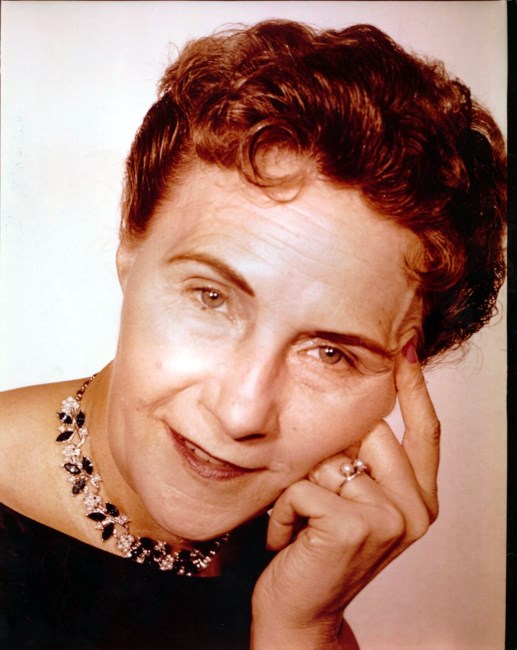
The All-American Girl
One hundred and six years ago, the year of 1909, in a small town in Southern Indiana, a little four-pound baby girl was born. She was so fragile and small. Her hair was curly and as blond as gold. Her eyes the light blue color of the sky. She was the youngest of eight children. She is Sally, an All-American girl.
Her ancestors date back to the 1700’s in the United States. Over many years they lived in peace with the Indians that were very friendly with the whites. Later they had to run or defend themselves from the Indians. Ancestors of both her mother and father fought in the Revolutionary War against England for their freedom from the king. Sally’s grandfather was a Union soldier in the Civil War. He fought against the Confederates in the South.
When Sally was only five years old, World War 1 was declared. They had lived near Bloomington, Illinois since she was three months old. When Sally was seven, she saw her first airplane at the county fair. They were called barn-stormers and followed the path of the railroad tracks. She wanted a ride on that airplane so bad that day, but her parents wouldn’t let her.
After the war was over, her family packed up and left Bloomington to live in Prentice, Wisconsin. They took a train and that’s when she saw Chicago for the first time. They had to transfer to a different station. She remembers that they got to ride a horse drawn carriage and their luggage was pulled in a horse drawn livery wagon for the transfer. It took almost twenty-four hours to make the trip.
Her family purchased six hundred and forty acres of unimproved land in 1920. The plan was for her father and the four brothers still living at home to clear and cultivate land to grow potatoes, and raise beef cattle.
Sally couldn’t believe her eyes when they got there. Their old house only had a single pine tree. She felt as if she were in a whole new world. All the evergreens, white birch trees, woods and all the corn and oat fields amazed her. She recalled it being absolutely gorgeous in the heavy white snow. She remembers one spring sitting on a fallen tree and watching as the bugs and worms woke up from their long winter nap.
Sally had to walk a mile and a half to school when she was a girl. One day when she was around eleven, a heavy blizzard hit while she was in school. She had to walk home and always walked alone. She couldn’t see and it was so cold and the snow was getting so deep. She fell to the ground and passed out. Sally almost died that day lying there in the snow. Thankfully one of her brothers went searching for her because she was so late and the blizzard was getting worse. She doesn’t remember how he carried her all the way home by himself. She remembers finally waking up tucked in her bed with hot water bottles all around her.
Three of her brothers left home to marry and they were never able to complete their house. Because of the post war prices in 1926 they had to leave the house and land behind and head back to Illinois. All they had left was some boxes with clothes, bedding, and dishes. They found a house in Saybrook, a small town of around six hundred people, where they rented a house. The following year her father passed away.
Sally married in 1929 at the age of twenty and would shortly thereafter give birth to two daughters. She said that she didn’t have much confidence in herself, but as to this, I have to disagree. The Great Depression began the year she married and didn’t end until 1941 with America’s entry into World War 2. I feel Sally was brave. She took her two daughters and divorced her cruel husband when she was twenty-seven years old. She left him in the middle of the Great Depression. She provided childcare and did housekeeping for another family to try and make ends meet. The doctor who delivered her husband and daughters had confidence in her. He gave her money to go to Chicago to look for a job. She had to leave her girls with her mother until she could figure out a way to make things work. Her mother was born in 1866, making her seventy years old at the time.
Sally was so scared to move away from farm life to the large city of Chicago. There was nobody to turn to. She was lonely and felt like no one cared. She said she had zero confidence in herself. She went from place to place looking for signs in windows in search of employment. There was an opening for a temporary position in a printing company for a copyholder. She didn’t even know what that was and when admitting this to the owner, he told her to leave. She told him to give her a chance for two days. Should he not be satisfied, she would leave without pay. He gave her a chance and she worked from 11PM until 7AM and did a great job. When this job ended, the owner recommended her to another company. She made $4 a week and sent her mother $3 a week to care for the girls.
Suddenly her mother told her that she wouldn’t watch them anymore, so she had to make other arrangements for them. People actually told her to put them up for adoption, which she would not do. She ended up farming them out to separate families until she was finally able to bring them to Chicago. Sometimes food was scarce and Sally would go without so her girls could eat. It wasn’t unusual to only have a can of sardines, noodles, and bread in the house. She did it though. She raised her girls, and made it through the Great Depression as a divorced single mother.
When the girls were gone and married in the 1950’s with families of their own, she lost her job. She left Illinois for a job selling children’s books in Alabama. When she arrived she was absolutely shocked by what she saw. There were signs by the water fountains and bathrooms. Some said Whites Only and some said Black. This was the first time in her life that she was confronted with the evil that was segregation. She said black people would step away from the sidewalk and let white people pass. She could not and would not get used to this. She felt that this was wrong and was angered by the treatment of black people there. She said she also wasn’t good at pushing the book sales. Many families couldn’t afford them and she remembered too well how that felt. She only stayed in Alabama for a month that winter.
It amazes me that all this time, since 1916, she wanted to go on an airplane and couldn’t. Her mother wouldn’t let her, her husband wouldn’t let her, and then she was just too poor to go on one. It was around 1953 and she was at work talking to her coworkers. She told them she wanted to go on an airplane, but wanted to wait until she could go on a jet airplane. They laughed at her and told her that she’ll never live long enough to see one of those.
She was finally able to reach her dream in 1959 and started by going on an airplane to California. She has traveled to every state in the United States, most of Western Europe, the British Isles, half of Mexico, and all but one of the Canadian Province’s.
Sally retired in 1971 to enjoy life. She had a Eurorail pass. The only reservation she made was for the airplane. She would take a packed bag, not knowing where she was headed, and would just get off the train anywhere that looked interesting so she could explore.
Sally has been displaying courage now for ninety-four years. Whether defying social convention or fulfilling her dreams. She suffers from extreme vision loss, but this still isn’t stopping her from traveling or enjoying life. My children are her great grandchildren and I want them to know the history of their great grandmother. I want them to be proud of her and the fact that their ancestors lived in peace with the Indians, fought for freedom, and rejected racism.
Montrez votre soutien
Envoyez Vos
Condoléances
Partager
L'avis De Décès
Obtenir les mises à jour
Prestations de Service
Partager l'avis de décèsPARTAGER
- RECEVOIR DES RAPPELS
v.1.18.0