
AVIS DE DÉCÈS
Rita Hoffman
29 mars 1927 – 29 septembre 2018
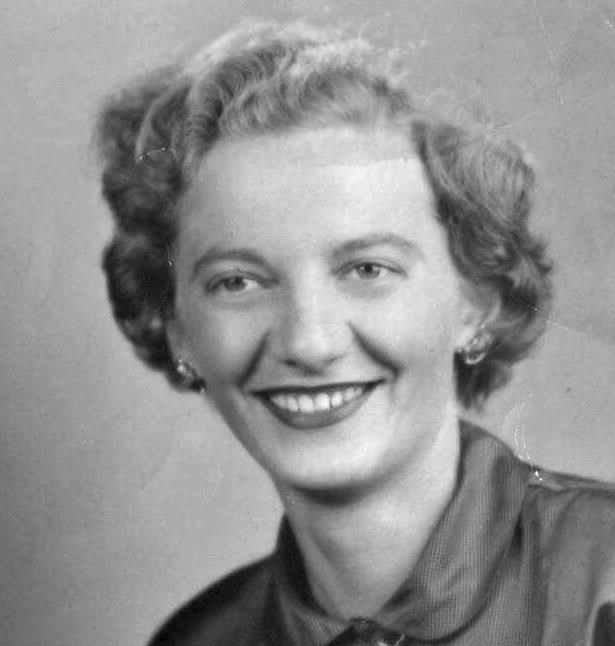
Beloved wife of Josef (deceased); devoted mother of Marilyn (Fred) Isaac of Coral Springs, FL, Melvin (Jeanette) Hoffman and Stanley (Ruth) Hoffman of Framingham, MA; loving grandmother of Sarah (Scott) Durst, Aaron (Yentel) Isaac, Erica Hoffman, Stacey (James) Orner and Naomi Hoffman; loving great-grandmother of Meir Isaac; dear sister of Meir, Malka, Leah and Ruth (all deceased).
Services will be held at BERKOWITZ-KUMIN-BOOKATZ MEMORIAL CHAPEL, 1985 S. TAYLOR RD., CLEVELAND HTS. on Wednesday, October 3 at 12 noon.
Interment Zion Memorial Park (Green Road Synagogue section).
The family will receive friends WEDNESDAY FOLLOWING BURIAL FROM 3 TO 6 PM at Menorah Park, 27100 Cedar Rd., Beachwood.
Contributions are suggested to the United States Holocaust Memorial Museum (www.ushmm.org).
To view this service at 12 Noon Wednesday please navigate to www.bitly.com/smallchapel.
**********************************************************************************************************************
A Void in My Heart
The Memoirs of Regina Godinger Hoffman A Jewish Holocaust Survivor (1927-2018)
Edited by her son, Stanley M. Hoffman, Ph.D. in 1989 [5749] and Revised 1999 [5759]
© Copyright 1989, 1999 Revised, by Regina Godinger Hoffman. All rights reserved.
A Void in My Heart
In the year 1913, my parents, Josef and Fay Godinger, were in America. They came from the Carpathian Mountain region of what was then Czechoslovakia. They were married and settled in Cleveland, Ohio. They worked very hard to buy a restaurant to support their growing family. My two older sisters, Leah and Monica, were born in Cleveland.
I do not remember many details, but a decision was taken that our family should return to Europe. My mother was with child at the time. My sister, Ruth, was born in Chust, Hungary.
After a year, our family returned to the town of Sinovoir where my brother, Meyer, and I were born. Sinovoir was a serene little town. The few years that we lived there were very pleasant ones.
Then, the tragedy began.
Startling knocks on the door at dawn, scant belongings in our hands, years of family accomplishments swept away in a matter of moments.
In the late spring of 1941, when I was just 14 years old, the Hungarian Fascist collaborators marched with lightning speed through Sinovoir. They forced their way into our home, pointed guns at our heads, and told us that we were being relocated. At that moment I realized that we would never be together again. I recall the cries of terror as my family ran about the house trying to escape, but their efforts were in vain.
The Fascists herded us onto a covered army vehicle, and our fateful journey began. As the truck rolled onward, hunger pangs began to strip us of our dignity. At times, the vehicle would either slow down or stop and good-hearted people attempted in vain to get food and water to us. The Fascists knocked these items out of their hands and severely beat them for their efforts.
We traveled on and on, day and night, through various towns, until we arrived at our destination, Nadvorna, Poland. There we were taken off the vehicle and were told to go anywhere we wished, but that if we turned back we would be shot.
There we were, left in the middle of nowhere with no place to go. I was the youngest member of my family. My sister Leah, the eldest of my sisters, had three little boys of her own. Each of us took turns carrying them in our arms.
We walked seemingly endless miles. We then found ourselves at a house from which Jews had been taken away to be killed. We settled there.
I had long blond hair that was in braids and my appearance could pass for that of a gentile. That being the case, I got away with not wearing the Star of David that would
have branded me as a Jew. This facilitated my moving around with relative ease in non- Jewish circles.
I met a Jewish couple who needed someone to care for their little girl and do housework while they worked. I accepted the job. I ate there and managed to take food back to my family.
One day, the Gestapo burst into their house looking for its owners. The beatings that I endured during their interrogation will haunt me as a painful memory for the rest of my life, for I refused to tell them the whereabouts of this couple. At some point after they had finished abusing me, I took advantage of an opportunity to escape.
I succeeded, but in so doing I had made a decision to leave the little girl behind in their house. Terrified, I spent the night with my family.
The next morning, I returned to find the little girl safe. Her mother asked me how I could have left her child in the clutches of the Gestapo. The feeling of guilt about that decision remains with me to this day. I learned at a tender age that one would do almost anything to survive if it seems the right thing to do at the time.
Then came a day that turned out to be one of the worst days of my life. The Gestapo showed up at the house in which my family was staying and rounded up all the members. A little voice in my head told me to run out of the house. I followed its dictate and ran outside, crossed a small pond, and hid in an outhouse. I recall the horrific screams of my family and of others as the Germans searched the entire area for Jews. I sat in that outhouse for hours, my heart pounding the entire time.
When the eerie quiet of evening settled in, I returned to the house my family had been occupying. Only my mother and Leah's three boys were there. Confused and terrified, we waited there for a very long time.
Eventually Monica, one of my three sisters, walked through the door with my father, Josef. He had blood gushing from his head.
After we attended to his head wound, my father told us that the other members of my family, as well as many other townsfolk, had been taken to a killing field.
There, he said many people were forced to dig their graves before being shot to death, whereas others who were not so fortunate were simply buried alive. There my sister Leah and my only brother Meyer met their cruel and untimely deaths.
Some time passed between that terrible day and the day that my mother, Fay, already stricken with heart disease, died as a result of stress caused by the events of recent months. At least she was spared the indignity of an unnatural death. We buried her in a cemetery with just a wooden marker with her name on it over her grave.
One day, soon after my mother's death, the events of recent months got to me as well. My mind snapped. With my desire to continue living gone, I hurled myself into a well. Being a fatalist, it seems an instance of predestination to me now that a passerby saw me in the well and pulled me out of it to safety.
Some time had passed when my father decided that it would be prudent for us to leave Poland to go to another country. He had come to know a man who knew of a way for our family to sneak over the border into Romania en route to Hungary. Father must have had some gold stashed away to pay this man for his assistance.
My father instructed Monica to stay behind with Leah's three children. His plan was that he and I should locate safe haven and then send for them through contacts, so that our initial pace should not be slowed down by the presence of small children. This was never to be.
One day my father and I left for Romania accompanied by our guide. The journey was a treacherous one. We were very cold and hungry as we ran filled with fright, night and day, over snow-covered mountains and fields. All along the way we encountered German soldiers, who shot at us, but running and "hitting the dirt" we managed not to get hit by their bullets, nor did they capture us.
Our guide was a very good one, for he succeeded in safely sneaking us into Romania. There, we came upon a river where we washed ourselves as best we could. It felt so good to be clean once again, even though we were so very cold.
In Yasin, Romania, we boarded a covered wagon in order to remain concealed to passers- by. I recall a feeling similar to the fear that I felt hiding in that outhouse in Poland; my heart never stopped pounding during the entire journey on that wagon.
Finally, we arrived at our ultimate destination, Chust. My father knew a family there who had not been harmed by the Nazis. We stayed with this family.
Before all those calamities befell my family in Poland, my third sister Ruth and my cousin Helen managed to escape the Nazi's clutches. Miraculously, we encountered them in Chust.
Then, sometime in 1944, the vicious circle started all over again. The Nazis captured my family and we were all taken to the Chust ghetto where we remained for what seemed an eternity.
Eventually, the Nazis herded us like animals onto cattle cars, stripping us of what little dignity we had left. It was a living nightmare on that train; looks of bewildered people everywhere, children screaming, and the Gestapo yelling "Mach schnell! Mach schnell!" as people were shuffled about like so much cargo.
As the vicious circle continued to tum, like the incessant rotation of the wheels of the train, another memory from my past played itself out once more. When the train either slowed down or stopped, good-hearted people attempted in vain to get food and water to us. The Nazis knocked these items out of their hands and severely beat them for their efforts.
Eventually, our predetermined destination, the Auschwitz concentration camp, came into view. From a distance we could see smoke billowing from chimneys, but we did not know at that time that the smoke was the result of men, women, and children being burned in the crematoriums. The Nazis spoke only of being relocated.
As we entered the barracks, we saw the now infamous sign over the front gate "Arbeit Macht Frei." When we saw all of the people standing around with shaved heads, we thought that they were the insane prisoners, not the population at large!
When we were taken inside the camp, the men were separated from the women and Ruth and I never saw our father again. The Nazi guards took away all of our belongings, including the clothes we were wearing. Then the heads of all of the women were shaved, and we were left standing there naked for a while.
Then, some so-called "doctors" came to examine us to see which of us was fit for work, and which were not. The one who examined me (that to this day I truly believe was the infamous Dr. Mengele) noted that I had had an appendectomy and that I was quite thin. The people who were if for work were sent to a line on the right side and the unfit ones were sent to a line on the left side. This "doctor" sent me to the line on the left side, but my sister Ruth pulled me beside her in the line on the right side. (I later learned that the people in the line on the left side were led straight to the poison gas showers!)
Life in Auschwitz was a living hell. Every morning we arose to a head count to see how many people had died. Breakfast was black coffee, lunch was pea soup with stones, and supper was spoiled salami or ham with a piece of bread, and once in a while moldy cheese was distributed. Finding the food unpalatable, I went around hungry most of the time. I had but two belongings: a striped dress and wooden shoes.
Winter approached. Ruth and I were both prisoners in Block #8. Everyone slept on bare bunk beds with one blanket for every six people. It was very cold in the barracks, so there was much pulling this way and that during each night.
Some people were removed from the barracks to work on repairing railroad tracks. I heard it said that if workers were uncooperative, or even if they were physically unfit to do the tasks they were given, that they were brutally beaten.
Time passed very slowly during those months in Block #8. I saw many people who, unable to bear their pathetic existence any longer, hurled themselves at the barbed wire fences that surrounded the camp in order to commit suicide by being shot to death by the camp guards.
Eventually, my sister and I were transferred to the camp at Nuremberg. There, the living conditions proved to be somewhat better than were those in Block #8. The bunk beds were more comfortable, and some of the food was actually edible. There we worked in an ammunition factory assembling explosive devices for the Third Reich.
One day, the factory was leveled by an allied air attack. Ruth and I managed to survive, having found safety in an air raid shelter. Within the shelter, Gestapo men hid behind us. (I believe to this day that they believed no harm could come to them if they hid behind Jews!)
After the aerial bombardment had ceased, Ruth and I remained trapped in the shelter for several days. Eventually, we were found after some rubble had been cleared away. My sister had sustained an injury during the attack; a piece of shrapnel had penetrated one of her fingers. When she was taken away for medical assistance, I feared I might never see her again. Thank G-d, she was safely returned to me!
Following some months in Nuremberg, we were taken to the concentration camp at Holeshovitz, near Pilsen, Czechoslovakia. There, too, we worked in an ammunition factory performing similar tasks.
When it began to grow clear that Germany was losing the war, the Germans poured gasoline all over the barracks. They intended to bum the concentration camp at Holeshovitz to the ground along with its prisoners!
May 5th, 1945 - this date is forever etched in my memory, for on this day the Polish partisans liberated us. The Poles, who had allied themselves with the Germans for the duration of the war, then turned against them.
As the camp gates swung open, the Poles asked us what we wanted done with the Gestapo men. The Poles would have done anything we asked of them. We could have had the Gestapo men tortured by employing the same sadistic methods they used against our people, or simply have had them cut up into little pieces.
However, the only thing that the freed prisoners asked for was that the Gestapo women have their heads shaven in humiliation.
Here is an example of the difference between us as peoples of the world at that time. After enduring all of the degradations with which the Germans had afflicted us, we were not able to force ourselves to have equally sadistic acts committed upon the persons of our former captors.
A frenzy of activity resulted when the Poles broke open the German's food storage bins. We all ran and grabbed as much fresh bread, salami, and other kinds of food as we could hold. Many former prisoners got sick to their stomachs by overeating after such an extended period of hunger.
When the American soldiers arrived two days later, we began to believe that our ordeal had truly come to an end. They transported all of the former prisoners to a place where they could wash-up and be issued new clothing. For the first time in years, I was experiencing a feeling of relief!
I have kept a memento from my liberation experience through all these years. A rabbi that I met gave me a pocket-size booklet that served as a Jewish calendar for the year 5703 (1942-1943.)
Shortly after being liberated, Ruth found a husband, Lou Davis, to whom she has remained married to this day. I moved in with them for a while in a domicile in Usti Nad Labem, Czechoslovakia.
Before the war began, we were aware that we had relatives living in the United States. In 1948, my Uncle Max and his wife Yehta bought plane tickets for all of us to come to America. We cashed them in because there had been so many airplane accidents that year. We came to London by train instead, and stayed there for a few days with Lou's younger brother. Then we boarded the Queen Mary in Southampton bound for America.
After being processed as immigrants at Ellis Island, we were met in New York City by my aunt Molly, her daughter Lillian, and Lillian's husband Alvin. We departed for Cleveland, Ohio, by automobile. Ruth and Lou had become parents by then. Little Fay was traveling with us, and Ruth was with child once again. She and her family moved into one of our cousin's apartments and I stayed with my aunt Molly for a few weeks.
One day, aunt Yehta and I went shopping for clothes in a department store. After such an extended time of being deprived of life's bare necessities, the feeling I experienced shopping for and wearing new clothing was wonderful.
Eventually, with help of Uncle Max, I found a job in a factory. Although I was appreciative, I later told him I needed to spend more time around Americans to learn to speak English better. The work environment at the factory was not conducive to achieving this goal. I was already enrolled in night school in order to improve my grasp of the English language and attain a better job.
Sometime later I left the job at the factory for another in a lingerie store in Cleveland's Old Arcade. After a year of this, I worked in a department store. My recollections of that period of my life are dominated by feelings of anguish caused by having been forced to leave Europe to live in a new country whose ways were so new and strange to me. The process of assimilation was very drawn out and somewhat painful.
Jewish immigrants in Cleveland formed a "newcomers club" in a building located at 105th Street and Euclid Avenue. I began to attend dances there around 1948. (That area was then quite beautiful, but has since deteriorated considerably.) Singles used to go there to meet one another at dances. It was there that I met my one and only husband, Josef, who is also a Holocaust survivor.
One night in 1949, I went there accompanied by a nice young man. At some point during the evening, Josef approached me and asked whether I would like to dance. I told him that I would if he asked for permission from my date. He did so, and my date reluctantly consented. After Josef and I had danced for a while, he asked me for my phone number and I happily gave it to him. By that point in the evening I found myself growing quite fond of him.
After just a few dates, Josef asked me to marry him! Even though this happened so quickly, I thought he was a very handsome man, and I already saw in him the qualities of a good husband, and the potential to be a good father to any children that we might have, so I accepted his proposal.
Soon after we became engaged, he left for Los Angeles to find a job, for we had seriously considered moving to that city. He found a job and an apartment there. We wrote to one another frequently. (I still have those letters.)
All of a sudden the situation appeared to change drastically. Josef received a draft notice from the United States armed forces. I wrote a letter to him to inform him that I refused to come to Los Angeles only to live by myself while he was away being a soldier. However, six months into this difficult period in our premarital relationship, relief came in the form of a letter from the armed forces stating that, since his twenty-sixth birthday had passed, he was no longer eligible to be drafted. Josef soon moved back to Cleveland. That whole ordeal halted our plan to live in Los Angeles.
On December 24th, 1950, Rabbi Rosenthal, a truly beautiful human being, married Josef and me at the Taylor Road Synagogue in the suburb of Cleveland Heights.
Since then, Josef and I have had three wonderful children, Marilyn Fay in 1951, Melvin Stuart in 1953, and Stanley Marc in 1959. Josef and I reside in University Heights, Ohio. Marilyn lives in Coral Springs, Florida with her husband Fred Isaac and their two children Aaron and Sarah. Melvin resides in South Euclid, Ohio with his wife Jeanette and their two children Erica and Stacey. Stanley lives in Framingham, Massachusetts, with his wife Ruth. We cherish all of them very much.
My sister Ruth Davis and her husband Lou reside in Beechwood, Ohio. Their daughter Fey Ruback and her husband Marvin live with their family in Skokie, Illinois. Their daughter Judy Schneider and her husband Steven reside with their family in Boca Raton, Florida. Their son Joe Davis and his family live with their family in University Heights.
There are two cousins among the survivors with whom I keep in touch: Helen Fixler, who resides with her family in Los Angeles, and Bertha Katz, who lives in University Heights. I also keep in touch with aunt Molly's son, Sandy Singer, who resides in Orange Village, Ohio.
The only member ofmy husband's immediate European family to have survived the war, his brother Max Hoffman, lives with his wife Miriam in South Euclid, Ohio. Their daughter Renee Resnik resides with her family in Columbus, Ohio. Their sons Alan and Leonard Hoffman live with their respective families in Santa Fe.
At times, I catch myself speaking in a surprisingly harsh tone to my children or to my son-in-law or daughters-in-law. Among the foremost reasons for my occasional severity with them are an urgent need to impress upon them the significance of our Jewish identity, and the intangible value of a unified and caring family. This need is, no doubt, a result of my Holocaust experience. Yet I realize that no one in my immediate family, except for Josef, will ever be truly able to comprehend the emotions stirred by my memories of the Holocaust.
Perhaps this brief memoir will inspire my family to care more about these values that I hold so dear, and perhaps even inspire my husband to document his own unique Holocaust experience for posterity.
Perhaps its existence will also serve to open up discussions between Ruth and me concerning our past experiences, for they are rarely mentioned. Instead, the feelings that she might want to share with me remain bottled up inside her. This inability to deal with painful memories manifests itself as an obstacle in our relationship that takes on various guises and which ultimately affects our feelings toward one another in adverse ways. I wish only to be at peace with the one member of my immediate European family spared from death in the war.
There are two issues that I must address in order to feel as though I have told as much as I feel I must that are connected to my experience as a Holocaust survivor.
First of all, recent media interest concerning the Holocaust has made it quite apparent that many leaders of countries in the Free World, including President Franklin D. Roosevelt, knew all about the concentration camps, and did nothing to stop the extermination process that was taking place. Surgical bombing of railroad tracks leading to the camps never took place. All the United States did about the camps was to document the atrocities that took place within them after the war was over, and to help bring Nazi war criminals to trial. These are both good things, but are in the most real sense of the phrase actions that were "too little too late." G-d forbid that such indifference to an ongoing tragedy of such staggering proportions should ever come over humanity again!
Secondly, I cannot remember feeling more distraught about anything since the war than when the first news reports broke that a Canadian anti-Semite (whose name I shall not mention) had published writings stating that the Holocaust is a fabrication. When writings by other Holocaust revisionists followed, I realized that I could no longer stand idly by and let this trash be disseminated around the world. I felt compelled to help counteract the negative effects caused by these intentional distortions of history.
The memoir you have just read is a cathartic reaction to those writings full of lies, written by individuals who clearly want the nightmare to start all over again. I hope that more Holocaust survivors will choose to document their own experiences. A preponderance of evidence must exist throughout future generations, leaving no doubt in the minds of people in the future that this horrible chapter in human history really did happen. The recollections of survivors, not the words of a handful of overzealous anti-Semites, must always be regarded as the truth. If you are a Holocaust survivor, I urge you to immediately record your experiences for posterity. It is never too late to tell.
I considered calling these brief memoirs "It is Never Too Late to Tell." I finally decided upon the title "A Void in My Heart," for the void caused by my Holocaust experiences will remain in my heart for as long as I live.
--------------------------------------------------------------------------------------------------------------------
My Red Boots (A Poem)
My red boots and ruby earrings were snatched away; they were so dear to me. My youth and family, too, were snatched away in the same way. I'll never forget that day. I'm told now to put it out of my mind. I find that task very hard.
I can still hear the dogs howling, the Gestapo rounding us up for appel, those dreadful words "Mach schnell"!
How can I not remember when my loved ones perished for no reason. Babies were taken from their mother's arms! Heaven and earth should have shaken from their cries and have been heard afar.
Yet the world stood still. Not a word was spoken to try to help us. I can't forget the helplessness that we endured. Listen! Maybe you will hear them, too. If we do this, we can keep evil from happening again, and again, and again!
Montrez votre soutien
Envoyez Vos
Condoléances
Partager
L'avis De Décès
Obtenir les mises à jour
Prestations de Service
Partager l'avis de décèsPARTAGER
- RECEVOIR DES RAPPELS
v.1.18.0