
AVIS DE DÉCÈS
Arthur Raymond Knowles
22 octobre 1923 – 3 juillet 2012
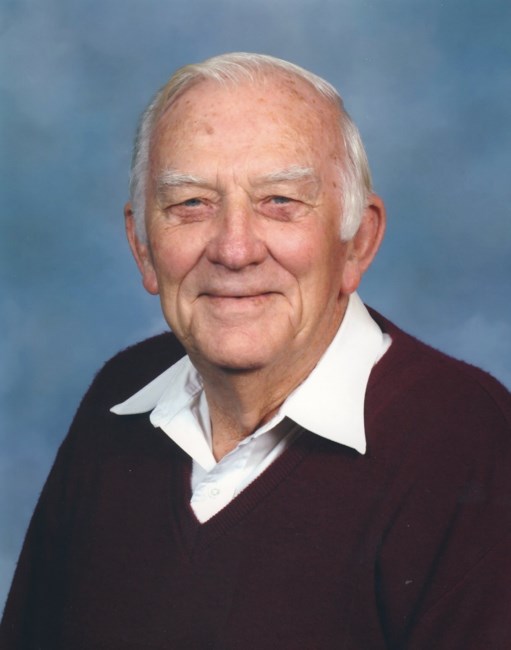
Written July 4th-5th, 2012
What defines a great man? Is a man’s legacy defined by the merits of his own story? Is it defined by the views that other people hold of him?
In the case of my grandfather, I believe that what defined him as a great man was a little bit of both, combined with having lived as part of what has become known as the “Greatest Generation.”
Long-time West Covina resident Arthur Raymond Knowles passed away peacefully around 6:30 p.m. on the evening of Tuesday, July 3rd, 2012 in his bed at the Bridgecreek Retirement Community on Holt Avenue in West Covina, California at the age of 88. But to merely see the man off with a blurb, almost as if he was an afterthought, another old man who’s time has past, seems grossly inadequate and unfair. You see, Arthur Raymond Knowles was my grandfather, and while human and in many ways humble, I believe that he was, in his own right, the definition of a great man.
My grandfather was born in Steubenville, Ohio on October 23rd, 1923 to Arthur R. Knowles, Sr. and Alice Addison Knowles. He grew up in and around Steubenville where he cracked various boyhood antics, got into his fair share of fights, and generally speaking won them all. He always would talk about the importance of education in that era and discuss how school today is not a thing like it was then, that studying was much more intense and teachers were much tougher task masters. He then went on to Charleston, South Carolina in his teen years where he excelled in sports. My grandfather brags of winning the Punt, Pass and Kick Competition in Charleston in August of 1936, beating out the guy who was the starting Quarterback at Charleston High School at the time, but then being kept off the football team for “being too small.” Despite this ill-thought determination of the high school football coach, my grandfather would go on to greater things.
After graduating from High School, my grandfather would go on to college at the Citadel with the understanding that he could be drafted into the United States Army and sent off to fight in World War II at any time. His Junior year he was officially enlisted in the U.S. Army Reserves and spent that year waiting for his call-up. By the end of his third year, the call-ups were made and he went to basic training.
One of the remarkable elements of my grandfather late in his life is that he took greater pride in being a veteran and wrote a story of his life to be passed on for the generations to come, so that we could all be aware of his story and what life was like for a soldier serving in World War II. Because of this I was able to learn that my grandfather gained the rank of Lieutenant. He wrote the following to describe the classification which he attained. “Most of the new officers from the class were assigned to the 84th Infantry Division in training at Camp Claiborne, Louisiana. When I got to the 84th, I was sent to the 334th Infantry Regiment. There the guy who was making assignments saw that I had some engineering background so I was assigned to the first battalion as an A and P Platoon leader. (Ammunitions and Pioneer). This meant that my platoon was responsible for supplying ammunition for the whole battalion, demolition of any land mines and constructing bridges for the battalion to cross waterways. For major river crossings the Division’s Engineering Battalion was brought in and we assisted them.”
My grandfather would go on to serve in the European theater extensively. He fought in the Battle of the Bulge, and a plaque distinguishing this service was displayed proudly in his home. When I went to say my good-byes to him, even moreso than the medals that were displayed in a case he had put on the wall above his television, this plaque struck me. He had participated in one of the worst battles of the war.
This would not be all that he would suffer through. My grandfather would be shot 3 times in total during the war and would earn purple hearts and a silver star.
His platoon leadership was something that was never lost on his men. A few years ago, my grandfather went to a reunion for his infantry division. Things did not go as well as hoped and he missed several events and was about ready to leave when he and my step-grandmother started a conversation with a middle-aged man and his daughter. When he explained who he was, the man perked up and effectively told my grandfather “Lieutenant Arthur Knowles? My father has talked about you all my life.” In an odd twist of fate, my grandfather was reunited with the soldier who had acted as the runner in his platoon. Over the final years of his life, my grandfather would recount this story, as well as the story of another soldier, a man by the name of Joe Nehane, who in one of his most memorable battles, one in which he would be shot twice, helped to clear the path of German gunners and allow for the survival of many men, including my grandfather. Nehane unfortunately would die in this battle, picking up a live grenade to throw it back and having it blow up in his hand. My grandfather always spoke of Mr. Nehane’s bravery in this battle. It is very likely that the reason my grandfather lived through the battle and, indeed, the reason why I am alive today to write about my grandfather is because of Mr. Nehane. I do not know his exact ranking, but if Mr. Nehane’s family is out there somewhere and reads this, please know that the sacrifice that he made will not soon be forgotten by my family.
My grandfather would go on to meet my grandmother, Stasia Fortuna, a native of Poland, at the end of the war. They would marry and go on to have four children: Peter, Margaret, Teresa and James. My grandfather spent his working career working on engineering projects. He most notably would work on flood control projects, and would frequently talk about how well projects he worked on held up through large storms, while pointing out the flaws in projects he was out-bid on that led to flooding. He often kept sketches of his work and would formulate the necessary heights, sizes, and weight load needs of projects freehand. While toward the end of his life he found computers to be an interesting method of communication and finding information, during his working career he refused to move to computer drafting programs in his own work, preferring to freehand.
One of the lasting impressions that my grandfather left on us was his love for children. My grandfather loved children. He would sing them songs, tell them stories, and regale them with tales of how he defeated the Nazis. I grew up believing that my grandfather was almost super-human. He’d embellish his stories, and I’d go around and tell people how my grandfather “pulled Nazi war planes out of the sky with his bare hands and threw them to the ground” and how “Hitler decided to stop fighting and went into hiding because he got scared when he heard my grandpa was coming.” How disappointed I was as I got older and read that history didn’t quite play out that way.
But even these stories served to show how great my grandfather was, and to note the impact of heroism that our brave soldiers who have fought in wars have on our nation. You see, I almost lost my grandfather when I was much younger. He had a massive heart attack and was, for all intents and purposes, dead about 25 years ago. Instead, he bounced back and lived for nearly 25 years more. With each ailment he had after, though it would take an element of his health, it only served to show his inner strength and will to live. As he entered the last few years of life, afflicted by Congestive Heart Failure and requiring oxygen, first intermittently and later almost full-time, I remarked “my grandfather is still a soldier. He has replaced his gun with an oxygen tank. But he still marches on.” Indeed he did, living his last few years with my step-grandmother (my grandmother passed 10 years ago now, my grandfather remarried a couple years later,) making sure that they got to the Senior Center regularly and were active in the community and visiting friends and family, dancing with the bride at every wedding he attended of a grandchild even if it resulted in him being completely winded. Seeing this, knowing the effort he put forth just to live to the fullest in his waning years, it suddenly did not seem so far-fetched to picture a young, strong man pulling planes from the sky, throwing them triumphantly to the ground, and instilling fear into his enemies even to the point of causing Hitler to surrender and disappear.
The last picture I have of my grandfather near death are the reminders of how full of life he was. He would sing to everyone. “Hey dolly, let me sing ya a song!” he’d say to the waitresses and hostesses when we’d take him to lunch, and he’d launch into a number from Sinatra or Bennett or any of another number of crooners from his youth, drawing smiles and laughter. The age of the woman didn’t matter, my grandfather had a song for the 9 month old, the 9 year old, the 29 year old and the 99 year old. And he put smiles on all his faces.
So “hey, dolly, let me sing ya a song!” and pay tribute to a great man. Lt. Arthur Raymond Knowles was given his discharge papers from this life this week. Wherever he is now is better for having him. And we are all better for having known him.
Lt. Knowles was preceded in death by his first wife Stasia Fortuna Knowles and his son Peter Knowles. He is survived by his second wife, Virginia Fernandez Knowles; his daughters Margaret (Knowles) Poer and Teresa (Knowles) Becker; his surviving son James Arthur Knowles; his grandsons Tony Poer, Eric Becker, Peter Poer, Jorgan Knowles, Jerick Janssen, Carlos and Christopher Knowles; his granddaughters Amanda Becker and Lauren Becker; and his great-grandchildren Conrad Poer, Ava Becker Rogers, Jude Becker Rogers, and Chloe Poer. Memorial services are being held privately. A military ceremony and tribute will be held Tuesday, July 10th, 2012 at 1:45 p.m. at the National Cemetary in Riverside, California In lieu of flowers or donations, please thank the soldiers in your life for their service to their country.
Montrez votre soutien
Envoyez Vos
Condoléances
Partager
L'avis De Décès
Obtenir les mises à jour
Prestations de Service
Partager l'avis de décèsPARTAGER
- RECEVOIR DES RAPPELS
v.1.18.0