
AVIS DE DÉCÈS
Mary Jean Munroe
15 juillet 1918 – 5 janvier 2016
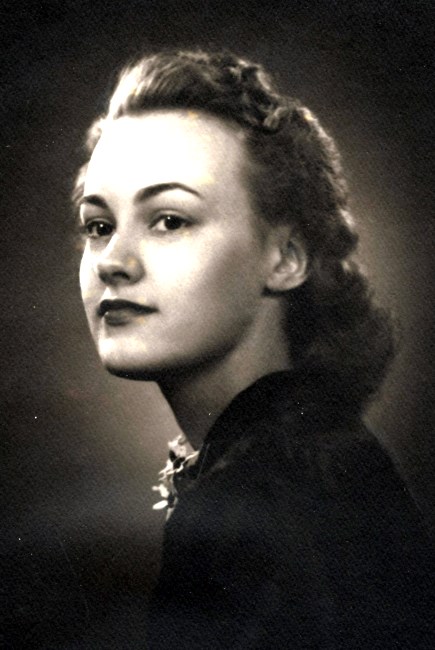
Mary Jean Mabie Munroe was born July 15, 1918 in Lansing, Michigan to Roy Mabie and Lucy Longyear Mabie. She died January 5, 2016. She is survived by her husband, Peter. At the time of her birth, her father was a soldier in the U.S. Army. Her mother and father were divorced while Mary Jean was an infant. According to bits of information acquired by Mary Jean as she was growing up, her father had been driven away by her maternal grandmother, the dominant matriarch of the family. Thereafter, Mary Jean and her sister, two years younger, were raised by her mother and her mother’s sister, Gertrude Longyear. Gertrude Longyear became the economic mainstay of the family. These two great and gracious ladies sacrificed all of their personal desires and dreams to raise and educate two beautiful girls. Both of the girls ultimately were graduated from Lansing Central High School and Michigan State University (then Michigan State College).
While in college, the two girls lacked for nothing. Mary Jean majored in languages, and her younger sister studied music. Both became members of Kappa Alpha Theta Sorority. In Mary Jean’s junior year, she met the man who was to become her husband. The romance began on one of Mary Jean’s infrequent trips to the college library and culminated in marriage in October, 1940. The young couple began their married life living and working in Detroit. Mary Jean taught herself typing and shorthand and became expert in both. When her husband was commissioned in the U.S. Navy in 1942, she returned briefly to Lansing and then obtained employment in New York where she worked in the personnel department of a major engineering firm. When the war ended, she went to Cambridge, Massachusetts with her husband. While her husband was a student at the Harvard Law School, she worked in the public relations department of the Poloroid Corporation. While Mary Jean worked for Poloroid, the company developed the famous Land camera, and she modeled frequently for photographs during the camera’s development.
After her husband’s graduation from law school, Mary Jean returned with him to Lansing where he began his law career. She became a secretary to the superintendent of the East Lansing Public Schools. For the next 43 years, she worked for several superintendents. One of her duties was to take and transcribe the minutes of the meetings of the Board of Education. She never missed a meeting of the Board. One of the superintendents called her the official grammarian of the Board.
When her husband organized and opened his own law firm, Mary Jean became the paymaster for the firm. She prepared the payrolls for the several lawyers, law clerks, and secretaries of the firm and made all of the necessary federal and state filings. She taught herself how to do it. A significant event, which turned into a grating disappointment, occurred at the beginning of Mary Jean’s junior year at Michigan State. When she started college, she had no plan for her future. “Going to college” was the “thing to do.” However, by the end of her sophomore year, she began to be concerned about her future. She went to her faculty advisor, the head of the department of foreign languages, to discuss a possible switch of her major to Business Administration. Obviously, in the 1930’s there was very little pragmatic value in the study of French, unless one planned to teach it to someone else after graduation. Foreign languages were fine for intellectual stimulation and pleasure and as a part of a well-rounded liberal education, but they did little to help one make a living. And Mary Jean detested the vapid, and generally useless, courses in “teacher education” that students were required to endure in order to obtain a teacher’s certificate. Mary Jean’s faculty advisor, himself a teacher of foreign languages, and being protective of his own turf, threw cold water on her idea for switching majors and recommended more foreign languages. So much for a faculty advisor helping a student prepare for the future!
There was nothing pretentious about Mary Jean. Everyone who ever knew her loved her. She was kind and generous and loyal. She was eternally optimistic, bubbly, and impulsive. Her smile lighted up the room. Mary Jean was 97 years old when she died. People, in expressing their condolences to survivors, often comment about the long life of the one who has died. But the aching, overpowering grief and sense of loss of the elderly survivor remain.
Mary Jean was beautiful in every way every day of her life. Mary Jean loved people – all kinds of people. Although she led a busy life, she was able to make time for some of her favorite pastimes: golf, movies, shopping, and travel. But at the center of it all was her love for her husband. In turn, Mary Jean was the center of her husband’s life.
In the last few years of her life, Mary Jean had to contend with some serious illnesses and disabilities. Although she suffered pain and, at times, severe physical limitations, she never lost her enthusiasm for being with people and participating in the limited activities of which she was capable.
There is a significant point here for anyone who is responsible for the care of someone that he loves. Do not be too quick to accept the advice of the faithful family or attending physician to make the patient comfortable and let her die quietly. Over a period of six years, Mary Jean came close to death three times. Three times three different physicians in charge wanted to “make this 90-year-old woman comfortable and let her die.” Three times her husband objected bitterly. Three times the doctors decided that maybe “there was something else that they could do.” Three times the “something else” saved her life.
A funeral service will be held at 11:00 a.m. on Monday, January 11, 2016 at Gorsline Runciman Funeral Homes, 1730 East Grand River Ave., East Lansing, MI. The family will receive friends one hour prior to the service. Online Condolences and memories may be shared with the family at www.greastlansing.com.
Montrez votre soutien
Envoyez Vos
Condoléances
Partager
L'avis De Décès
Obtenir les mises à jour
Prestations de Service
Partager l'avis de décèsPARTAGER
- RECEVOIR DES RAPPELS
v.1.18.0