
AVIS DE DÉCÈS
Irene Meyerhof Erdoes
15 mars 1924 – 21 juin 2011
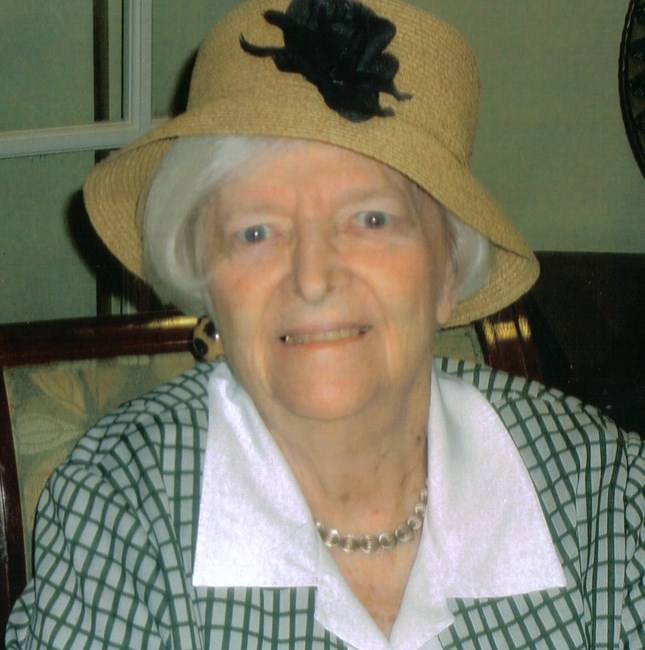
Irene Meyerhof Erdoes was born March 15, 1924 in Berlin, Germany, to Ursula Van Diemen, a renowned opera singer, and Justus Wilhelm Meyerhof, the owner of a textiles company. Her uncle, Otto Meyerhof, was a Nobel Prize recipient in science.
Sadly, all of the family possessions were seized by the Nazis after the rise of Hitler during pre-World War II Germany. Her father, a Jewish descendant, was persecuted and forced into a labor camp near Sachsenhausen, Germany. With the help of family, he was released, but kicked out of Germany, leaving his family behind. Mom was tragically instructed never to mention her father’s name in public so the family would not be further persecuted by the Nazis.
After the War broke out, she spent several harrowing months in Berlin, dodging Allied bombing runs. She even survived a machine gun attack by British RAF fighters. Fearing that her daughter would be killed or worse by the advancing Communist Russian army, Irene’s mother sent her to live with friends in the Bavarian part of Germany, well south of Berlin. There she met a young German conscripted soldier who was shortly sent to Africa to serve under Rommel. The couple had a daughter, Yvonne, Irene’s only daughter, who still lives in Bavaria near Munich.
After the war ended, Mom survived the destruction of the economy and infrastructure of post-war Germany on whatever food she could find, including dandelions used for making salad.
Mom was well educated and fluent in English, French and of course, her native German. She landed a job in Munich with the U.S. Army as a translator and received high commendations for her work. She worked for a United States Commission that worked in recovering lost and stolen art that the Nazis had taken from Jews, political enemies, and anyone else who tried to get in the way of their fascist beliefs.
While stationed in Munich, she met Ervin Erdös, a Hungarian refugee, who had survived the Holocaust in the same forced labor camp as Irene’s father and had returned to Hungary only to be further persecuted by the Communists. Ervin was in medical school in Budapest, Hungary when he learned he was about to be arrested by the Communists as a political dissident. He paid a man to smuggle him across the mine fields that dotted Eastern Europe and formed part of the iron Curtain. He arrived in Munich without a penny, but managed to get into medical school and completed his medical degree at the University of Munich.
After they met, Mom and Dad married in Munich and then immigrated to the United States to seek freedom. Mom became an interpreter at the United Nations. After becoming a proud U.S. citizen, Irene moved to Pittsburgh, Pennsylvania, where she had three sons. In 1963, her family moved to Oklahoma City, where her husband took a job at the OU Medical Center as a professor and research doctor.
Mom served as a volunteer substitute foreign language teacher at Northeast High School and became involved in the OKC Flower Club, raising champion tulips, daffodils and peonies.
Mom went to work for the United States government once again in the mid-1970’s when she took a job with the Internal Revenue Service as a taxpayer service representative.
Mom was always extremely grateful for the freedom this country gave her and her family. She never took her citizenship for granted. She voted, paid taxes, and served on juries when called. Her patriotic beliefs never waned.
She is survived by her daughter, Yvonne Marx, three sons, Martin, Peter and Philip Erdoes, two daughters-in-law, Mary Erdoes and Kimberly Erdoes, seven grandchildren and two great grandchildren.
Services will be held on June 25, 2011 at 10:00 a.m. at the Baggerley Funeral Home Chapel.
Services entrusted to the care of Baggerley Funeral Home of Edmond, Oklahoma.
Montrez votre soutien
Envoyez Vos
Condoléances
Partager
L'avis De Décès
Obtenir les mises à jour
Prestations de Service
Partager l'avis de décèsPARTAGER
- RECEVOIR DES RAPPELS
v.1.18.0