
AVIS DE DÉCÈS
Dale S. Good
17 avril 1918 – 17 février 2015
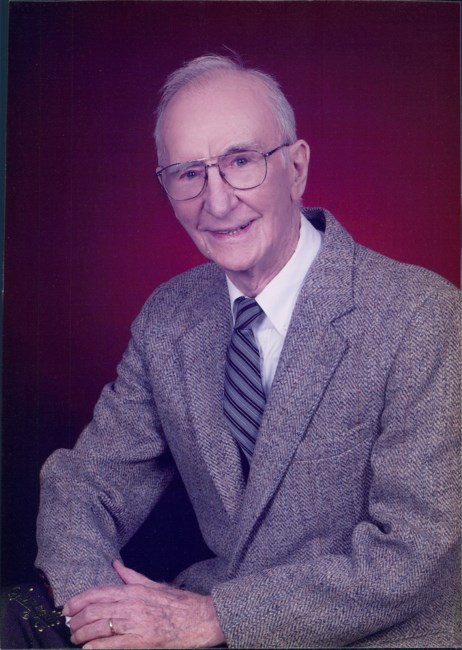
Dale Shively Good was born in the small farming community of Lake Cicott, Indiana, on April 17, 1918, the third of four children. His father, Glenn Good, was a local postmaster and general storekeeper, having broken away from two centuries of farming that began with the immigration of the Guth family from Germany in the early 18th century to Pennsylvania, and progressed through homesteads in Pennsylvania, Maryland, Virginia, Ohio and, finally, Indiana. In 1925, Dale's father Glenn was lured by Henry Ford's promise of $5 a day on the Ford assembly lines, and he moved the entire family to River Rouge, Michigan, where Glenn began work at the huge Rouge assembly plant.
By the time Dale graduated from River Rouge High School in 1936 after a happy and sports-filled childhood (he once told his sister Jane that he never noticed The Depression because he was too busy playing football!), he had distinguished himself sufficiently to receive a football scholarship to Bowling Green University. (It came just in time, because he had already begun corresponding with a mortuary school to start training in that profession.) After a college career that was noted more for his varsity letters and presidency of his fraternity than for academic achievement, Dale graduated in 1941 - just in time to enlist in the Navy in the lead-up to World War Two.
By this time, he had met Mary Ann Pavelle, a young co-ed from Fremont, Ohio, in the Bowling Green library and began a partnership that would last more than 60 years. After officer's training in Chicago and pilot's training on PBY Catalinas in Pensacola, the war had begun in earnest and Dale was sent with his seaplane squadron - VP 53 - to Trinidad in the Caribbean on Atlantic Ocean patrolling duty. Eventually, when VP 53 was transferred to the Pacific theater of war, Dale and Mary Ann decided to marry quickly, like so many wartime couples, and she crossed the country from her home in Fremont to San Diego, California, where they married on August 14, 1943. Following a quick honeymoon in Tijuana, Dale shipped - or rather, flew -- out to Hawaii and then to the air base on the atoll of Funafuti, now capital of the Island nation of Tuvalu. He spent the rest of the war flying patrols and air-sea rescue missions out of several Pacific locations.
Despite the hardships and horrors of war, both Dale and Mary Ann looked back on their early married life as the most exciting years of their lives. They jointly decided to stay in the Navy as a career following the end of the war, and started a peripatetic life moving from one Naval Air Station to another, and began a family that came to include Michael Christopher, born in 1945, and David, born in 1948. Tragedy struck in 1967, when Michael died of cancer, not long after secretly marrying Micky - who became in many ways a daughter-in-law and remained in touch for many years despite remarrying and raising a family of her own. David eventually embarked on a Foreign Service career and in 1973 married Ila - an Indian whom he met in Calcutta - and they were joined in 1979 by their daughter Mallika and in 1982 by another daughter, Maya. Their overseas life gave Dale and Mary Ann the opportunity to visit them in India, in Israel, in Kuwait, and in Jordan. They became loving grandparents to Mallika and Maya and affectionate in-laws to Ila, who found in them the ideal of Americans that she had admired during her years as a foreign student in the United States.
Dale retired from the Navy in 1965, after 24 years of service, and embarked on a career in the private sector, working on defense contracting issues at Grumman Aerospace Company in New York and elsewhere, before retiring for good in the 1980s.
Mary Ann passed away in 2002, after 59 years of marriage. She never knew her grandson-in-law, Michael Filtz, whom Mallika married in 2008, or her great-grandchildren Mira, born in April 2013, and Lucas, born in November 2014. Dale, however, has gotten to know both Mira and Lucas, and spent one last Christmas and New Year’s with them before taking ill in January. He had always kept up the family tradition of cabbage rolls for New Year's dinner, and enjoyed his last roll on January 1, 2015. It was not long after that when he lost both his appetite and his will to live, and passed away peacefully on February 17, two months shy of his 97th birthday, and a year older than his father, Glenn, who had passed away in 1982.
Dale Good's was called The Greatest Generation. They were ordinary Americans - many, like him, from rural backgrounds - who answered the call to fight the biggest and most destructive war in history, and then returned to build the most prosperous period of the most successful country in world history. He was an exemplary member of that generation - beloved by his family and friends in America and also in India, where Ila's family came to accept him and Mary Ann as part of their own extended families.
It is a cliché, but true: his like will not come again. He will be missed by more people than any of us know.
Montrez votre soutien
Envoyez Vos
Condoléances
Partager
L'avis De Décès
Obtenir les mises à jour
Prestations de Service
Partager l'avis de décèsPARTAGER
- RECEVOIR DES RAPPELS
v.1.18.0