AVIS DE DÉCÈS
Clark Golden Adams, Sr.
21 juin 1925 – 7 mai 2023
June 21, 1925 -- May 7, 2023
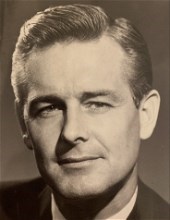
Clark Golden Adams Sr. began a “life fully lived and enjoyed” with a rambunctious and enterprising boyhood and college football glory in Utah. He flew B-17s, worked at Yellowstone National Park, became an aerospace executive in California and a federal contracting watchdog in Washington, D.C. Along the way he was a devoted husband, doting father, grandfather and great-grandfather, and a master storyteller. He died May 7, 2023, at his home in Washington, D.C. He was 97, flashing a winning smile to the end.
Clark was born in Layton, Davis County, Utah, on June 21, 1925, the third of four children born to Golden Marion Adams and LaVerde Evans Adams. The name “Clark” was a family name on his mother’s side. His father, Golden, was a high-school principal and part-time farmer, so young Clark got an education in agriculture as well as the three R’s. He also spent quite a lot of time in the Layton pool hall, honing a skill in eight-ball that would impress family and friends many decades later.
At Davis High School, Clark was a self-described average student but a strong athlete, playing alongside his cousin Lyman Clark on standout varsity Darts football, basketball and baseball teams that were among the best in Utah.
Clark and his cousin Beecher Adams enlisted in the U.S. Army Air Corps after graduating from Davis High in 1943. The Army moved Clark from base to base throughout the Southwest. He was commissioned a second lieutenant, selected to fly B-17s and named the youngest aircraft commander at the airfield in Ardmore, Okla. This was an early reflection of his leadership skills, but it also was a reflection of an uncanny ability to identify silhouettes of allied and enemy aircraft on flash cards quicker than anyone else in his training class.
The allies declared victory in Europe as his air wing flew to England in May 1945, so the disappointed fly boys turned their Flying Fortresses around at Goose Bay, Labrador, and headed home. He was training to fly B-29s as World War II ended, and soon he was discharged from the Army. He enrolled at the University of Utah.
Standing 6’3” and dashingly handsome, he was a true big man on campus at “the U.” Wearing number 19, he was a star two-way tackle on the football team that had a lot of success in the Mountain States Conference. His exploits on the gridiron were well-documented by the Salt Lake Tribune and Deseret News, including when he collapsed from exhaustion after a game in Denver and was rushed to a hospital. He recovered quickly and played the next game. He was named to the All-Conference team two years, and received an invitation from the Pittsburgh Steelers to try out. He declined.
He loved to regale family and friends with his antics as a member of the Sigma Chi fraternity at the U.: digging up sod from a local park for the front yard of the fraternity house, cutting neighborhood roses to present to sororities, running “boat races” on soapy basement floors of the frat house, and buzzing the house in a trainer aircraft.
During college he began an association with Yellowstone that would last a few years. He and fellow Sigs, including cousins Lyman Clark and Beecher Adams and friend Spencer Hatch, turned a fishing outing at Yellowstone Lake in 1946 into jobs as rangers, with Clark assigned to work at Old Faithful geyser. That summer he also survived a perilous spill at Tower Fall (he credited his “football tackle legs” with saving his life).
In 1947 he led private tours at Yellowstone for the Union Pacific railroad. In 1948 he and Lyman sold fruit at West Yellowstone, eventually getting unwanted attention from a local grocer who got the operation shut down.
It was through his active Greek social life (well-documented by the Salt Lake Tribune) that he met his true love, Barbara Jean (BJ) Newcomb, a member of the Kappa Kappa Gamma sorority and a champion tennis player. She was at the U because her father, a naval commander, was assigned to the naval ROTC unit there. They wed at the Kappa house on March 18, 1950.
Clark received his bachelor’s degree and a law degree from “the U.” He tried his hand as an attorney in Salt Lake City for a time, but he and BJ decided to join the rush to southern California. He landed a job in the contract administration department of North American Aviation in Los Angeles. Clark rose through the ranks at North American to become vice president of contracts and pricing. Two of his many projects there were the XB-70 and B-1 bombers.
During his time at North American he became a sought-after speaker on government contracting matters. In 1964 he became national president of the National Association of Professional Contract Administrators. It soon merged with another organization and he became the first national president of the new National Contract Management Association. (He is an honorary life member of the NCMA.) It was during this time that he also began teaching courses on government contracting for Government Procurement Associates, later called American Graduate University.
Clark and BJ bought a new home in Hawthorne, near the aviation industry, and soon welcomed Clark Jr. and Victoria to their family. The young family then moved to Palos Verdes and over time lived in two houses that overlooked the Los Angeles basin. Clark Sr. and BJ were quite active, hosting many neighborhood and work parties, paddle tennis and volleyball tournaments, playing tennis at the Jack Kramer Club, and skiing near their cabin at Lake Arrowhead. Clark Sr.’s sister Marion and her family also moved to Palos Verdes, and the two families spent many weekends and holidays together.
In 1971, Clark received an offer to move to Washington to join the Cost Accounting Standards Board, which Congress had just created to devise new standards to control and monitor federal contracting procedures, and write standards for contractors doing business with the federal government. Clark jumped at the chance, moved to Washington, and became a project director at the CASB.
He was especially proud of standards that he wrote focusing on home-office expenses, allocation of business unit general and administration expenses, and independent research and development and bid proposal costs, all of which were designed to help federal auditors and company officials account for the use of taxpayer funds.
Congress disbanded the CASB in 1981. Clark transferred to the General Accounting Office (now Government Accountability Office), where he spent the remainder of his federal career as an assistant director for contract management. As it happens, the CASB had been housed in the GAO headquarters, so he transitioned to the new job without moving his desk.
At the GAO, Clark was particularly proud of his studies on the effects of progress payments and other cost reimbursements, particularly on defense contractors. Decades later, he schooled many family members and friends on the finer points of contract management and progress payments in particular.
Clark retired from the government in 1992, but the concept of retirement always rankled him and he was determined to keep his body and mind active. He continued to teach for American Graduate University until 2021. The week-long seminars he taught (and where his extensive collection of jokes came in handy) became online courses in contract negotiations and pricing, contract law, and contract management. With AGU Press, he published the eighth edition of “Federal Acquisition and Contract Management” in 2015. He also volunteered at AARP in downtown Washington.
At home he continued to support BJ’s work in fiber art, creating frames for her pieces, and put his woodworking skills to good use by making cabinets, tables, workbenches and even a four-poster bed for his daughter Vicky and son-in-law Alan Fogg. He played ice hockey and continued to ski (often for free because of his advanced age). On a trip to New Zealand, he and BJ bungee-jumped from high above a river canyon.
Clark had a rich baritone voice, and he loved to sing tunes from his childhood such as “Bill Grogan’s Goat” and “In the Little Red Schoolhouse,” as well as songs such as “The Streets of Laredo,” “Cool Water” and “Mule Train” from his young-adult days. He was always quick with a joke or a folksy saying such as “you’re OK no matter what they say about you down at the plant” and “they said you weren’t fit to eat with the pigs, but I stuck up for you and said you were.”
Clark and BJ were consummate hosts, running a bed-and-breakfast in their Northwest Washington home for 14 years in the 1980s and 1990s, hosting a wedding reception for their daughter and the wedding of a family friend.Inquisitive to the end (sometimes the grandkids considered him too inquisitive), Clark into his 90s engaged family and friends in conversations about blockchain technology, artificial intelligence and capitalistic altruism, and you were sure to get a snarl out of him with the very mention of Donald Trump.
One of Clark’s crowning achievements late in life was publication of “Clark Golden Adams Sr.: Memoirs of a Life Fully Lived and Enjoyed,” which he published as he turned 90. In it he recounts his boyhood and “Davis County Rowdies” days, his university and Yellowstone exploits, his life as a bomber pilot trainee, his career and family life, and many “lucky breaks” that he got along the way. That book was an important resource for this obituary, as was “The Life and Times of Clark Golden Adams Sr.” created by daughter-in-law Jill Hammond Adams.
Clark is survived by his wife of 73 years, textile artist Barbara Jean (BJ) Adams of Washington and daughter Victoria Adams Fogg (Alan) of Fairfax Station, Va. Son Clark Golden Adams Jr., (Jill) died in 2014.
Survivors also include seven grandchildren: Ashley Jean Adams, Lindsey Anne Adams Fieldsted (Brandon) and Hayley June Adams Andrus (Ryan); Spencer Simon Fogg, Alexandra Adams Fogg, Caroline Clark Fogg Jarvis (Rob) and Julia Jean Fogg; four great-grandchildren: Golden Mack Fieldsted, Vivian LaRue Fieldsted, Clark Lloyd Fieldsted and Scarlett June Fieldsted; and Florian Behrendt of Viernheim, Germany, who was a foreign-exchange student with the Adams family in 1970 and called Clark “Dad” ever since.
Clark’s sisters, Elaine Adams Harris (Bryan), Lois Adams Putnik (John) and Marion Adams Robinson (Steve) preceded him in death.
The family thanks caregivers, especially Claudine Bornelus, Sophia Wilson and Reward Eleogu, who supported Clark and BJ for two years and helped in so many ways. The family also offers a special thanks to John Yakaitis, a GAO colleague and close friend who honored Clark by stopping by to shave him twice a week for the last 20 months.
A gathering will be held this summer where family and friends will swap stories about Clark, Dad and Grandpa, and sing a stanza or two of “The Streets of Laredo” and other old tunes to say thank you, goodbye and farewell to the old duffer. In lieu of flowers, donations may be sent to Engedi Refuge (www.engedirefuge.com), which serves women who have experienced sexual exploitation.
Montrez votre soutien
Envoyez Vos
Condoléances
Partager
L'avis De Décès
Obtenir les mises à jour
Prestations de Service
Partager l'avis de décèsPARTAGER
- RECEVOIR DES RAPPELS
v.1.18.0