OBITUARY
Dr. Arthur Richard Cecil Butson
24 October, 1922 – 24 March, 2015
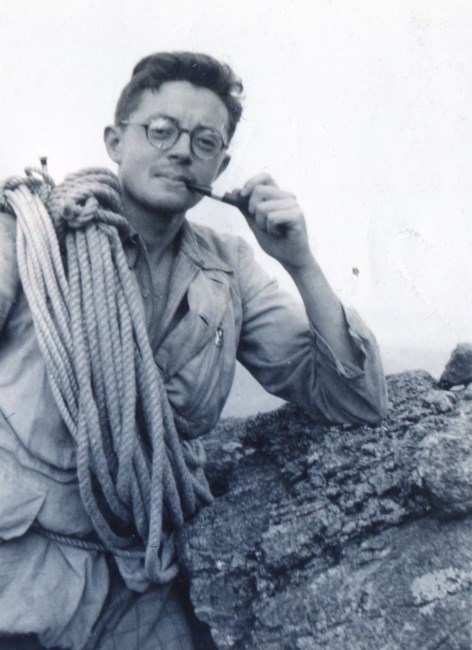
Dr. Richard Butson, GC, OMM, CD, OSTJ, PhD, MD
Richard Butson, who has died aged 92, was awarded the George Cross for saving the life a fellow member of a research expedition who fell into a crevasse in the Antarctic in 1947.
The Falkland Islands Dependencies Survey (FIDS) originated in 1943 when an expedition left Britain to establish Antarctic bases on Deception Island in the South Shetlands and on Goudier Islet in Port Lockroy. After the end of the Second World War, responsibility for the expeditions was transferred from the Admiralty to the Colonial Office.
In 1947, FIDS, under the leadership of Major Butler, drew up a programme with the United States Ronne Antarctic Expedition (RARE), under Commander Ronne, for their joint cooperation during the sledging season. To provide better weather forecasting for the long exploratory and survey flight Cdr Ronne intended to make, two meteorological stations were set up: one at an altitude of 5,600ft on the Graham Land plateau, north-east of Stonington Island; the other on the shelf ice off a point shown on some charts as Cape Keeler.
During July, the RARE planned to sledge supplies to the base on Graham Land. The first attempt was unsuccessful and, on the evening of July 26, two men were left on the plateau at 4,700 ft while the rest of their party returned for fresh supplies. Bad weather set in, their tent was damaged and, while returning to base on foot, Peterson, an American, fell into a deep crevasse.
His companion marked the spot and walked the six miles back to base, arriving alone in the dark. Teams from both camps were sent to the rescue, but the hazards of crossing a heavily crevassed glacier were greatly increased by darkness. Fortunately, it was a clear night with a full moon – the only night like that for several days – and at 4am on the morning of July 27 they found the crevasse into which Peterson had fallen.
Butson, the FIDS medical officer, immediately volunteered to be lowered into the crevasse. He found Peterson 106ft down suffering from shock and exhaustion, but conscious. The tapered sides of the crevasse had broken his fall; otherwise he would have been killed. The American’s pelvis and legs were trapped in the lower, narrow part of the crack. To try to free them, Butson had to work head down, and he got stuck several times.
At this point the two men heard a loud noise and the sound of cracking, warning them that several million tons of ice were on the move. Butson felt the crevasse narrow by about half an inch on either side of his chest, but he managed to extricate himself and tried to work faster.
For nearly an hour, in an extremely confined space, he chipped the ice away until he was able to free Peterson. The American was not seriously injured, so Butson placed a rope sling under his thigh and called to the men above to pull. Peterson suddenly became dislodged and shot upwards to the surface, where he was quickly put inside a tent.
The rope was lowered again and the equipment hauled up, followed by Butson, who rendered the necessary medical aid to Peterson. At dawn, the party returned to base, carrying the American on one of the sledges. Peterson recovered after a few weeks’ rest.
Butson was invested with the Albert Medal by King George VI at Buckingham Palace on November 2 1948. After the Albert Medal was revoked by royal warrant, he was reinvested with the George Cross in July 1972.
Arthur Richard Cecil Butson, always known as Dick, was born to British parents on October 24 1922 in Hankow, China. He was educated at Leighton Park School at Reading, then Cambridge University and University College Hospital, where he took an MB, BChir, graduating in 1945.
During the air raids on London, Butson served in the Home Guard and the light rescue squad. From 1946 to 1949 he was a medical officer to the FIDS, the British government sponsored expedition to the Antarctic. The expedition, which included Kevin Walton among its members, discovered a route for dog teams over the 5,000ft high mountains of the Graham Land Peninsular and surveyed the last 1,000 miles of the most inaccessible coastline in the world.
Butson pursued his postgraduate studies in surgery until 1952, when he emigrated to Canada. The following year he settled at Hamilton, Ontario, where he practised as a surgeon. In 1970, with the establishment of the McMaster University Medical School, he joined the faculty part-time, eventually being appointed clinical professor in the department of surgery. For two years Butson was chief of staff of St Joseph’s hospital in Hamilton, a 600-bed teaching hospital, where he was head of general surgery for many years.
In 1956 Butson joined the Canadian Militia as medical officer to the Royal Hamilton Light Infantry Regiment, later transferring to Hamilton’s Militia Medical Company as commanding officer with the rank of lieutenant colonel. During his command, the unit twice won the trophy for the best militia medical unit in Canada.
Butson qualified as a parachutist at the age of 55. One winter, he commanded a Canadian field surgical team on a Norwegian Army field hospital exercise.
Butson was president of the Defence Medical Association of Canada and for four years represented Canada in medical matters on the Nato Reserve Officers Association. In 1977 he was appointed honorary surgeon to the Queen, and in 1982 an officer of the Order of Military Merit of Canada. He was awarded the Polar Medal for distinguished service in Antarctica.
A keen mountaineer, Butson climbed extensively in the Canadian Rockies, the Antarctic, the Alps and at Baffin Island. He also led a climbing expedition to the Hindu Kush in the Himalayas. On his farm near Hamilton, he raised Galloway breed cattle.
Dick Butson married first, in 1946, Joyce Scott Cowell. They had two children. He married secondly, in 1967, Eileen Callon, with whom he had a son.
Richard Butson, born October 24 1922, died March 24 2015.
As published in "The Times"
Colonel Richard Butson, GC
Doctor with a British Antarctic expedition who rescued a colleague trapped in a crevasse as the ice closed in
In the days of National Service, few were lucky enough to spend their time practising their chosen profession and hobby simultaneously. Dick Butson came by this privilege after being spotted climbing across the Bridge of Sighs over the river Cam. His Cambridge tutor, James Wordie, was a veteran of Shackleton’s trans-Antarctic expedition and was seeking an adventurous young doctor for the forthcoming Falkland Islands Dependencies survey of 1947-48.
Butson accepted the assignment, but was disappointed at how little his medical skills were put to the test. Only the frostbite of his colleagues and injuries to the huskies caused by fighting amoung themselves kept him busy. Yet an extraordinary feat of never and bravery awaited him.
Shortly after the expedition reached Marguerite Bay it was joined by a team from the American Ronne Antarctic Research Group. The US team was “dry” and co-operation became close when it was discovered the British expedition had a bar.
Two members of the US team were taking seismic readings 20 miles from the base camp on July 26, 1946, the middle of the Antarctic winter, when a violent storm blew away their tent. Immediate return to base was the only option for survival and one of the pair- a man named Peterson- fell through a crevasse bridge and became wedged 100 feet below. His companion marked the spot and hastened to the base camp for rescue. The British rescue team, including Butson, reached the crevasse at 4 am.
They found Peterson so tightly wedged in the crevasse that Butson could get to him on ropes only after removing some of his clothes. On finally reaching the trapped man, he had to cut him loose from his throat and in danger of throttling him. The casualty was still conscious but jammed head down with his shoulders across the gap and his chest compressed. Butson lifted him enough to free his shoulders and got two lifting slings under his thighs.
Cracking and booming noises were beginning to be heard from the surrounding glacier wall and Butson began to feel the increased pressure from movement of the ice. Having secured the slings around Peterson, he took an hour to chip away the ice still holding him before calling up for him to be pulled clear.
Peterson screamed as the haul from above began to drag him free, but he was abruptly released and shot upwards like a cork from a champagne bottle. Just as he was almost at the top of the crevasse it appeared that he could be about to slip out of the slings and fall back on to Butson, but the rescuers got their hands on him and dragged him to safety.
Having sustained only cuts and bruises, Peterson made a complete recovery yet never thanked Butson for his rescue. His mother was appreciative, however, and sent Butson food parcels, even vainly suggesting that he might marry her daughter.
He was awarded the Albert Medal for his courage. In 1971 a royal warrant provided for all 64 surviving holders of the Albert Medal to receive the George Cross. The latter had been instituted by King George VI in 1940 for “acts of most conspicuous courage of extreme danger.” He received his George Cross from the Queen in July 1972.
Arthur Richard Cecil Butson was born in Hankow, China, where his father was working as a consultant engineer, in 1922. His mother, Doris Stanton-Cook, was an artist. As an eight-year-old, Butson had the distressing experience of witnessing the decapitation of a Chinese felon in the street. But his adventures had scarcely begun.
In his final year at school in Reading, he joined his parents who had gone to the south of France for the 1940 Easter holiday. Following the German advance into the Netherlands, Belgium and Northern France in early May, the family joined a milling mass of British subjects at Cannes searching for a passage to England. Two British colliers, coal-carrying cargo ships were put at their disposal and on June 18 some 400 evacuees boarded each vessel.
Butson, then 17, was allocated a 6 ft. x 2 ft. space in the hold of the SS Ashcrest. Only one mug of tea was provided to the evacuees during the two-day voyage to Gibraltar but Butson had his first glimpse of war.
The Ashcrest was challenged off the Balearic islands by an Italian submarine. Two torpedoes missed but the submarine surfaced and began to shell the collier. She replied with her single armament of one 4in gun and the submarine rolled over and disappeared. The voyage continued in an atmosphere of mounting hysteria, a situation worsened for Butson when he was put in charge of a delirious young French woman suffering from pulmonary tuberculosis. Butson struggled to calm his hysterical patient. They reached England after 12 days at sea.
During the Second World War he served in the Home Guard while continuing his medical studies at Cambridge. During the year he subsequently spent in the Antarctic, the expedition found a route suitable for dog teams over the 5,000-ft. Grahamland Peninsula and surveyed 1,000 miles of previously unmapped coastline.
In 1956 he emigrated to Canada to work at a hospital in Montreal and also joined the Canadian Militia (Reserve) Forces.
He met his wife, Eileen Callon, while she was working as a nurse in Hamilton. They were married in 1967. Their son Andrew followed his father into the militia. Their daughters Sarah and Caroline are respectively, a psychologist and an artist. His wife and children survive him.
He was an honorary surgeon to the Queen in Canada between 1977 and 1979. In the late 1980’s the ridge between the McClary and North-East Glaciers in Antarctica was named “Butson Ridge” in his honour.
Colonel Richard Butson, GC, doctor, was born on October 24, 1922. He died on March 24, 2015, aged 92.
As Published in "The Hamilton Spectator"
Dr. Arthur Richard "Dick" Butson was an adventurer, a surgeon, a militia commanding officer, a provincial election candidate and an avid cattle breeder but he is most remembered for a harrowing act of bravery at the bottom of the world 70 years ago.
Butson was a medical officer in the Antarctic in July 1947 with the British sponsored Falkland Islands Dependencies Survey when he received word that an American surveyor had fallen into a crevasse.
The man was wedged more than 30 metres below the surface, and was suffering from shock and exhaustion. Butson quickly volunteered to be lowered in a harness and spent more than an hour breaking ice away to free the man.
Amid "loud cracks and booming noises from the glacier's movement ... I pulled his shoulders around so that freed his chest a little. I was then able to get two slings under his thighs," Butson once told an interviewer about the rescue.
After Butson managed to free the man, "he suddenly shot up from the wedged position like a cork out of a champagne bottle" and from there he safely made it to the surface where rescue personnel were waiting.
For his heroism, Butson — who died March 24, at the age of 92 — received the Albert Medal from King George VI at Buckingham Palace on Nov. 2 1948. The Albert Medal was years later replaced by the George Cross, and Butson was reinvested with the George Cross in July 1972.
The cross is the highest gallantry award for civilians and military personnel for actions which are not in the face of the enemy.
And while the rescue received widespread accolades, the man who was saved from the bottom of the crevasse apparently never thanked Butson.
"Dick told that to me one night in the officer's mess when he was signing copies of his book," said retired Royal Hamilton Light Infantry captain and historian Tim Fletcher. "(The rescued man's) mother was very grateful and tried to marry her daughter to him except of course he was already married. But the guy who was rescued never said thanks at the time or later, for whatever reason."
Butson joined the RHLI in 1956 as a medical officer before being made commanding officer of the 23 Hamilton Medical Company (now called 23 Field Ambulance) where he served as commanding officer.
George Frid, a former lieutenant-colonel of the RHLI, said "Dick never flaunted the recognition he well deserved." And he was never daunted by hard work.
Peter Young, honorary lieutenant-colonel of the RHLI, said, "He was always down to earth and treated all ranks well ... He had a great sense of humour and was a wonderful story teller ... He didn't brag about himself but, when asked he was able to tell his story in such a way that you could picture yourself right there with him."
Butson was born to British parents in Hankow, China. In the United Kingdom, he attended high school, Cambridge University and University College Hospital, graduating as a physician in 1945.
He took part in the Antarctic expedition from 1946 to 1948, which among other things found a route for dog teams over the 1,500-metre mountains of the Graham Land Peninsular and surveyed the last 1,600 kilometres of the most inaccessible coastline in the world.
After this he immersed himself in graduate studies moving to Canada in 1952, settling in Hamilton the next year.
In 1970 he joined the newly established McMaster University Medical School, eventually becoming a clinical professor in the department of surgery. For two years Butson was chief of staff of St Joseph's hospital in Hamilton, where he was head of general surgery for many years.
Another one of his passions that he carried into his retirement years was raising Belted Galloway cattle on his Ancaster farm.
"When not in his uniform or hospital scrubs he would be at his farm in rubber boots and work clothes doing the most menial of chores caring for his animals," Frid said.
"When my children were very young we would visit Dick and Eileen at the farm ... (I remember) when one of his cows got loose and ended up in their swimming pool. I'm not sure how it got out."
Butson also ran for office for the upstart Ontario Provincial Confederation of Regions Party in the 2003 election in the riding of Ancaster-Dundas-Flamborough-Aldershot. He received less than 300 votes.
Rick Butson says his dad was attracted to the party — that was against government bilingualism policies among other things — because of dissatisfaction with mainstream parties.
"I don't think he felt the government was being very responsible with taxpayers' money and was wasting a lot of it on these pet projects and special interest projects that really weren't the benefit of most of the population."
Butson is also survived by his wife Eileen and daughters Sarah and Caroline.
Eulogy as Presented at Holy Trinity Anglican Church
When I was young, I remember my Dad would challenge me to improve. “Too tough for you, just right for me,” he would joke. But that was really how dad lived his life.
I recall a story of Dad taking the Canadian Forces basic parachutist course, as one of the oldest members to take this physically demanding course, dad would finish the training for the day and take his evenings and weekends to go skiing while his younger peers would recover in quarters. Getting out in the mountains climbing or skiing was a passion for dad. His photo albums are filled with photos of exotic scenery and summits. Giving up skiing in his 80s was a sad day for dad who finally had to admit his balance wasn't up to skiing anymore. However, he carried on with scenic walks into his late 80s and would often be seen on his daily trek up and down the Niagara escarpment stairs down the street from home.
Dad’s photo albums are like a tour of the world that can captivate a viewer with the diversity of remote locations visited during his life. Early in life dad visited the Antarctic, where he developed a love of penguins which made for easy birthday and Christmas shopping, and late in life he toured Canada’s Arctic with a close friend. In between it seems as though his passion was to hit all the best spots in between. For Dad, life was for living and was an adventure to be experienced.
Adventure was something Dad certainly experienced. It is well known that he was awarded the George Cross for valiantly saving the life of an American who had fallen and become wedged in a crevasse in the Antarctic. Dad would refer to this as experience rather modestly as, “in the middle of the night, in the middle of the winter, in the middle of the Antarctic.” However anyone who was fortunate enough to know Dad well would have also heard other stories of his eventful life, such as witnessing the Chinese revolution as a boy, or being torpedoed by a German submarine while escaping Nazi Germany on a coal boat. The kind of stories that would be unbelievable if told by someone else.
Perhaps his experience so close to tyranny was a factor that motivated Dad to value service of his country through the Army Reserves. Whether with the home guard as a student in London during the war, the Royal Hamilton Light Infantry, The 23 Hamilton Service Battalion or the 23 Hamilton Medical Company, Dad would give his time to serving Queen and country. Others will recall Dad’s service based on his accomplishments such as being appointed Queen’s Honourary Surgeon or being appointed Honourary Colonel to 23 Hamilton Medical Company, something he was very proud of. However my recollections are of a childhood surrounded by the distinguished members of these units; either colouring at an orderly room desk, attending a Church parade or stumbling across a camouflaged soldier walking at our farm. Members of the military were more than friends they were, and are, our family.
For most people a challenging and distinguished career in medicine, travel and serving in the reserves would keep them pretty busy. Possibly taking up some golf to relax would round things out nicely. However, for dad, a few rounds of golf were too sedentary. For a hobby Dad thought he would take up raising cattle. Harvesting feed and putting several thousand bales of hay in a barn, tattooing cattle, and putting up many miles of fencing seems to have struck dad as a great way to kill a few hours after work. Naturally a good option was to recruit any family available to help with these tasks, something he happily did. I can recall many days at my dad’s side, shivering in the cold feeding cattle or fixing fences by the light of car headlights. Dad was of the opinion that taking breaks was for after work was done, so an average night when hay was being brought in might end at 10pm when we could have some dinner. I remember in my teens getting up my courage late one afternoon at the farm; I told Dad I was taking the car so I could get something for lunch. He looked up surprised, as though it had never occurred to him that others got hungry at lunch time, nodded and told me not to take too long. It wasn’t until much later in life that I learned to appreciate the value of this time spent with my dad. My time at the farm was more than work, it was my Dad’s way of teaching me about hard work and work ethic, a lesson I carry with me to this day.
Later in life I would poke fun at my dad, “too tough for you, just right for me” I would say. The truth of the matter, however, is that Dad was tougher than most. Even in his last years confined to a bed he was more alert and complained less than most people. He continued to live every day of his life to the fullest right up to his last. Dad was a mentor and example to his children, he taught us the value of life and to aim to be the best people we could be. I'm proud to be his son.
* * * * * * * * * *
BUTSON, Dr. Arthur Richard, GC, OMM, CD, OSTJ, PhD, MD
Passed away at home on Tuesday, March 24, 2015 with his wife by his side in his 93rd year. Beloved husband of Eileen and loving father of Sarah, Caroline and Richard. Proud grandfather of Hannah. Dr. Butson served as Chief of Surgery at St. Joseph’s Hospital and was a former Commanding Officer of the 23 Hamilton Medical Company. He was an avid breeder of Belted Galloway cattle. Dr. Butson had a passion for adventure and exploring the world; he lived his life to the fullest. Friends and family may call at CRESMOUNT FUNERAL HOME – FENNELL CHAPEL, 322 Fennell Avenue East, Hamilton on Sunday, March 29, 2015 from 2-4 and 7-9 p.m. The funeral service will be held at Holy Trinity Anglican Church, 120 Fennell Avenue East on Monday, March 30, 2015 at 11 a.m. A private family interment will follow at Spring Creek Cemetery, Mississauga. Memorial Donations may be made to the Scott Polar Research Institute, the Royal Hamilton Light Infantry, or the United Way.
Show your support
Add a Memory
Share Obituary
Get Reminders
Services
SHARE OBITUARYSHARE
- GET REMINDERS
v.1.18.0