AVIS DE DÉCÈS
Sydney Gamage Nanayakkara
21 septembre 1934 – 5 avril 2025
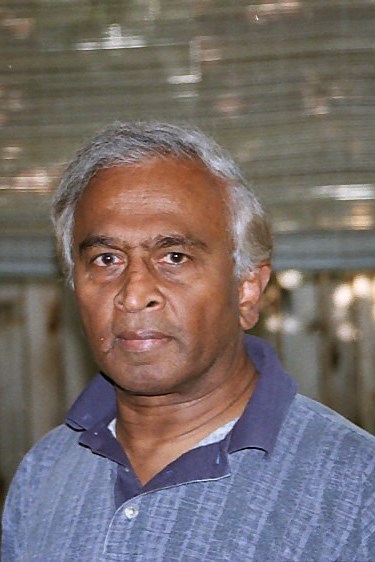
Sydney Nanayakkara passed away peacefully at the age of 90, closing a remarkable chapter of strength, intellect, and enduring love. He is survived by his former wife, Needra; his children, Chevan (with wife Gabi) and Nilanthi (with husband Michael); and his cherished granddaughter, Liana, with whom he shared a bond so deep it seemed to defy time. He is also survived by his brother Leslie (with wife Priya), their daughter Dholani (with husband Chatura), and grandson Daivik—all of whom live in Salt Lake City. His siblings Ayoma, Sybil, and Basil remain in Sri Lanka. Needra’s sisters—Nali, Naomi, and Shirani—were also an important and loving part of the family’s extended circle. Their connection will echo across generations.
Born in Galle, Sri Lanka in 1934, Sydney’s life began in modest surroundings but with boundless inner drive. From an early age, he was defined by insatiable curiosity, mechanical brilliance, and quiet integrity. He had a deep love of puzzles, fueled by his engineer’s mind—finding joy not just in solving them, but in creating them. The Rubik’s Cube was a favorite, and he even invented a few puzzles of his own. He delighted in the elegant challenge of pattern and structure, and could fix or build almost anything, often guided only by his intuition.
On May 6, 1962, Sydney left Sri Lanka for the United Kingdom to pursue higher education. He attended the prestigious Imperial College London, where he studied electrical engineering with devotion and earned credentials from the Institution of Electrical Engineers (IEE). It was the start of a lifelong commitment to innovation, excellence, and the belief that building and learning are sacred acts.
In 1972, Sydney married Needra. After several years in London, the couple made a bold and unlikely move to Salt Lake City, Utah—a place far from their Buddhist roots but full of promise. It was a leap of faith taken with humility and determination. In 1989, Sydney became a U.S. citizen, a moment he embraced with pride and reverence—one of the true highlights of his life.
Professionally, Sydney began as an electrical engineer at Kenway, and his career spanned several of Utah’s most pioneering institutions: the University of Utah Chemistry Lab, where he formed lifelong friendships; the Utah Innovation Center; Evans & Sutherland; and finally, the aerospace and communications leader L3. He retired in 2006, having contributed with quiet strength and deep insight to the intellectual and technical fabric of his adopted home.
With Needra, he also purchased and built the Montessori School of Salt Lake—an institution that still stands today as a living testament to their shared belief in education, community, and the power of nurturing young minds.
Yet Sydney’s truest identity lay beyond titles or roles. He was a man of service—strong in body, gifted in mind, and grounded in a deep instinct to help. His service-oriented spirit extended to friends, neighbors, family, and strangers alike. If he could help, he did—often without being asked, always without seeking credit. It brought him joy simply to be useful.
In his later years, he became a devoted volunteer at St. Mark’s Hospital and helped quietly shape a Sri Lankan cultural presence in Salt Lake City simply by being who he was.
Tennis was his lifelong passion—both as a player and as an ardent fan. Two moments stand out: watching Arthur Ashe play at Wimbledon in the 1960s, before the advent of tie-breaks when games stretched into double digits; and witnessing Andre Agassi’s final match against Roger Federer at the 2006 U.S. Open. These memories echoed the grace and quiet intensity of his own life.
Sydney was also an avid ham radio operator, known by the call sign N7RJS. In that global community, he will be remembered as a “silent key”—a final sign-off for those whose voices once traveled the airwaves with care and connection. 73, N7RJS.
To his son, Sydney embodied and modeled what America means at its best: freedom, civic service, and the beauty of plurality. To Sydney, plurality meant the dignity of difference—the richness of cultures, beliefs, and perspectives coexisting in mutual respect. These weren’t just abstract ideals. They were lived values, passed down through quiet consistency. Father and son shared a deep love for what the United States represents—not just to them, but to the world. That love is among the most meaningful legacies he leaves behind.
Sydney came farther in life than he ever dreamed—and likely farther than he ever fully recognized. His was not a story of spectacle, but of steady impact, deep integrity, and enduring wonder. His kindness touched every person he met. His spirit leaves a space that cannot be filled—but it will continue to guide, uplift, and live on through the lives he touched.
In every way that mattered, Sydney Nanayakkara was a builder—not just of machines or institutions, but of relationships, communities, and meaning. He was radiant in both personality and belief, and the warmth of that radiance continues in all who knew him. In the 1980s, the Sri Lankan community in Salt Lake City was very small, but Sydney's presence, generosity, and quiet leadership gave it an outsized sense of belonging, cohesion, and pride. His influence was felt deeply and widely—even by those who had only just arrived. He will be lovingly remembered by many names: Sydney, “Syd”, “Grampa”, "Sydney Aya" (Sri Lankan for older brother both in age and respect), “Uncle" (a title in Asian culture used with reverence and affection), “Seeya" (Sri Lankan for grandfather)—but for us, he was just, and always will be, Dad.
Montrez votre soutien
Envoyez Vos
Condoléances
Partager
L'avis De Décès
Obtenir les mises à jour
Prestations de Service
Partager l'avis de décèsPARTAGER
- RECEVOIR DES RAPPELS
v.1.18.0