
OBITUARY
Antonio Esmeraldo Homem
October 13, 1939 – March 24, 2026
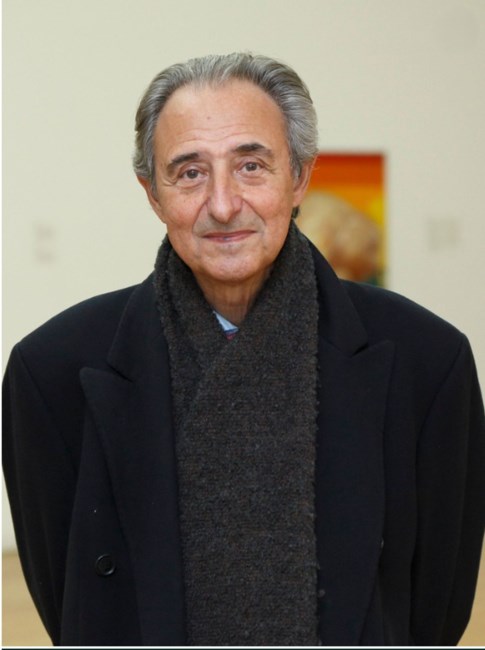
Erudite to his fingertips, kind, generous, and eternally curious, Homem was, from the time he joined the gallery in Paris in 1968, its rudder. Arnold Lehman, director emeritus of the Brooklyn Museum of Art, whose friendship with Homem began at that time, called him an “irreplaceable figure in the art world. As consigliere to the great gallerist Ileana Sonnabend for forty years, his quiet but profound impact on contemporary art of the second half of the twentieth century, while unmarked, is indelible.”
Indeed, Ileana and Antonio — as everyone knew them — formed an inseparable unit, promoting and supporting U.S. and European avant-garde art by the newest and, to their minds, most challenging artists. It was that thrill of discovery that drove them, just as it drove the artists they championed who now form part of the Sonnabend Collection: Robert Rauschenberg, Jasper Johns, Jim Dine, Roy Lichtenstein, Andy Warhol, Bruce Nauman, Dan Flavin, Mel Bochner, Gilbert & George, Anselm Kiefer, Sol LeWitt, Mario Merz, Vito Acconci, John Baldessari, Bernd and Hilla Becher, to name just a few.
Jeff Koons credited Antonio and Ileana with quite literally changing his life with their “unconditional love” and material support at a critical early period of his work in the 1980s. But he admitted that attention wasn’t an exception; the pair gave unequivocal support to all the artists in their stable. Jim Dine said of Antonio in particular, “He was the nicest person in the virulent art world. I loved him like a brother in the 60s.”
The regard for artists on Homem’s part was as deep as it was genuine. “My father, Antonio, loved working with the artists of the Sonnabend Gallery and the Sonnabend Collection Foundation,” said Phokion Potamianos Homem. “He was deeply immersed in his appreciation for art in all its forms—whether Classical, Renaissance, Belle Époque,
Modern, or Contemporary. For him, every period was grist for the mill, fuelling his understanding of art’s progression and its historical references—a passion he shared with everyone he knew.”
Mr. Homem—Antonio—thought of the art collection that he and Ileana built as an autobiography, or a picture album of their lives. In 2025, he created a home for that collection in Mantova, Italy, in the thirteenth-century Palazzo della Ragione. “The Sonnabend Collection at Mantova was the culmination of this vision,” said Potamianos Homem, “reflecting the lifelong dialogue he, Ileana, and Michael Sonnabend shared with the artists who defined the gallery.”
Antonio was born in October 1939 in Lisbon, the only son of an upper-class Portuguese family of lawyers and religious zealots whose beliefs ran the gamut from doctrinaire Christianity to spiritualism. Antonio was interested in neither the law nor the spirits—except as intellectual concepts. What did interest him were books, and it was there that he discovered art.
As a child, he said, it was the story the works told that fascinated him. At first, his interest tended toward Surrealism—the kinds of fantastical images a boy might escape into. Then his father took him to a 1954 exhibition of American art in Paris where he saw Edward Hopper paintings, including the 1939 work New York Movie. “I was amazed to see such themes treated in a painting. I could not imagine an auto being the subject of a painting and also not a movie house or an usherette,” he recalled. “I think that was my first step toward the American Pop Art I saw ten years later.”
Art did not figure in Antonio’s parents’ plans for him. His father wanted him to work as a chemical engineer in Switzerland, and so the seventeen-year-old enrolled in the ETH in Zürich for a course of studies that did not suit him. Serendipitously, the apartment he soon took in that city was above a gallery run by a young Bruno Bischofberger. Antonio began spending time there and volunteered as an unpaid assistant.
In the early summer of 1965, when Bischofberger opened an exhibition of Pop Art on loan from a gallery in Paris, Antonio became part of the festivities. “For me it was a rather glamorous event,” he recalled. “Roy Lichtenstein was there with his girlfriend
wearing a dress made in fabric designed by him. There were American gallerists from New York and several European artists.”
Seated at the end of a table during the opening dinner was a small, unglamorous older woman introduced to him by the Italian dealer Gian Enzo Sperone. She introduced herself in French: Ileana Sonnabend. Antonio soon realized that this was the same woman whose artists he had seen on the gallery walls—and whose role in Robert Rauschenberg’s Venice Biennale success had stirred controversy.
Ileana invited Antonio to Paris. Though he was married with a young son, his path toward a life in art was set. After personal upheaval, he arrived at the Sonnabend Gallery in Paris in 1966, and in 1968 he formally joined the gallery, where he would remain for the rest of his career.
It was not until 1971, when the gallery moved to New York and opened in SoHo at 420 West Broadway, that Antonio’s influence became fully apparent. He championed artists whose work was often unsellable but, in his view, essential. “We would do things just for the excitement of doing them,” he said. “Actually, both Michael and Leo always said, ‘Why are you doing this? There’s nothing to sell!’” What mattered most was whether the work was interesting.
Antonio considered the gallery his home; where he slept was immaterial. He eventually lived with Michael and Ileana Sonnabend, becoming family in all but biology. In 1986, they formally adopted him. “He’s been our son for a long time,” Michael Sonnabend said.
As the art world increasingly became defined by the market, Homem remained committed to artistic value over commercial success. The Sonnabend Collection—built through decades of dedication—became one of the most significant collections of contemporary art, though it was not widely recognized as such until the late 1980s.
Reflecting on their shared life, Antonio said: “Whatever happened always seemed to me less important than what we all were.”
On learning of his death, Gilbert & George wrote: “Goodbye, our dear lovely Antonio… We miss him very much, especially his laugh.”
Antonio Homem is survived by his son, Phokion Potamianos Homem; his daughter-in-law, Liz Anne Potamianos Homem; and his granddaughter, Chloe Potamianos Homem.
Show your support
Add a Memory
Share Obituary
Get Reminders
Services
SHARE OBITUARYSHARE
- GET REMINDERS
v.1.18.0