
AVIS DE DÉCÈS
Linda H. Leibel
7 décembre 1925 – 28 novembre 2013
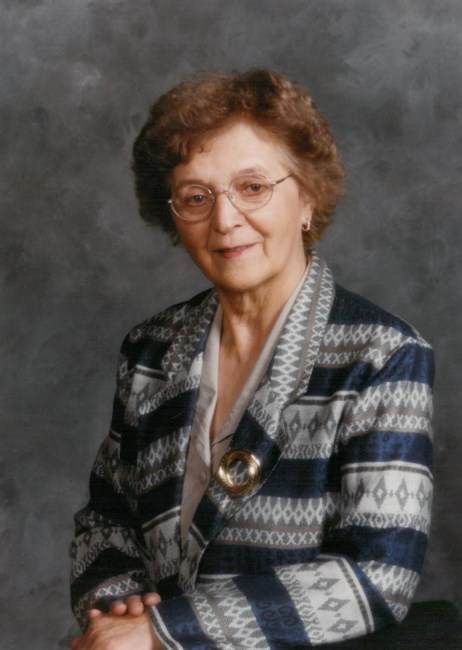
If Linda Helen Leibel’s life can be described as a play, her first act, of course, would be her birth. She was born to Anton and Anastasia Materi, in Macklin, Saskatchewan. Her birth date was December 7th, 1925. The total number of siblings that she would eventually have would be thirteen. Linda was a middle child.
As a girl, Linda was involved primarily in domestic activities. She would help care for the younger children, prepare meals, water and weed the garden, feed the chickens, gather eggs, tend the wood stove, cook and houseclean. These duties would prepare her for the upcoming drama of her life. Later in life, she played the role of waitress in a small diner, live-in-nanny and housekeeper for a doctor’s family, and finally, a Nurse’s Aide in three Battleford hospitals. Her primary roles however, were to be a wife to Philip Leibel, and a mother of four: Patsy, Willy, Ivy and Donna. Because Linda played so many care-taking roles in her life, perhaps it is somewhat safe to say that she very often placed herself in a secondary role, perhaps even, to her detriment at times--a number of times actually. And perhaps, maybe it can be said, that at times, Linda was of two minds about whether she was ever able to put herself first in order to be more kind to her self--namely, to feel more like it was okay to enjoy the fruits of her own labours.
When Linda recalled various scenes from her childhood, one of the most cited stories was about being almost struck by lightning. While standing near the phone in the farm kitchen, Linda witnessed a bolt of lightning come through one of the three vent holes in the wooden frame of a storm window. The lightning circled her and the kitchen, making its way to the manually rung phone hanging on the wall. After destroying the phone, the lightning snaked its way back out of the room, following the same route it had come in by. Perhaps an accident such as this can help explain the constant anxiety that plagued Linda throughout her life. Later, having the family home on the farm burn down because of another lightning storm surely didn’t help her nervous anxiety; Linda’s wedding gifts, stored in her parents’ attic, all went up in smoke. Once again, if Linda’s life can be used as a kind of teaching model to those who are coming up behind her in their roles in life, no doubt it can be said of Linda that she was a survivor; hopefully, however, she was more able than not to find a balance--between a fear of the future--and an ability to find enjoyment in the small, precious, carefree moments that life can hand to us in the present--if we are aware that they are there.--And, also, if we can believe or know, that we deserve to have happiness in our lives too--that it is o.k. to have others treat or serve us once in a while, as opposed to always being the server.--Not that it’s not okay to be a server--just look at Mother Theresa.
Linda’s parents, Anton and Anastasia, were extraordinary people, extremely hardworking, and possessing a strong faith that would pull them through incredible pain, such as the deaths of two infants, and now, besides two homes--a barn-- that also would be destroyed by fire. As Anastasia came out the door from Mass one Sunday morning, someone called out to her and Anton that the Materi barn, seen in the far distance, was on fire. “Mom”, Linda recalls, “was crying, and Dad was trying to get everyone into the buggy as quick as possible, so he could get home and put the fire out.” Perhaps an unfortunate incident such as this, now one of many, can help explain how Linda learned to withstand future brutal hardships.
Linda loved the geese on the farm, as they paraded here and there, honking up a storm. She loved the strong, hard-working team of horses that pulled the wooden Box-Sleigh with the large, heated, blanket-covered rock; the sleigh was how the children went to school in the winter. In the summer, one of the boys would drive the children to school in the buggy, and then quickly water the horses and tether them in the pasture before he entered the one-roomed schoolhouse.
Linda remembered her Roger’s Syrup pail with much fondness; the pail carried her lunch-- maybe a piece of fresh bread with butter and jam, and maybe a hard-boiled egg from the eggs that she had helped collect earlier that morning. She loved the giant, stubborn oxen who escaped horseflies on a sweltering hot day after plowing the fields, by immersing themselves, neck deep, in the muddy slough. Linda especially loved recalling with her brother, in her last hospital stay in her final days, the red metal incubator that was brought into the living-room in the winter to hatch baby chicks--and the time that a piglet had to be brought into the kitchen in a baby blanket and held by the big warm wood-burning stove till it was warm.
Linda loved when neighbors randomly dropped in to visit and play cards; often they would bring a small cake with them to share. She remembered listening to the news on the big battery operated radio, and related that her mother once told them that she had heard on the radio when she was a young woman, about how a ship called the Titanic sank, and several lives were lost by drowning. She was proud when she recalled how her father raised pigs to supply “Bacon for Britain” during World War II, where her oldest brother was fighting--the same place he would later come home from, with a beautiful English war bride at his side. Later in life, Linda loved looking at the picture she took, of a brother, when he was very young. Linda’s little brother and her mother are holding hands. Linda’s mother is dressed in a lovely ankle-length coat, wearing a pretty hat and shoes. He is dressed in a miniature military suit and is giving a very smart salute. Together, they are waiting for the oldest brother and his new wife to come home from the war. Linda recalled proudly how it was she who had bought the miniature uniform for little brother to greet his older sibling.
Linda was also proud of her father, Anton, for being one of the first farmers in the area to plant a wind-break of Caragana bushes so that the soil in the fields wouldn’t blow away in the frequent windstorms. And whenever she saw a blue, lacy, Hydrangea flower, Linda would say that she remembered that Anastasia had one just like it in her lace-draped kitchen window.
When Linda met Phil, before they married and finally settled in Battleford, Linda’s brother Frank recalls Phil coming to court Linda from Phil’s family’s farm down the road. Phil was in a two-horse-team buggy. Later, Phil would call on Linda in a much more modern contrivance--a two-door black Plymouth coupe. One of Linda’s favorite memories around this time--when Linda was taking Home Economic courses at Kelsey College, and Phil was simultaneously taking courses in Electronics, paid for by the army because of Phil’s service in the War--was taking in a movie in Saskatoon on Broadway: “Gone with the Wind”. The two young people couldn’t afford the 25 cent popcorn, but that didn’t matter; they had each other.
Linda often recalled how Phil took on a series of jobs after the war in various small towns, (Luseland, Sylvan Lake, Macklin, Wilkie), and being very independent-minded--moving from one job to another if he didn’t like the job, or the boss. She followed him, anxiously no doubt, worried about their financial state, especially since they now had a young daughter, Patsy. Still, Linda was proud of her husband’s independent nature and strong convictions.
At this stage of her life, having settled in the beautiful little town of Battleford, Linda now had a home of her own. Phil, and some of Linda’s brothers, dug the basement, and then constructed the home with their own hands. Linda started a vegetable garden, and grew hollyhocks and dahlias and cosmos for their pleasing beauty. Sometimes, to her delight, delphiniums would jump the neighbor’s fence and plant themselves wherever they pleased. Linda’s next three children entered the scene, and like Linda’s flowers, they grew and excelled in their various arenas. She was proud of their accomplishments, instilling in them her love of music. As a child on the farm, she and her brothers and sisters played a variety of instruments: Linda played the mouth organ, others strummed guitars and played accordions, and some sang. Linda’s husband and brother played in a polka band, touring here and there, playing at various functions. Early on, on occasion, Linda would sing in the band, being partial to Wilf Carter and Patsy Cline songs.
For a time, at her children’s school, St.Vital, Linda took minutes at the P.T.A. meetings. She helped lay the linoleum-tile floor in the school auditorium with her husband and another couple. She bravely cheered on her husband in his and her passionate and successful roles in bringing Tommy Douglas to power. And she took on the role of Nurse’s Aide to help supplement the family’s income; music lessons for four children didn’t come cheap. Linda’s life was full, and often exhausting.
Linda’s husband died at the age of 64, just short of retirement age. Before he died Phil and Linda travelled to California; Lawrence Welk’s ranch was a highlight. They travelled to Alaska on a small Princess cruise boat. They went on the trip of a lifetime in a group tour in Europe. It was on this trip that Phil began showing signs of a serious illness, namely cancer. Throughout Phil’s illness Linda continued to work as a Nurse’s Aide while at the same time nursing her husband. Two weeks before Phil’s death, one of Linda’s sons-in-law was injured at work and was left a paraplegic, albeit a very brave one, with two very young daughters left to be cared for by Linda and her daughter. A few months later, Linda’s mother, Anastasia died, Anton having died several years before. Because of Linda’s fortitude and religious faith, she persevered. Sometimes it was all she could do simply to put one foot in front of the other.
Linda retired from her position as Nurse’s Aide soon after her husband’s passing. For nearly 30 years, Linda lived at home by herself. Her children helped whenever and however, they could.
A total of 6 grandchildren now were to take their parts in the latter scenes of Linda’s life story. When they came into her life, along with all their furry, four-legged siblings—namely their
pets--they brought her much distraction and joy--on her life’s stage that was losing more and more of Linda’s fellow actors. However, the part played by Tragedy did not want to exit Linda’s stage just yet.
A few days before Christmas, 1996, Linda was crossing a road on the way to her son’s home for Christmas dinner; she was struck down on an icy road at dusk. It was snowing fairly heavily. Linda had been driven over by a small truck that could not stop in time in order to miss the shadowy figure crossing the road--a very dramatic scene played out on the driver’s life’s stage that now contained a strong element of tragedy written out in his script. Linda was immediately attended to by volunteer firemen, who were, fortuitously nearby. She was also attended to by patrons at the Queen’s Hotel pub. A doctor, in a nearby home, also came to her aid. All these “angels” lifted the truck from her broken body.
Linda was rushed to hospital in Saskatoon where she would have to endure several operations. Over four long months in a dark, harsh winter, Linda was confined to a narrow bed. With one leg pinned and unable to move, Linda often wondered if she would ever be able to walk again. She also wondered, “Why her?” Perhaps some might guffaw when one possible answer comes to mind: While in hospital Linda would pass the minutes, hours and days watching T.V. One of her favorite daily dramas was called The Young and Restless, a show whose writers fill their characters’ lives with tragedy, and whose players often do not seem to learn any life lessons arising from their misfortunes. A scenario similar to Linda’s arose matching Linda’s path almost step for step: Was it coincidence or otherwise when one of the T.V. show’s actor’s dilemmas matched Linda’s dilemma? The “actor’s” dilemma was: Does she forgive the driver who drove over her? Likewise with Linda: Was she to forgive the young man who had caused her so much pain by driving over her?
Did Linda make her compassionate choice to forgive her errant driver because that’s what the corresponding actor in the T.V. show did? Or, was she in any way influenced by watching the daily Mass broadcast every weekday immediately before The Y. and R.? The “Our Father” prayer comes to mind here, with its message of forgiveness. Linda was amazed by the curious timing and nature of how she was guided to “know” with such certainty: that she must forgive. It gave her much peace and seemed to bring some meaning to an otherwise senseless accident.
When she bravely took her first steps, Linda’s demeanor displayed evidence of an iron will. Her face’s profile showed that she was a Queen who could show her family and the public that she was a force to be reckoned with. She was a Queen who had come through the wars, even though she now walked with a pronounced limp.
And yet again, Tragedy took centre stage when ten years later Linda had a serious stroke. Grace rained down on her however, when she was “lucky” enough to receive a miraculous drug--a drug that pulled her back from the brink in a matter of minutes. How could a woman be so fortunate, and yet at the same time, so devastatingly unfortunate? No doubt Linda’s strength of character and strong faith helped pull her through.
As her final act approached, Linda moved back and forth between Saskatchewan and British Columbia so that could spend time with all her family more equally. In Saskatchewan two identical twin boys named Jack and Ben rambunctiously entered the scene in order to play out their beginning roles on Linda’s stage. The name of Linda’s latest role was called Great-Grandma.
In Linda’s final act, after a number of scenes played out against the backdrop of her lovely, ever evolving home and earthly Garden of Paradise, Linda discovered that she had cancer. As bravely as she could, she faced this awesome foe, who, years earlier, had taken her husband. She fought hard--brave warrior that she was--with her ever increasingly frail body. And yet she could still offer a sweet smile of gratefulness to all who came to visit and/or to care for her. At times one would witness her swollen fingers-- that could no longer grasp her delicate rosary beads-- entwine shakily, as she mouthed a resolved, silent prayer to Mary.
One can only wonder, in the long run of Linda’s play, if her suffering had some purpose. Of course there were some good times too, but surely not in proportion to the bad. Was her life then, to be seen, ultimately, as a tragedy? The answer is surely, NO. For in spite of the awful pain, one could feel, how?--impossible to explain--one could sense: the unconditional love seeping through in her final days: of a mother’s love for her children and husband: of a sister’s love for her siblings: of a child’s love for her parents: of a friend’s love for her friends. No amount of suffering was going to bring the curtain down on the unconditional love coming through, from the heart of such a noble human being.
(At this point in the church Eulogy, a somewhat shaky explanation was given for requesting that two of the Pallbearers be dressed as Voyageurs. Here is, hopefully, a less shaky one:
1. Linda’s grand-daughter and her husband, two of Linda’s Pallbearers, have a canoe business. Sometimes they teach about the life of the Voyageur.
2. A Voyageur has to be flexible. He has to be tough, both physically and mentally. He has
to switch back and forth from paddling, sometimes in heavy rapids--to portaging, often
over extremely difficult terrain, all while carrying a heavy canoe.
Perhaps Linda’s journey in life could be compared to that of a Voyageur’s journey.
3. Linda had never had a chance to ride in a canoe. Perhaps her short journey from the church to the grave to “Heaven” could be described as a canoe ride--the part of the journey when the Voyageur has to carry the canoe with its heavy load--the load being Linda’s life, when it was “heavy”. )
Montrez votre soutien
Envoyez Vos
Condoléances
Partager
L'avis De Décès
Obtenir les mises à jour
Prestations de Service
Partager l'avis de décèsPARTAGER
- RECEVOIR DES RAPPELS
v.1.18.0