
AVIS DE DÉCÈS
Erwin Hamilton
30 novembre 1924 – 20 octobre 2022
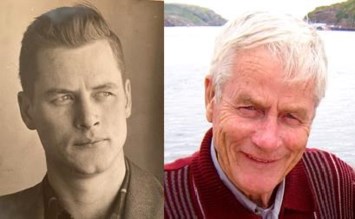
November 30, 1924 - October 20, 2022.
It is with sadness that we announce the passing of Erwin Chadsey Hamilton, resident of Saint-Anne de Bellevue, on October 20th, 2022, 40 days short of his 98th year. He was surrounded by his loving family to the end.
Erwin Hamilton was born November 30th, 1924 where he lived with his parents Ross Joyner Hamilton and Carrie Ruth Hamilton (Nee Scott) on Decarie Street in NDG. He is predeceased by his Siblings; Robert, Philip, his sister Harriet (Christie) and his beloved wife of 67 years, Dorothy Uda-May Hamilton (Nee Brown). Erwin was the father to Carol (Ralph), Douglas (Pamela), Robert, James (Liane) and John (Maureen), grandfather to Linda, Laura, Michael, Heather, Christopher, Sarah, Emily, Derek, Kenneth, and Laura Marie, and great-grandfather to Freya, Henry, Kate and Emily Ida.
His early years were typical of young men growing up in depression era cities. They made their own fun with sports, organized through the local gang of boys. An excellent athlete, Ewin excelled in Hockey, Tennis, football, water polo and his favorite, Baseball. He grew up playing with and against fabled heroes of the day such as Doug Harvey and Dickie Moore.
His mother Carrie Hamilton was a school teacher and musician who loved to play the piano, often in Victoria Hall in Westmount. She was a kind person who always helped him with his lessons, encouraged reading and writing and supplied endless fruit pies to share with his friends like Bill Christie, his best buddy and eventual brother-in-law, marrying his sister Harriette.
Carrie was a serious church person and a teetotaler. She made sure Erwin never missed Sunday Church, even when he was nearly dead with pneumonia as a young boy. In church he learned many of the lessons that shaped his values and desire to live a virtuous life. His mother did not tolerate alcohol at all in the home. Not to be deterred, his father always kept a bottle of scotch or gin behind the furnace for use when the men would come over to “fix things in the basement”. His minister, Arduit Scott, who caught them once, loitering in front of the drug store said, ”Hey boys. What do you think I am thinking about? ….. I’m thinking about time and how you spend it!”. The strict household and his church days taught Erwin the value of thoughtful action, discipline, the need for mentoring and hard work.
His father, Ross Hamilton was an avid hunter and crack shot, who taught him how to live and work in the bush. Here he developed his renowned survival skills, and his love of nature and animals. His life long love of the wild was a perfect match to his chosen profession of geologist and Mineral consultant, where he spent most of his working life as a field research geologist.
Erwin had a well-earned reputation of one of the best bushmen in the business, respected by many an old-time prospector. Given a map and a compass, Erwin could always find his way home. He used to say, “Sometimes I don’t know where I am, but I am never lost.”
He treated life the same way he lived in the bush. Always armed with a plan and direction, Erwin was a constant contributor to community life, where ever he lived. Having a detailed plan was a discipline he learned from his favorite professor Dr. Clark at McGill, his geology professor. A good geologist had to go into a property with an idea and a plan to do effective research. Whether it was starting a community association, community watch, fighting for local green space or a local hockey rink, Erwin was a team player and local activist, who always had a plan.
Once Erwin reached legal age, as with most men, he enthusiastically enlisted in the army, but was rejected because of his hand, injured while playing tennis in younger days. This injury prevented this master bushman and crack shot from going to Europe. He did then find his way into the Navy, and was trained on Corvettes to patrol and guard the east coast, out of Halifax. Corvettes were the mainstay of the coastal defence against German Submarines. Many men died in the frozen waters of the North Atlantic. Fortunately for his children, his tour of duty was shortened by the end of the war. Ross Hamilton, his father, sent three sons to fight in the second world war and with grace, all three men returned alive, with few scars.
Erwin was motivated to take a government grant to attend McGill University, after a summer of hard labor working in a moving company. He decided it was easier to read the books than lift and move them for a living. Erwin earned a Masters Degree in Science in Geology, where he was inspired by his favorite professor Dr. Clark. Later Erwin helped fund the McGill chair in Dr. Clark’s name in the department of geology. This degree choice in geology would soon bring him to meet the love of his life.
Erwin loved his country. He was a very proud Canadian. He knew Canada like few others, having worked in exploration geology all his life, he had travelled through most small towns in every province. He would always stop and get to know the local people. His belief that local people were the closest to the land and thus the best primary source of geological information, brought him to local Canadian communities across the country. Erwin was at his happiest when meeting local people, whom he considered the salt of the earth. He had a natural affinity for the common man and was always motivated to help in any way he could.
Erwin loved Newfoundland. He delighted in the people there. He met Joey Smallwood, the Premier at the time. He was impressed with Mr. Smallwood’s natural ways with people, his humour and ability to make people laugh and work together. Inspired by Mr. Smallwood, Erwin spent many summers working in Newfoundland. He did find a zinc mine in Newfoundland. He was proud of the achievement and how the wealth generated would help the province.
In addition to founding and organizing Geological discussion groups in Toronto, Montreal and Winnipeg, Erwin also taught prospecting and mine finding in Quebec, Ontario, and Manitoba. In his work, meeting people in their little towns across Canada, he discovered his love of community, and was inspired to bring a sense of community to every place he lived.
Erwin thus worked all his life to better the communities he lived in. He founded community associations, he founded community watches, worked to protect historical monuments, was very active in green space preservation with the West Island Green Coalition and with the Beaconsfield Save the Golf Course group, he was active in politics and supported mayoral, provincial, and federal candidates to elected office, he was active on the local environmental committees, he worked hard to get local hockey rinks available to the kids on the streets where he lived. Dad could even be seen on a sunny day, picking up garbage on the street to help keep the city clean. He was proud of where he lived and he showed it with the simplest act of public service.
In his professional community, Erwin founded and managed Geological Discussion Groups in the cities in which he lived. These were meant to act as a place where people in the mining business could come to hear speakers, learn techniques, discuss properties to develop and places to research. Erwin was always thinking in terms of collaborative endeavors, and ways to work with communities and Government to deliver the best outcomes for Canada. He saw his professional mission was to find wealth in the wilderness that could be developed for the economic good of his beloved Canada. He worked to bring investors, engineers, geologists and prospectors together in an effort to synergize mining development.
Erwin worked for a time as a mineral consultant in the investment industry, writing reports and evaluations of properties for potential investors. He was cautious in this part of the industry, seeking to maintain his integrity while writing honest reports. There is an old adage in the business that Erwin used to say; “What is the definition of a mining promoter?” Answer; “A liar with a hole in the ground.”. Erwin was always very cautious to confirm information provided about properties, for he knew his job was to protect the investor. Most of us can remember the Bre-x investment disaster. Had he been on that job, Erwin would have protected us.
Erwin was always trying to make a backyard rink for his boys to play hockey on. It was endless work, often not rewarded by good weather in Toronto, being too mild. His desire to see hockey enjoyed by young children never ended. When living in Morrisburg, Erwin tried to get the city to make a rink for the children on his street. He was refused a local rink for the kids to play hockey on. So, he tried to join community influencers in the “Old Timers League”. He was refused entry to the league.
Not to be deterred, he attended town council and learned about the local delinquency causing vandalism in town, late at night. He stood up in the meeting, succinctly explained the structure of local community watches and how they could solve the problem. He called for volunteers and was immediately rewarded. They set up teams of two in private “patrol cars” to do after midnight surveillance. The vandals were stopped in their tracks and dad was rewarded with a spot on the old timer hockey team and with a hockey rink in the park in front of his house, put up by the local firemen that winter. Seeing the kids playing hockey from his front window was his cherished reward.
In Sainte- Anne-de-Bellevue, he attended the Environmental committee and learned of a plan to spend millions of dollars with an engineering group to investigate the source of E-Coli, creating hazardous water in the bay. He quietly went off to McGill McDonald campus to enquire about the pig farm. After gaining access to the library and checking the archived maps and construction drawings of the early campus, he discovered a long-forgotten drain pipe from the pig farm to the lake. He went to the farm and asked the manager to check if it was still there. The manager was stunned to find an historic drain, which did not conform to code buried under the farm. No one had any idea that it was there. It did pose a risk for e-coli contamination. They immediately removed it and the water cleared in the bay. At the next council meeting they prepared to approve the expense. Erwin stood up to explain that the problem had been solved at no expense to the city. He then quietly sat down.
Erwin joined the “Done Work’n Investment Club” when retired and living in St. Anne de Bellevue. He and his retired friends would each take turns being President and guide the group in investing, offering each other ideas on portfolio management and stock picks. Erwin then applied this same effort to the family. In an effort to teach his children the value of investing, he started a family investment club, where we all put some money into the pool and purchased shares. Although mostly ceremonial and social, we all did develop a respect for the need to save and invest for a good return.
Erwin was a supporter of the Veterans and after helping his brother Bob in his final years in the Veterans’ Hospital, he became a regular volunteer. He said what he offered was something that no one else could. He was old, and thus able to talk to the men about their lives. They were of similar vintage and could reminisce over the old stories like “Crazy Legs Charlie”, the Montreal Canadiens goalie in the 60’s. They could talk about the war, early life in Montreal, hopping trains to Plage Laval and share other such adventures of their youth. These men, many of which had physical and emotional scars from combat, were able to find comfort from loneliness through Erwin’s visits, remembering former happier days. He said “I did not know that I would feel so good helping others in this way, but it makes me feel very good. However, that is not why I do it. I do it because it is the right thing to do.”
Erwin and Dorothy worked together starting a choir for the men in hospital. The old soldiers joined the choir and enjoyed singing the old songs they knew. Erwin found a retired opera singer and a guitar playing minister, who would back up these mature musicians. The group was able to sing at many events including the retirement party for the long-term director. The singing group was a great success. In providing a link to their youth through music, these soldiers found much joy. Dad was a regular volunteer for the hospital for over 20 years.
We are proud to say that Dad was very supportive of First Nations communities. He always tried to hire from the local communities for his teams working in the bush. He had great respect for their work effort, their ability to function in the bush with no complaint of flies or of the food. They were never lost nor afraid. He was one of a few people from the south who would show such respect to these communities.
As a thankyou for his productive work in the area when with the Cree community in Chibougamau, Dad had a lake named after him by his boss in charge of mapping the area. “Lake Erwin” is on the map, named after the geologist who provided much geological exploration work, and local income, and respect for the local Cree band.
On one of these summer tours, a black bear was raiding the camp for food when the men were out cutting the lines in the bush. To prevent a loss of the food and thus production in the camp, Dad had decided to shoot the bear and eliminate disruption. Trained as a hunter in his youth by his father, and good shot, Dad dispatched the bear on his first morning hunt.
Unexpectedly, the camp workers butchered the bear, gave him a piece of the heart to eat as the provider of meat, left him a paw and then exited the camp to deliver the rendered bear to the village. Their departure to the village ended camp work for several days. Dad had inadvertently shut down the camp with his single shot, but had provided much loved meat for the community. He was hence treated with much respect in the village. He was respected as a provider of work and of food. He had learned a lesson that he remembered. It was about the value of supporting your local community.
In deed there were many stories of wilderness adventures. We all knew that our Dad was a modern day Davie Crocket. He shot a bear to protect the camp, and proved it by sending the paw home in a jar of alcohol. I was proud to bring it to kindergarten show and tell. Mom was happy to get it out of the house and never see it return. The teacher was strangely impressed and said she would show it to her friends. Shockingly, it was never returned.
Dad had a fight with a rutting antlered moose when alone in the bush. He won this battle by hiding behind a tree to avoid the antlers and then tapping it on the head between the eyes with the blunt back side of his axe. This caused the moose to lose interest in him and it wandered off.
He was once hunted by a pack of wolves while deep in the BC wilderness. “The only place I have been in Canada where there was no evidence of man having been there before. He heard a snap of a twig and snapped his head up to see he was surrounded by a pack of about 10 wolves. Then an alpha wolf charged him in a clearing at the rocky outcrop site. Unexpectedly, instead of running, he calmly reached for his rifle. This spooked the wolves who bolted as he snapped off a shot. The pack receded into the woods and were not seen again.
Erwin famously, punched a bear in the nose one time when it came into camp looking for food. Woken by hot bear breath on his face, he punched the wet nose and they both ran screaming, out opposite ends of the canvas tarp tent.
He had survived falling through the ice into a river in January, when alone in the bush. He fell in up to his neck. He saved himself by starting a large fire, stripping down and drying out his clothes enough to avoid freezing to death before retreating to his very distant car.
Once, when a remote work site slowed, he suspected alcohol in the camp and wanted to check in on his men. There were no float planes available to get him to the camp on this inaccessible lake. So, he grabbed his rucksack, stuffed only with the essentials (matches, compass, map and hatchet), and trotted off into the early morning bush. With no roads or paths, he made his way through the bush, marshes, lakes, and streams. He championed the flies and the heat of the day, to emerge after a day’s trekking, into the remote camp. The boys were indeed drinking, and off the job, with nothing done. They were startled and thought it was a bear attacking when Erwin emerged from the woods. No one could believe he could do this. An old-time silver back prospector pulled Dorothy aside later and said with great reverence, “your husband is a very good bushman, the best I have ever seen.”. It was a great compliment.
Erwin met the love of his life after his first assignment as a geologist. Fresh out of McGill, he was hired by Shell Oil to do exploration in Alberta, stationed in Calgary. Just home from weeks in the bush, he was instructed to clean up and join his roommates at “the girls house”. Upon arriving at a dinner party, he was stunned into silence as “the most beautiful woman I had ever met opened the door and said; “Hello, you must be Erwin.””. He could not speak, but just starred at this beauty. “Well, are you coming in?” he said. This was the woman with the eternal smile he would call “Dottie”, the one who would be his wife for the next 67 years. Together they had 5 Children Carol, Douglas, Robert, James and John. This nuclear family was the pride of his life, or as he put it, “the singular most important thing I have done that is of lasting value.”.
Mom and Dad, once back to Montreal from Winnipeg, would host our family Thanksgiving at their beloved home in Sainte-Anne-de-Bellevue. Dad would set up a 4-hole golf course to be played with a plastic ball, a 3 iron and a putter. He kept a score card each year noting score, handicap and who won the large chocolate bar. A sentimentalist, he kept all the old score cards over many years. They had us bobbing for apples, fed us dinner and we would finish with some sort of semiformal debate on the issue of the day. Everyone in the family who was in town would be there, all his children and grandchildren. It was a loved family event each year.
Erwin and Dorothy donated their time to help their favorite politicians get elected. Most of them were NDP, some Liberal and of course Erwin’s cousin Alvin Hamilton, the former minister of Agriculture in the Diefenbaker Conservative government. They were fond of the Mayor of Sainte-Anne-de-Bellevue and helped her as much as they could at election time.
Erwin was passionate about green space and wilderness. He supported the Trans Canada Trail, buying a portion of that, he worked to save the forests in the West Island and was a member of the Green Coalition. He led nature walks to promote preservation. He was the lead on the committee to save the Beaconsfield Golf course from development, only thwarted by the mayor at the time who was threatening higher taxes. That of course was not true, but they lost by a narrow margin. Erwin even worked to preserve the old Senneville Fort, by getting it recognized as an historic preservation site.
Once moved back to Montreal, Erwin and Dorothy were living in their favorite house on Saint- Anne Street, where they lived for over 20 years. There they had a view of the lake and the sunset from their window every night. They would often walk over to the lake front, holding hands and sit together to rejoice in the day and to watch the setting sun. They could be seen crossing the road and walking over to their lakeside park bench, holding hands. Perhaps latterly, they had to hold hands to hold each other up, but they genuinely loved each other all these years and were truly happy together.
When asked about belief in life after death, Erwin would say; “I don’t know about life after death, but I do believe in immortality of influence.”. He believed that the people he influenced here on earth, his family and community were the most important things to leave behind. “This is how we shape our future.”
Even in his final days, Dad was giving out words of wisdom like:
• “We must learn to get along with each other. To do that you have to learn how to compromise. Your mother was very good at that. I was not.”
• There is nothing more important than the family. We must stay strong as a family. For that, we need to do things together.
• “We have to learn how to receive help from others. You must do that graciously. Until you do this, you will never really understand how to help others, and we must help others as much as we can. This is how we stick together and help Canada be a great country. We must help out each person in our family, we need to help our communities and we need to help our country. “
• “We must learn how to get along in this country. To do that you have to learn French so we can keep Canada together.”
• We must do our best to help the First Nation peoples in Canada. We have not treated them well and we must make up for it.
• Erwin said that he cannot believe how lucky he has been all his life. He is full of gratitude. “You know, I never missed a meal my entire life. I cannot believe I was never hungry. We must be thankful to live in such a country.”
• “Everyone should know how to do practical things, like keep a garden,”, and earlier advice, “Every woman should know how to mix cement.”.
• All his children remember the eternal phrase; “Room for improvement.”. He would always guide us to seek out better ways to be, do and achieve.
• Conscious of our multi-generational family, Dad would encourage us to “Pass on the wisdom you have learned.”
• He said that he was so proud to have 10 grand children, but felt a couple more would have made for a great hockey team. “I really wanted a full hockey team.” He said with a smile.
Erwin always had a plan. He was always looking ahead. In his final year, when diagnosed with cancer, he asked the doctor; “Doc, do you think you can get me through to the spring?” Dr. Lee; “Yes, I believe so. Why?” Dad; “So I can plant my Tomatoes.” A while later that summer we saw Dr. Lee for a follow up. Dad asked; “Doc, do you think you can get me through to the fall?” Dr. Lee; “Yes, I believe so. Why?” Dad; “So I can eat my tomatoes.” He did get a chance to eat the tomatoes, the raspberries, the black currents and of course generously give most of them away to his family and visitors.
Dad once told me that there were some essential things to take with you into the bush. They were the basics for survival. You needed to put these into your ruck sack every time you left camp. The items were; matches, a map, an axe, and a compass. I asked him “What about food for survival?”. “Not essential.” he replied. “You can go days with out food, but you can find some in the bush. You can also find water if you need it. To survive, you must be able to start a fire, build shelter and find your way.”
This was really a metaphor for his most important life lesson. In life, you always need to carry the essentials with you:
• The compass is your direction in life. Your value set and philosophy that gives you meaning and a way of choosing your path.
• The map is your plan. We all need a plan. With out one we will end up somewhere, but perhaps not where we want. Dad always had a plan for all his many endeavors, ideas, and goals.
• The matches represent the fire in the belly, the passion and drive that makes you move. We all need to find a way to light our fire. With out it our lives will have less sparkle and lack meaning.
• The axe is hard work. Dad always believed in hard work. There was no need to fear failure as long as you are willing to put in the effort to achieve. Dad was always pushing himself to his dedicated purpose and encouraged us to do the same.
Dad was a quiet, man, with fire in the belly. He was also a humble man who chose to put his energy into local concerns. In his life he strived to improve the country he loved, communities where he lived and worked, and to keep his family whole and well. Together Erwin and Dorothy did achieve their dreams and did inspire a new generation. They both had lives of consequence and meaning, filled with love of family. If he were here, Erwin would wish the same for us all.
Erwin leaves behind his immortal influence on those he served in family, community, and country. The man who was never lost, has now found his eternal home with his beloved Dottie.
Montrez votre soutien
Envoyez Vos
Condoléances
Partager
L'avis De Décès
Obtenir les mises à jour
Prestations de Service
Partager l'avis de décèsPARTAGER
- RECEVOIR DES RAPPELS
v.1.18.0