
AVIS DE DÉCÈS
Jack Richard Klocko
9 décembre 1921 – 17 août 2016
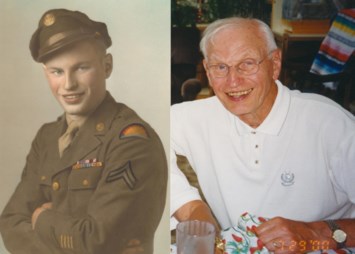
Jack Richard Klocko passed away on August 17, 2016 at the age of 94. Jack was born in Killdeer, North Dakota on December 9, 1921. He was the first child of Christina and Alex Stupnisky, immigrants from the city of Kiev in the Ukraine. A year and a half later, his sister, Inez, was born. His father, Alex, was a farmer and Russian Baptist minister who established a church in the town of Grassy Butte. In 1923, when Jack was only two years old, his father was injured in a car accident and later died in the hospital. Christina was later remarried to James Klocko, and together they had three children, George (known as Jimmy), Alice and Frankie.
Jack worked on the 12,000 acre family farm, and supplemented his income by trapping and hunting jackrabbits for their fur and meat, helping his family during the Depression drought years. In 1936, he hopped a westward-bound freight train and ended up in Oregon where he joined the Civilian Conservation Corps (CCC). The CCC was established to provide work for the unemployed and included a camp-style place to live. Workers received three meals a day and $1.00 in wages. Jack was stationed in Heppner, Oregon, where they built dams and roads. The lodges on Mt. Hood, Crater Lake, Glacier, Yellowstone, and Yosemite were all built by the Civilian Conservation Corps.
In 1940, Jack joined the US Army and was stationed at Ft. Lewis in the state of Washington. During World War II he was part of the Sunset Division, the 41st Division known as the "Jungleers”. After his training, he was to be sent to New Guinea to defend Australia in early 1942. Jack was held back from boarding the first ship with 2,000 troops aboard. This ship was sunk by a Japanese submarine and there were no survivors. Jack was scheduled to be on the second ship with 1,000 troops. He was again held back by command to train new troops. This ship was also sunk by a Japanese submarine and all men were lost. Finally, he was assigned to be on a converted small liner, "Argentina”, with 300 men aboard. The Argentina successfully completed the voyage in early 1942.
Jack lead a five-man artillery crew with a 75mm Pack Howitzer. This artillery piece was small enough to be disassembled into five pieces so it could be carried wherever it was needed. This was useful in New Guinea, which had very few roads. Later, the 75mm was replaced by a 155mm Howitzer, which was a huge improvement. During his R&R, Jack visited Australia and developed a love for the land and its people. He loved their beaches, fishing, and women! He even caught a baby koala bear, which he kept as a pet.
Finally, in May of 1944, the Americans began to move north to retake the Philippines. The first battle was for the island of Biak, off the northwest corner of New Guinea, which was protected by Wakde Island. The Japanese had intercepted an Allied message and knew the Americans were going to attack in May, so they decided to set a trap and just wait. General McArthur believed only 3,500 Japanese were in the area, but the actual number was 11,500. These Japanese were seasoned veterans unlike most of the Americans being brought in, which were new recruits. Jack and his crew had never had anyone seriously wounded or killed until May 31, 1944. During the fifth day of the Biak battle, Jack was shot through the neck by a sniper. His second-in-command, Dick Cavanaugh, kept Jack upright so he didn't drown in his own blood. Jack was in the "dead row" when a soldier, loading the dead to be shipped home, noticed Jack was still warm. He told the doctors, but they said it was impossible and kept treating the other wounded men. The soldier then checked for and found a pulse, but was ignored again. The soldier put his ear down to Jack's nose and could hear him breathing. When the doctors were told, they immediately began treating him. Jack was paralyzed and could only hear. The doctors called him "The Miracle Man”. Many months later his paralysis slowly left.
Following the war and recovery, he married Mable Bennett and went to work for J. C. Penney Company in Hillsboro, Oregon. He often met with Mr. James C. Penney with whom he shared a belief in Jesus Christ. During Jack's career at J. C. Penney, he worked as a “troubleshooter”, being sent to different small town locations to fill in as a temporary manager. From Hillsboro he moved to Enterprise, then to Burns. Jack later returned to the Portland area as an assistant manager in the Oregon City store. Eventually he moved to Arlington, Washington, as a permanent manager. He was then offered a job managing the clothing section of the Seattle-based Big Bear Stores, the first of the superstore concept. Later he was offered another managing position in Portland with a new chain of stores called Value Mart, later changed to Villa Mart. Jack opened a number of stores for Villa Mart and found former Penney's employees to manage them. Finally, he was offered a job with one of the biggest superstore chains of the time, Kmart, where he stayed until retirement.
Jack was dedicated to Mable, his wife of 57 years, and their four children, Rick, Debbi, Greg and Jackie. He always encouraged his children to do their very best and instilled the love of the Lord in their lives. In retirement, Jack enjoyed spending time with his family and hosting get-togethers in his home. He also enjoyed studying the Bible, reading, gardening, fishing, walks around Glendoveer golf course, and visiting with friends. He always treated his family, friends and employees with respect and encouragement. Jack cared greatly for his country and was proud of his service during World War II. Jack was always faithful and loving and will be deeply missed by family and friends.
Jack was preceded in death by his wife, Mable. He is survived by his children, Rick (Marcie), Debbi, Greg and Jackie (Audy); grandchildren, Tracy, John (Lydia), Kristen, Heston, Amy, Lexi and Abby and great-grandchild, Lila.
Montrez votre soutien
Envoyez Vos
Condoléances
Partager
L'avis De Décès
Obtenir les mises à jour
Prestations de Service
Partager l'avis de décèsPARTAGER
- RECEVOIR DES RAPPELS
v.1.18.0