AVIS DE DÉCÈS
Mathilda Maust
25 mai 1917 – 28 novembre 2014
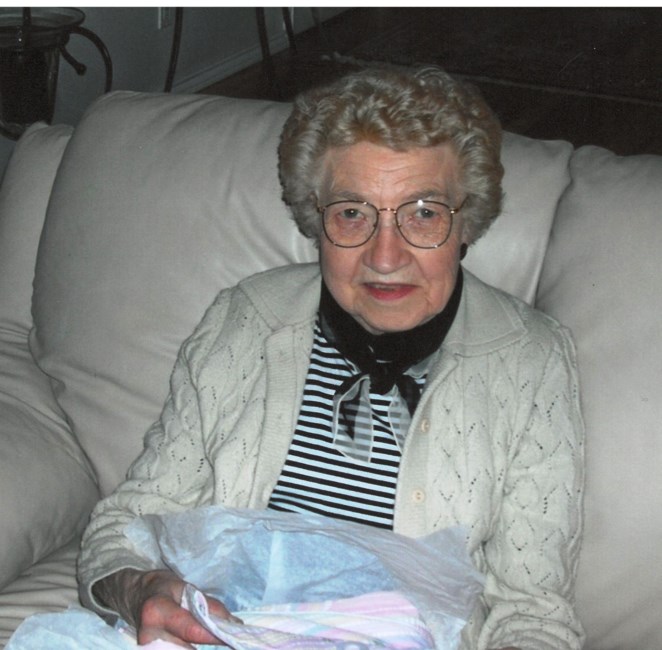
After a wonderful childhood on the farm with her siblings and graduation from high school, she married Orvil Maust. They had two daughters, Barbara and Dorothy. In 1939, the family moved to Portland, OR where she was a homemaker followed by a career as Food Service Manager in the Reynolds school district. Her legacy to her family involves a life of hard work, perseverance, self-discipline, values, and heritage (Norwegian). Until age 95, she was still making Norwegian lefse for her family at the holidays.
She was preceded in death by her husband, Orvil; her daughter, Dorothy Wiles; her great-grandson, Jonathan Zeuske; her brothers, Albert and Henry Vang; and her sister, Edna Vang Ruesink. She is survived by her daughter, Barbara Zeuske (Vern); son-in-law, Tom Wiles; grandsons, David Zeuske (Tracy), Jeff Scrabeck (Carrie), Dan Scrabeck (Sue); and six great-grandchildren.
A visitation will be from 9:30 a.m. to 12:30 p.m. on Thursday, December 11, 2014 at Skyline Memorial Gardens Funeral Home, with a funeral service to follow in the chapel at 1:00 p.m. . Remembrances in her memory may be made to Zoar Lutheran Church, 190 Sw 3rd Ave., Canby, OR 97013, or your local chapter of the American Heart Association.
The following is copied from a partially completed life story in Mathilda's own hand.
“Home Sweet Home”– By Tillie Maust
I was born on a farm, three miles north of Canton, Minnesota on May 25, 1919. It was a beautiful farm with a snow white house and brick red farm buildings. The yard was kept immaculate with lots of big shade trees.
My parents, Con and Anna Vang, were one of the many true pioneers of Canton township and I have many memories of my parents, as they worked side by side, through a depression and many hardships on their small farm. With a lot of hard work and the help of their kind neighbors, they lived a happy and contented life without all the luxuries we have today.
My father Con, was born in Norway on May 5, 1872 and passed away on February 26, 1962. In 1890, he, together with his brothers, Edward, Andrew, and Ole, and two sisters, Martha and Thea, emigrated to America, making a brief stay in Stoughton, Wisconsin, whence they soon moved to Minnesota. Con worked in lumbering and farming for several years. In about 1914, he bought 40 acres of land north of Canton and started to cut the trees and clear the brush. He then grubbed out the stumps with a grubbing machine pulled by one horse. He bought a small house in Lenora and moved it on his land. It had one big room and a small bedroom downstairs and three rooms upstairs. He built a small barn and some sheds and little by little built up his farm. He always had two horses, a few cows and pigs, and very little machinery. In those days, the neighbors helped one another and always enjoyed spending time together. They would help each other butcher, then share the meat. They also would help each other with trucking and harvesting.
My mother, Anna, was born July 30, 1888 in Lacrosse, Wisconsin. Her parents, the Emil Finstad’s, were also of Norwegian descent. Her whole life was devoted to hard work helping on the farm, milking, and caring for the family and was always ready to give what she had to help someone else. Anna Vang died May 12, 1979. I will always remember my mother for her great ability to cook delicious meals on her wood-burning range. Her fried chicken was out of this world. The work she did was endless. My parents had seven children, three dying in infancy. Those living are Edna, Henry and Mathilda. Albert passed away August 1, 1992. There are 10 grandchildren and several great grandchildren.
In 1925 my father bought a new Model T Ford which was his one and only car. It lasted him for a lifetime.
My parents farmed this little farm for over fifty years with a team of horses and were very proud of their life and heritage. My father loved to sit under the shade tree and visit with friends and neighbors. He was of a jovial disposition. He also liked to read the Decorah-Posten, which was a Norwegian paper printed in Decorah, Iowa, that he subscribed to all of his life. My mother liked to crochet and made a lot of pretty doilies and tablecloths. She also made her own quilts.
Every Saturday, they would crank up the Ford and go to Canton to buy their weekly groceries and supplies, and on Sunday would attend services at Henrytown Lutheran Church where Con and Anna are now buried in the lovely cemetery adjoining the church.
My Childhood
My early childhood on the farm was a happy carefree time to wander around in the fields and go barefoot in the summer with the powdery dirt squishing between my toes and when it rained, I’d wade in the water puddles. We had a black and white collie dog named Rover who was always by our side and lots of kittens in every color to play with. My mother always had little chickens to care for and I’d go with her to pick the eggs in the hen house. Some of the old hens would be sitting on eggs to hatch more little chickens. They were pretty feisty and preferred to be left alone. We also had little pigs in the spring. Sometimes there would be a little runt pig and my parents brought it in the house and wrapped it up in a rug and put it in a box near the stove until it got enough strength to be with the other pigs. We also had cows and baby calves and two work horses. The horses worked very hard and had to pull the plow and rake to prepare the ground for planting. They also pulled the wagon and the buggy to town to grind feed and get groceries. My mother would wash the eggs and take them to town and exchange them for groceries. The stores in Canton were open on Saturday night so we all went to town in the buggy. My mother would buy her groceries and my father would visit with the neighbors and have a beer or two. Us kids usually roamed the streets with the other kids in town and would sometimes end up playing “hiding or seek”. We used to be very disappointed if it rained on Saturday night so we couldn’t go to town. We used to say, “Rain, rain, go away and come again some other day.” Sometimes we’d get an ice cream cone if there was 20 cents left after buying groceries, so we’d always look forward to that.
I’d always like to catch butterflies in the field and press them in a book to dry. My sister, Edna and I used to go in the woods and pick wild flowers in the spring. There were mayflowers, buttercups, daisies, jack in the jackets, dutchman breeches and lady slippers. The lady slipper was Minnesota’s state flower. They were rather scarce, but sometimes we would find them. We also picked wild raspberries and blackberries in the woods. My mother liked to pick them too and made a lot of jelly with them, which we all enjoyed. We didn’t have electricity or water in the house and no bathroom. It was mighty cold in the wintertime to go out to the outdoor toilet, but we made do with what we had. We read by lamplight and had a wood heater for heat. We took a bath in a square tub in the shanty in the summertime and behind the heater in the wintertime. The shanty was a small building next to the house where my mother cooked on an oil stove in the summer. We also did a lot of her canning there. We had a wood range in the kitchen with a water tank on it to heat water for dishes and baths. We had a cistern by the house that caught the rain water from the roof and provided all the rainwater for the household. We had to get our drinking water from a spring in the pasture, so had to carry it by pails full to the house. It was a big chore every day. In later years, my father had a well dug and got a pump and windmill so we were really living then. We also added a kitchen to our house, which was built by my father and grandfather. It really made it nice to have more room. My sister and I helped more as we grew older. Our job was to wash the dishes while my mother milked the cows and we mopped the floor and helped with cleaning. We also helped churn butter in the old barrel churn that was turned with a crank. After we got butter, my mother would sit with her butter bowls paddle and work the milk out of the butter and put salt in it. In the fall, we helped shell popcorn and seed corn. We popped corn and played cards in the wintertime. We also had music in our home. My father bought a new organ and we soon learned to play and sing. My father played a fiddle and enjoyed playing old songs from Norway, which he enjoyed very much. My brother Henry got a guitar and later a banjo which he learned to play. We also had an accordion, which I learned to play, and my sister, Edna, learned to play the violin. We soon had a little orchestra going. When we got older, we played for a few parties at the neighbors houses. I have a great love for music. As a child, I spent a lot of time picking potato bugs off the potatoes for 5 cents a jar. We didn’t have pesticides in those days. We always had a big field of potatoes and a big garden so we had plenty to put in the cellar for winter. We had a lot of good vegetable soup in the wintertime. My mother canned a lot as well.
My School Days
When I was six years old, I started school in Canton. They had first built a new school. We had two classes in each room. I spent twelve years there, as I attended High School there as well and graduated in 1935. We had very good dedicated teachers in those days. We rode the bus to school. In the spring we had a wagon bus pulled by horses and a sleigh bus in the winter time. It was a mighty cold ride sometimes and your feet got cold, so we heated a pumice stone in the oven and put it in a burlap bag to take on the bus to put our feet on. We had to smell of hot rubber from our boots. Those were the days. Times were hard and we had to make do with hand-me- down clothes. My Mother sewed most of our clothes. She sent to Sears Roebuck for material and made overalls and shirts for the boys and dresses for us. We had one pair of shoes and when the soles wore out we usually got them resoled. There was a shoe cobbler in every town and they kept busy. I always liked school and learned reading, writing and arithmetic without any trouble. I liked to draw and make posters. I also liked to write, and kept a diary of everything that went on, and all the births and deaths of the farm animals as well as people.
Montrez votre soutien
Envoyez Vos
Condoléances
Partager
L'avis De Décès
Obtenir les mises à jour
Prestations de Service
Partager l'avis de décèsPARTAGER
- RECEVOIR DES RAPPELS
v.1.18.0