
AVIS DE DÉCÈS
Wilbert Skeets Lee Mehrer
21 mai 1927 – 3 août 2011
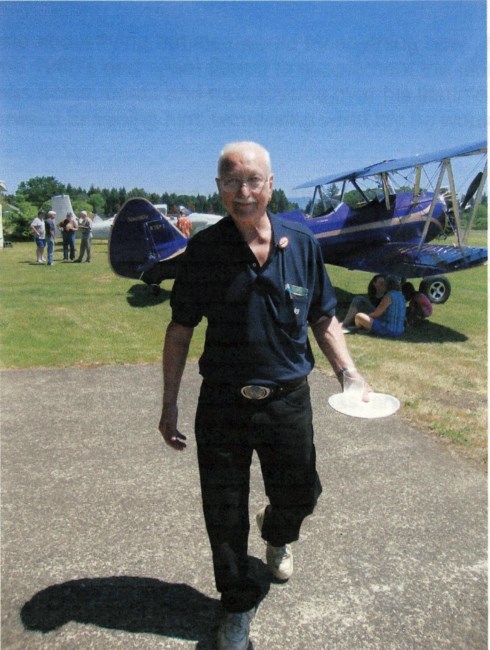
May 21, 1927. This is an important day in aviation. For two reasons. The first is that this is the day Charles Lindbergh landed in Paris. The second is that this is the day that Fred and Anna Mehrer became the parents of Wilbert Mehrer.
He was born in a small, one room home on a farm outside the little town of Lustre Montana. Early memories told to his children included images of living in a Mennonite community, speaking German, abject poverty, a beloved older brother Karl, and lots of work.
He spoke of his father instructing him on how to put poison in gopher holes. He believed he was barely old enough to understand what he was told. And barely walking. He recalled that he didn’t understand was poison was, but did as he was told. He may have been 2 or 3 years old.
His stories of this time always include his adored brother Karl. It cost 5 cents to see the movies, which always included serial movies. They rarely, if ever, had enough for both of them to attend the movies, but could generally scratch up enough for one to go and then tell the story to the brother who didn’t go.
Skeets’ favorite reading material was the comic book, Tailspin Tommy. Tommy’s mechanic was Skeets. That is where the nickname came from. He said that he and Karl would play Tailspin Tommy whenever they could. One time, they scrabbled enough lumber and farm gear to create what they thought was an airplane. They had it hidden and were planning on when to toss it off a cliff with Skeets gloriously in control. This plan was hatched not realizing that the sleeping porch they used shared a wall with their parents’ bedroom. Fred waited until they were ready to fly this hunk of wood and surprisingly, the plane disappeared right before its maiden flight.
Skeets also talked about a boat they built, which their father thought to try in a local river. It lasted until about mid stream until it sunk and their father had to swim to shore.
Life in a farm during the depression in Mennonite community was hard, to say the least. Skeets talks about doing chores before school. Karl would harness the farm nag to the wagon, and the children would go to school in the wagon. School was a one room school house. Skeets’ first year of school was spent learning English. The second year, learning his ABC’s.
Skeets and Karl spent much of their early life harvesting food and supplies to support the family. Everyone in the family worked. Harvesting potatoes, Skeets would shake the roots until the potatoes fell out. Karl would take the potatoes and bag them. He said that “Karl was the strong one” who would have to do the heaviest jobs.
Skeets was an original inspiration of Dennis the Menace. Even the only photo that exists of him as a child shows a remarkable resemblance to the character. He said he was always into trouble, and Karl was always getting him out of said trouble.
Mennonite life centered on the church. Skeets talks about attending church and he said he could never sit still for the long sermons. Always fidgeting. Also, he was always finding ways to get into trouble. For example, he talked about sneaking out and letting the air out of tires of the Model T’s outside the church. He enjoyed watching the men have to hand pump the tires back up in their Sunday best, complete with tall hats and long coats. He talked about challenging a friend to see who could spit in the bald heads that passed below them. As he admitted, “I always got beat on Sundays”.
The depression hit the family hard. They lost the farm in Lustre and moved several times to find work and keep the family going. Skeets remembers his dad got work through the government at a logging camp in the woods. He remembers seeing President Roosevelt visiting the camp and the long limousine going through the camp. Years later, thanks to Jim Clymer, Skeets got the huge pleasure of riding in that exact limo and sat where Roosevelt sat.
For awhile, the family settled in Prosser Washington, near Hanford. That was a hard time for the family.
Skeets showed his daughter a high trestle train bridge in Prosser once. He told her he recalled clambering under that bridge to catch “squabs”. Sometimes, this was the only meat on the table.
He also recalled from his Prosser days that he and Karl would join their dad and a group of other men. They would hide at night near where the train would stop. Once it stopped, they snuck into the coal car. Most of the time the car was mostly empty and the only coal there was iced hard onto the car. They would take shovels and scrape off what coal they could get and bag it. At the next stop they would toss the bags out and sneak off themselves. That coal was important to keep their families alive during the cold Prosser winters. The only other fuel that they had for heat was what Skeets called Buffalo Chips aka dried cow manure.
Later on in the late 1930s, the family moved to Portland to find work in the shipyards. This is where they settled.
Then Pearl Harbor happened. Skeets was too young to join the military, but the Merchant Marines would take anyone who was 16 or older. With his brother, they both joined up. Skeets fudged his age from 15 to 16 at this time so he could join. This also meant the end of any regular schooling. He spent the war shipping on various Liberty ships and other tankers. For a young farm boy right off the farm, this service was quite a shock. He talked about the huge casualties in the early years of the war. And the painful memories of men drowning by the side of the ship left there when their ships were sunk from Japanese torpedoes. They could not stop to pick up the men or else they would be torpedoed. They had to go on. He said these memories stuck with him for the rest of his life.
He worked in the engine room. That is where he exercised his love for large machines. Admittedly, Skeets was a genius with regard to machines. There is nothing he loved more than tinkering with machines and making them work. The bigger the machine, the better.
At this time, Skeets also learned how to fly and got his license at the age of 15. Flying was always his passion and reason for living.
At this time in the Merchant Marines, he made two friends that would influence the rest of his life. Jack Dickie and Fred Irvin. He roomed with Fred Irvin, a hard drinking, hard living, rascal. He endeared himself with his bunkmate by making sure Fred never missed a sailing. Sometimes, he had to spend hours traveling from seedy bar to seedy bar at the port to find the drunken Fred to drag back to the ship.
Fred thought so well of Skeets that he thought he would introduce him to his niece, Barbara Patterson. Barbara, when she first heard that Fred had a guy for her to meet, worried what kind of wastrel Fred had in line for her. She says, though, when introduced, she saw those beautiful green eyes of Skeets and fell instantly in love.
He met Jack Dickie through his brother Karl. Jack and Karl shipped together in the Merchant Marines. The friendship of Jack and Skeets is one that lasted 50 years, through thick and thin. One of the truest friendships a person could ever see.
Skeets and Barbara’s first date was a double date with Jack and Betty. Barbara remembers dancing to “Sentimental Journey” and after that, this song became “their song”. As a beautiful quirk of fate, the last time they shared a dance floor (at granddaughter Lindsay’s wedding); they danced to this song again.
Skeets and Barbara dated for quite awhile.
Then the Korean conflict arose. Since the Merchant Service did not qualify as prior military service, Skeets was drafted into the army. Barbara told Skeets that she would not wait while he was in Korea. So, he mulled this over for a few days and told he told her that they would do it. So they married in a small service, with Karl as best man. They didn’t have much of a honeymoon. One day. Skeets’ dad had some brainstorm on how to keep him out of the army. It couldn’t wait. So Fred sent out the State Police to find them and bring them home. Obviously, Fred’s idea didn’t work.
Skeets didn’t talk much about the first part of his military service. He has mentioned that “the bayonet is there for a reason” and has mentioned that the war was bloody and hand to hand combat did occur. One event he did mention is the story of getting wounded. He recalls landing on the beach with his unit, an explosion close to him, and then, waking up in Tokyo. He didn’t tell his bride about this experience for almost 50 years. He said he didn’t want her to worry. Skeets did talk about the rest of his service after release from the hospital. He was then stationed in Okinawa. He told the story about seeing the dry dock and asking the Sergeant why it wasn’t being used. The Sergeant told him that the hoisting mechanism didn’t work and no one knew how to fix it. Skeets looked this over and told the Sergeant he could fix it. The Sergeant said “Yeah – right”. And to the Sergeant’s astonishment, Skeets fixed it.
Skeets mechanical genius also earned him the appreciation of the base commander. The commander discovered that Skeets could keep the air conditioning going. After that, Skeets said that the rest of his tour was pretty easy. He had his own little room. He even hired a Japanese boy who would tidy up his little room. Skeets said he also ran the movie projector on the weekends for the base. He said that after that, he could always see the mark on the movie that signals when to start the next reel.
He got his GED through the Army and returned to civilian life. He tried various jobs in the 1950s including Fireman (sitting for hours at a time was too boring), reserve Policeman, furnace repair. At this time he joined the Steamfitters and Pipefitters Union, of which he was a proud member for the rest of his life.
He was also a proud Mason an Elk and Quiet Bird (QB).
Barbara says that when his daughter, Patty, was born, that spurred him to find regular full time work at Diamond Fuel. He worked there until 1977.
Skeets always had an airplane. He was always passionate about flying. Barbara says he had one when they married, and continued to purchase, or restore aircraft for their entire marriage. Skeets also bought and restored vintage autos, including a Model T, classic Ford convertible and classic Thunderbird. Barbara talks about sewing up fuselage fabric on the sewing machine and having Model T wheel spokes bleaching on the stove.
Barbara taught Skeets the two things he could do in the kitchen. Make coffee and run the toaster. The mechanical genius never learned another thing to do in the kitchen. Though that never stopped him from kibitzing on meal preparation. If left to his own devices, his meals would be ice cream (and lots of it) and cookies. His version of health food diet.
Skeets always wanted to learn how to do new things. When scuba diving became popular in the 1960’s, he learned how to dive. Barbara talks about Skeets spear fishing in the Puget Sound and bringing home fresh fish for the dinner table.
In 1959, he told Barbara that he figured out what to do with some land his father had. Build duplexes. Barbara says she asked him “Haven’t you heard what they have been talking about, the end of the world is coming”. He just looked at her and built the duplex anyway. Barbara says she has told Skeets “no” many times on many projects or schemes during their marriage. Skeets never understood what “no” meant. He was always figuring out a new way of making money, restoring something, fixing something or learning something. “No” was not in his vocabulary.
He also had various boats, cars and motorcycles during his life. They were active in the Methodist church “Adams Group”. Their friends often said that they looked forward to group trips to see what toy Skeets would bring this year.
In the 1960’s, Skeets would work for Diamond Fuel in the winter fixing furnaces. In the summer, he would build duplexes. Patty talks about watching her father frame houses. She would watch him on the ladder and tap the nail, and then BAM, in one hit the nail would be in the wood. If he couldn’t reach the nail, then he would grab the ladder and hop the ladder to where he could reach the nail. She says she thought he was a god.
She also talks about pretending to be a tiger in a jungle and the tiger attacking him on his chair. That attack generally ended up with tickling and a hug.
During this time, Skeets and Jack Dickie continued their friendship. Jack’s passion was boats, and Skeets flying, but they both loved machines and what machines do. Their friendship was unshakable and lasted for the rest of their lives.
Skeets was a devoted husband and father. His family shared in using the boats and flying.
Son Kent joined the Air Force and inherited the same passion for flying. Kent helped out in maintenance on the duplexes and spent lots of time with his father.
In the 1970’s, Skeets worked for 3 years on the Alaska Pipeline.
In the early 1980’s, Skeets and Jack bought a beat up airplane - a T-6. They worked to restore it and named it Lickety Split. They started racing in 1983. They were proud of having the largest team in Reno. The requirements for being on the team was to show up and be ready to work. The fun meter in the pits was always off the chart.
Skeets was extremely proud of Kent as he started his flying career in the USAF. Skeets was always bragging about his jet pilot son. Whenever Kent was around the planes, Skeets always opened opportunities to fly the planes. Skeets event told Kent could fly any of the planes at any time. He especially enjoyed teasing Kent about flying Lickety Split because it was "too fast".
Also, in the 1970’s, Skeets and Jack managed to find and purchase the vessel Zodiac, a 130 foot sailing schooner. The Zodiac now belongs to Karl, who has the know how and man power to restore Zodiac to its former glory. Without Skeets and Jack, this historic vessel would not exist.
During his life, Skeets collected Stearman parts, Model T parts, antiques and collectibles. Being a furnace repairman, he worked in a lot of basements and would purchase decaying or ignored items. This includes a player piano (with rolls), Victrola, Edison tube record player, paintings, radios, grandfather clocks etc. These items are treasured by his children and grand children.
Skeets retired in the mid 1980’s. But Skeets was not one to retire to his easy chair. This is when the full time aircraft restoration began. Skeets said it took him and Jack 7 years to restore the first Stearman “BJ”. Named in honor of both wives, Betty Jean and Barbara Jane. Now that he had one Stearman, the assembly line began. Next was Breezy, and then the rest, as they say, is history.
Skeets friends all pitched in to help with the restoration projects, with Camas producing a wealth of beautiful aircraft. None that would exist except for Skeets in the director’s chair.
Retirement was a busy time for Skeets. Restoring aircraft, racing Lickety Split, keeping the Camas club house going, various air shows and fly ins, the annual May birthday picnic, all kept him busy.
Skeets had that gift of making everyone his best friend. He was generous of his time, effort, ingenuity, intellect and money. He was there for any one, any time, for any thing.
People were so important to him. The more people there was there, the better. And there is nothing he enjoyed better than a good party.
He was always working through and solving problems. And if he didn’t have a problem to solve, there was always problems of his friends to solve.
He was also passionate about learning. He was always reading books magazines on history, ships and aircraft. He was a devoted fan of the History and Military channels. His hunger for knowledge about a variety of subjects from aircraft to archeology was insatiable.
But he also like to watch his cowboy movies, to the continuing frustration of Barbara. Teasing his wife about anything was one of his favorite things to do. He would get that twinkle in those “beautiful green eyes” and start in on the tease.
He had “no rhythm”, but loved to dance. It didn’t matter if the song was a waltz, tango or two step, he always danced the same dance. No woman was without a partner at a dance as long as he was around. He would enthusiastically swing any woman around. He wore out many a partner dancing at the various air shows and fly ins.
He loved his “Camas special” drinks. And hosting his Camas club house for his friends to visit at any time. The coffee was always on and the bar was always open.
With his brothers, they were always game for a bowl of ice cream. A giant bowl. With peanuts of course. And he would bring a bag of sunflower seeds to add to his Wendy’s frosty.
Every woman he met was “the most beautiful woman in the world”. And every woman deserved one of the plethora of “Lickety Split” pins he always had. And every pin he gave away was his “last one”.
He loved and was loved by his wife, children, grand children and great grand children. One of his last flights was giving a first airplane ride to his 5 year old great grandson Ryan. Ryan’s comment “AWESOME!!” The passion for flying continues to the next generation.
When Barbara was asked what it was like to be married to Skeets, her reply was “Well, I was never bored”.
To quote his grandson Nathan “He touched more people in a day than most do in a lifetime”.
He will be seriously missed by so many people. The hole he leaves in our lives is endlessly deep, and unfillable.
Montrez votre soutien
Envoyez Vos
Condoléances
Partager
L'avis De Décès
Obtenir les mises à jour
Prestations de Service
Partager l'avis de décèsPARTAGER
- RECEVOIR DES RAPPELS
v.1.18.0