AVIS DE DÉCÈS
Yoshihiro Uchida
1 avril 1920 – 27 juin 2024
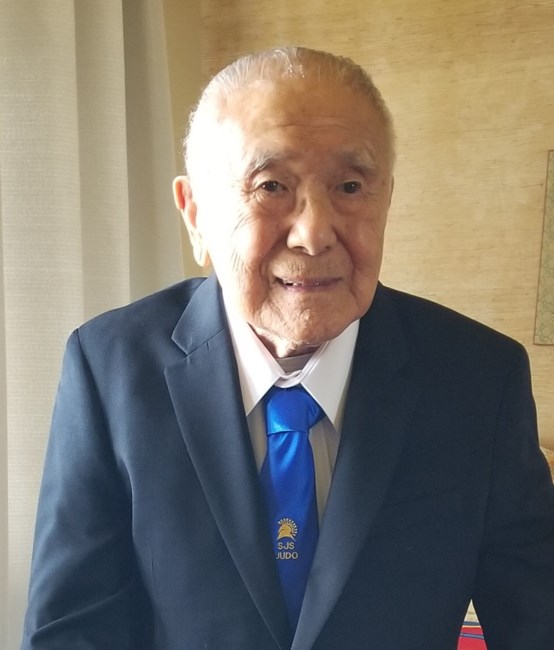
Yoshihiro “Yosh” Uchida was born in Calexico, CA in April 1920 to Shikazo and Suye Uchida. Raised in Garden Grove, where his family grew chili peppers, lettuce, tomatoes, and other vegetables. In 1930, his parents wanted him and his siblings to learn about their Japanese heritage, so they enrolled them in the local Japanese school. At that time, boys could also take judo, sumo, or kendo. He and his three brothers enrolled in judo. As a 15-year-old sophomore, Uchida earned his black belt at the Grand Judo Championships in Los Angeles. After a year at Fullerton Community College, Uchida’s friend, Tak, convinced him to enroll at San Jose State. There he met Sam Della Maggiore, a student coach who recognized Uchida’s talent as a wrestler and judoka. A few years earlier in 1937 the SJSC Police Academy had seen the advantages of adding judo to their curriculum. Sam introduced Yosh to Emilio Bruno, who taught judo at the Police Academy and only months earlier had started the SJSC’s judo team. In 1940 Bruno left SJSC and Yosh was asked to coach the judo students.
Executive Order 9066 ordered the internment of citizens of Japanese descent on February 19, 1942. Though the Uchida family was sent to the Poston Internment Camp in Arizona, and later sent to Tule Lake, Yosh had already received his draft notice. From Fort MacArthur in California, he was sent to Camp Robinson in Arkansas, then Fort Meade, South Dakota where he trained as a Medical Laboratory Technician. Following his discharge, in 1946 he returned to SJSC where he graduated in 1947 with a degree in Biological Sciences.
Upon his return to San Jose, Uchida not only continued coaching judo at the Police Academy, but also began tirelessly working toward establishing judo as a nationally recognized sport. With guidance from U.C. Berkeley’s wrestling coach, Henry Stone, the pair teamed to change judo, a martial art, into a sport by instituting a weight class system. Establishing weight divisions allowed judokas to be judged by their technique and not by their strength alone. The change helped judo become more popular through the collegiate circle and they worked to establish judo as a recognized sport by the Amateur Athletic Union (AAU). In 1953 they were successful, and the first National AAU championships were hosted by San Jose State, and Coach Uchida was the tournament director. On an international level, he and Dr. Stone were able to qualify judo as a recognized sport with the International Olympic Committee. He was the first Olympic judo coach for the United States judo team in 1964 at the Tokyo Games.
His accomplishments and recognitions are many. The Spartan Complex where the dojo resides was the site where Japanese Americans had to report before being sent to camp during WWII. This building was renamed Yoshihiro Uchida Hall in 1997 and rededicated in 2014. He was inducted into numerous Halls of Fame, including the San Jose Sports Authority Hall of Fame and SJSU’s Legends Hall of Fame. He also received the President’s “Tower Award” for decades of service to SJSU. In 1986 he received the “Order of the Sacred Treasure, Gold Rays with Neck Ribbon” by his majesty the Emperor of Japan. This award is the highest a non-Japanese citizen can receive for the furthering of Japanese culture outside of Japan. It was received because of his work in furthering the sport of judo across the country and around the world. In 2013, he was promoted to the rank of Judan (10th degree), the highest rank in judo. At 103, he was still checking in at the Spartan dojo to visit the students and offer guidance.
While the world may recognize him for his work in furthering the sport of judo, he would not have been able to do this without the support of his family. In 1943 Yosh married Ayame Mae Hiraki, who he met at SJSC and was teaching 2nd Grade at Poston when he proposed. He said he felt bad because her class loved her so much they all cried the day they married and left the Internment Camp. Sam and Dina Della Maggiore welcomed them back to San Jose following the war and helped them get resettled. With his training as a med tech and help from friends, he worked at various hospital labs until 1956 when he and Mae founded Physicians Laboratory, later Laboratory Services, Inc. In 1989 the Uchidas sold the laboratory. At the time Laboratory Services was the largest privately held medical reference laboratory in Northern California with 450 employees and 42 satellite labs.
Yosh is survived by his two daughters Lydia Uchida Sakai (Steve Sakai), Aileen Uchida (Steven Shimizu), grandsons Michael Sakai and Kyle Sakai (Anh Thu Tran) and granddaughter Amelia The Sakai, many nieces and nephews and grandnieces and grandnephews, many judo students, alumni and friends. Preceded in death, by wife Mae, daughter Janice Uchida, brothers Isamu Sam, Suehiro Henry (Chieko), Shikao George, sister Kazuko Maehara (Yoshio). We thank the caregivers, Kathy, Maeden, Gemae and Jessie and the nurses and physical therapists who helped him live comfortably these last years.
Private services have been held. A public memorial is being scheduled for early Fall when the students return to the University and friends, family, alumni and colleges are all welcome to attend.
Montrez votre soutien
Envoyez Vos
Condoléances
Partager
L'avis De Décès
Obtenir les mises à jour
Prestations de Service
Partager l'avis de décèsPARTAGER
- RECEVOIR DES RAPPELS
v.1.18.0