
AVIS DE DÉCÈS
Edward Mahon
7 février 1927 – 26 juin 2011
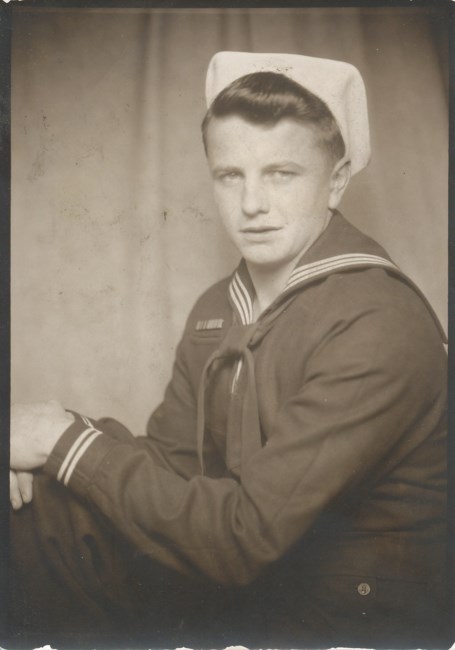
Ed was born in Chicago in 1927, and he was a child of the depression era. His father was a mailman. He had an older sister named Betty. Betty called Ed “Bro”, and the name stuck. For at least the first half of his life, Ed was always called “Bro” by his mother, his sister, and all of their blood relatives.
The family moved to Evergreen Park, a nice community on the southwestern edge of Chicago. Ed fondly remembered his mother sending Betty and him to the market each week to buy groceries, pulling a red wagon. On the way home, if they had an extra nickel, they’d stop at the bakery for a treat. For the rest of his life, Ed could never pass up bakery goods.
Ed’s father was a tough, sometimes brutal Irishman who raised Ed to be tough. His father left the family when Ed was a teenager. His mother went to work on an assembly line, making electrical relays, and Ed went to work, too. He grew up quickly. As a teenager, he did a variety of hard labor jobs, including shoveling coal on a steam locomotive and picking fruit on the local farms.
His mother, an iron-willed, no-nonsense, working-class Irishwoman, was a strict disciplinarian and an extraordinarily hard worker. As wartime orders boosted production, she was promoted at the relay factory, and earned a good income throughout the 1940s. She was very frugal, and was able to provide a good living for her small family, in an era in which not many single women could.
At the end of 1944, midway through his junior year of high school, Ed joined the Navy. The rules at that time allowed enlistment at 17, but only with a parent’s permission, so his mother had to sign for him. Although she agreed to do that, unknown to Ed, she took precautions, as she did in all things. Her sister-in-law was married to a general in the Pentagon, and through him, she got Ed assigned to a hospital ship, supposedly the safest place in the Navy.
As fate would have it, the hospital ship was still being fitted with its surgical equipment, and Ed was assigned to temporary duty aboard a troop transport. On his first voyage, they were sunk at night by a German submarine off Halifax. Fortunately, the ship went down slowly, everyone got into lifeboats, and they were rescued by PT boats with big searchlights.
After that exciting adventure, Ed joined the hospital ship crew and sailed to the Pacific. He got to the theater of war just as it was ending. His ship survived a major typhoon off Okinawa. Ed was among the very first people to enter Nagasaki after the atomic bomb blast, ignoring the radiation warnings. He also witnessed the surrender of the Japanese forces in that area.
After the war, Ed returned to Evergreen Park and finished high school. He worked in factories and was able to buy a nice used Buick Roadmaster. That classy car attracted an Evergreen Park girl from a German family, Lorraine (“Lee”) Schaeckenbach (“SHACK-en-back”). Ed was a very handsome young man with jet black hair. In addition to the car, Lee also liked the fact that he had been a sailor. They dated, and they married in 1947. They would spend the next 63 years together.
In 1952, they bought their first house with help from Ed’s mother, and they had their first child, Terry. Their house was in Park Forest, one of the nation’s first planned suburban communities, about fifty miles south of Chicago. Ed’s mother also helped his sister Betty and her family buy a house on the next block at the same time.
In many ways, Park Forest was an idyllic place to raise children and build a life, isolated from Chicago’s fast pace and traffic. It was quiet and peaceful, simple yet modern, with its own large shopping plaza. Ed had a large back yard and a well-equipped garage, and spent all his free time building things, including several elaborate wooden backyard toys for Terry. He worked in Chicago factories as a union electrician and instrument repairman.
Lee and Ed welcomed their second child, Susan, in 1963. Susan’s childhood in Park Forest was the happiest time of Lee’s and Ed’s life together. As they became a little more affluent, Lee finally persuaded Ed to take the family to California for a vacation in 1967. Everyone enjoyed the trip, but for Lee it was a glimpse of the Promised Land. Over the next two years, she persuaded Ed to take a huge gamble.
In 1969, in the boldest act of his life, Ed moved the family to the Los Angeles area, without a job prospect. With a lot of help from Lee’s sister-in-law Pat, the family settled into a whole new life. Ed was unable to find a job, and as the weeks went by, he was afraid he had made a disastrous mistake. Finally, after two scary months, he landed an electrician job at the ALCOA aluminum plant. Ed would work there for 22 years before retiring.
The family bought their first modern home in Cerritos in 1970. Terry went off to college and then marriage, and Lee and Ed raised Susan as a Californian. As a big treat, Lee, Ed and Susan took a vacation to Hawaii. Working a great deal of overtime, Ed saved enough to afford a much more upscale home in Placentia (“pluh-SEN-chuh”) in 1976. The family also took a dream vacation to Europe.
Soon, Susan too went off to college and marriage, and Lee and Ed became empty-nesters. Terry and Susan built their own successful lives and families nearby, giving Lee and Ed three granddaughters: Diane, Katie, and Kirstie.
In Placentia, before and after retirement, Ed pursued his hobbies of woodworking, shooting, and gardening. He had an elaborate workshop with great power tools, a gun collection, and a big garden with automatic irrigation. He made many fine pieces of furniture, but his masterpiece was a beautiful roll-top desk for Susan.
Ed belonged to the local gun club, and enjoyed target shooting at their private range. One of the highlights of his life was the opportunity to take several deer hunting trips with his buddies from ALCOA. They all had trucks with campers, and they towed an old jeep that Ed co-owned with his best friend Frank.
In his later years, Ed endured two bouts with cancer, each ending with successful surgery. Lee also fought off multiple cancers, and had a successful corneal transplant. Lee and Ed lived in Placentia for thirty years before Terry and Susan persuaded them to join them in Oregon in 2006. Sadly, they were never able to enjoy their beautiful new surroundings, because more health problems overtook them.
Ed developed dementia, perhaps from a severe infection he had around 2003. The disease progressed slowly at first, but accelerated after the move to Oregon. Lee developed pancreatic cancer, but bravely fought it, surviving far longer than her doctors thought possible. While Lee’s treatment continued, Ed moved to a special care facility. In June 2010, Lee finally succumbed. Ed lived another peaceful year until breaking his hip in a fall from his chair. He passed away June June 26, 2011, from complications of the hip injury.
Arrangements under the direction of Young's Funeral Home, Tigard, OR.
Montrez votre soutien
Envoyez Vos
Condoléances
Partager
L'avis De Décès
Obtenir les mises à jour
Prestations de Service
Partager l'avis de décèsPARTAGER
- RECEVOIR DES RAPPELS
v.1.18.0