
AVIS DE DÉCÈS
Marlene Rose Gale Clevenger
2 juin 1933 – 19 août 2014
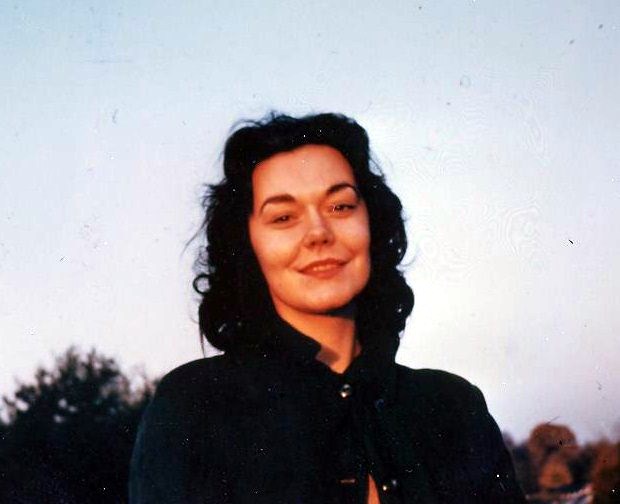
…was born June 2, 1933 in the tiny mountain village of Townshend, Vermont, the sixth of seven children of George Howe Gale and Mary Martha Johnson, and was named by her mother after the film star Marlene Dietrich. Her father’s ancestors had helped found the town in the 1770s, and in later years she traced her ancestry back to Civil and Revolutionary War veterans and further to some of New England’s earliest inhabitants, including two victims of the Salem Witch trials, Rebecca Nurse and Elizabeth Howe, hanged side by side in 1692.
Marlene’s grandfather and great-grandfather were doctors and her father was tapped for West Point, until a diagnosis of epilepsy ended that dream. Her mother, the daughter of Danish and German immigrants, wrote songs and poems and wanted to be a dancer. In 1910 at age 14 she auditioned for the St. Louis vaudeville stage, but quit when she discovered that performing would mean showing her legs in public. Instead she went to work in the sewing factories of St. Louis and Bridgeport, Connecticut to earn money for her family. She could sew anything without need of a pattern and reproduced a number of fashionable styles for Marlene in high school and college.
When Marlene was a toddler the family moved downriver to Brattleboro, Vermont, struggling through the Depression and then World War II with the rest of the nation. Marlene remembered a large pot of oatmeal on the stove most mornings, as it stretched a long way in a family of nine; her father’s Victory Garden out behind the apartment house (she was sent out to weed it and pulled out all the carrot seedlings by mistake); and the whole town gathering at the railroad station some months after Pearl Harbor to send its young men, including her 19-year-old brother Rodney, off to war. All three of her brothers served in the Pacific theater, and Marlene recalled her parents sitting at the kitchen table reading letters from their boys, crying and praying. Somehow all three came home intact. Marlene came away with a lifelong interest in and admiration for the music, history and veterans of World War II.
Marlene grew up listening to all the old radio serial dramas and variety shows, including one that announced it was "coming to you from beautiful Galveston Bay in Galveston, Texas." Galveston sounded to her like the most exotic place in the world. Brattleboro was a small town and the train’s whistle could be heard from every place Marlene’s family lived in during her childhood, including the apartment building they eventually purchased at 31 South Main Street, which sat on a hill right above the station. She later said that lying in bed at night she would hear the whistle and think, some day I’m going to get on that train and go somewhere.
Marlene loved to sing and her earliest memory was of standing on her father’s knees, belting out songs in church as he tried to get her to turn down the volume. As she grew she kept her love for music but not her family’s religion, making her declaration of independence at age 13. She and her younger sister Beverly took piano lessons and sang duets at family gatherings, and each owned a prodigious collection of sheet music. Marlene continued singing and playing until Parkinson’s Disease took her singing voice and her fine motor control. It never took her sharp mind, nor her near-perfect recall of favorite poems or every song she’d ever sung.
Marlene attended Brattleboro High School where she was a cheerleader and stellar English and French pupil. Upon graduation in 1951 and funded by her beloved older brother Truxton she went off to Becker Junior College in Worcester, Massachusetts to become a medical secretary, her mother’s idea of a suitable occupation for a girl. Marlene would rather have been an airline stewardess, but in the 1950s girls who wore glasses couldn’t get those jobs.
In her first year at Becker she went sans glasses to a fraternity party at nearby Worcester Polytechnic Institute, where she noticed the blurry outlines of a “cute blond boy” across the room. He had noticed her, too. Up until then Stan Clevenger, a football player and engineering student from Albany, New York, had always dated little blond girls like his mother. Years later he said that when he spotted Marlene across the room -- dark-haired, statuesque, looking like the model she would later become -- “It felt like someone hit me between the eyes with a two-by-four.”
Stan and Marlene dated throughout her two years at Becker, but broke up before her graduation. She still had places to go and things to do. She moved to Boston, Massachusetts to take a medical receptionist job on Massachusetts Avenue near the Back Bay. She lived with her Aunt Dot and Uncle Emil in the brownstone apartment building they owned on Marlborough Street, then with her friend Mimi and sister Beverly in a series of apartments on Commonwealth and Fairfield Streets and on Queensberry Street near Fenway Park. During this time she did some intermittent modeling, discovered the hidden treasures of Filene’s Basement and became a lifelong Boston Red Sox fan, though she couldn't afford to go to many games.
When Mimi decided to move to Los Angeles, California, Marlene did too, and moved back home for a time to save money for the trip. She found a young man driving that way who agreed to take her along for gas money, and after he was thoroughly cross-examined by her father, they headed across the country on Route 66. She and her father wrote each other regularly while she lived in California. Often it was not letters but original poetry that they mailed back and forth:
Like a bird taking flight by the sweep of its wings
My Darling has gone swept along by her dreams
The pioneer blood that flows in her veins
Is urging her on like a wind on the plains
My heart is so lonely, it’s flooded with tears
The days pass so slowly, they linger like years
The nights are so empty I search in my dreams
For my Darling Daughter, who left with her teens.
-- By George Howe Gale, 1955 or 1956
In Los Angeles, Marlene worked at a series of jobs as a medical receptionist and assistant. Taking blood samples from patients was just one of the unexpected duties she found herself performing, but the day one of her employers donned a white glove, swiped the top of a desk and held up an accusing finger, she quit. She soon found a job with a Beverly Hills psychiatrist who was dating a former film star of the 1930s and had a Hollywood clientele. Marlene, who was often told she resembled actress Jane Wyman, was over the moon the day Ms. Wyman booked an appointment for her teenage daughter, Maureen Reagan, but the appointment was canceled and she never did get to meet her.
She did encounter other Hollywood celebrities of the day, including Burt Lancaster and Kirk Douglas, both of whom once wolf-whistled her as she walked down the street. She dated actors, including Harry Guardino of later “Dirty Harry” fame. He asked her to marry him, but she declined. She received another marriage proposal just before she left California for an extended visit with her family, and declined him too. During that trip she dropped in on friends in Boston and received a surprise phone call from Stan Clevenger. He had graduated from WPI and was working as a mechanical engineer for General Electric in Lynn, Massachusetts. Stan had heard she was in town and suggested they get together “for old times’ sake.” Within two months they were married.
Two roads diverged in a yellow wood,
And sorry I could not travel both
And be one traveler, long I stood
And looked down one as far as I could
To where it bent in the undergrowth;
Then took the other, as just as fair,
And having perhaps the better claim,
Because it was grassy and wanted wear;
Though as for that the passing there
Had worn them really about the same,
And both that morning equally lay
In leaves no step had trodden black.
Oh, I kept the first for another day!
Yet knowing how way leads on to way,
I doubted if I should ever come back.
I shall be telling this with a sigh
Somewhere ages and ages hence:
Two roads diverged in a wood, and I—
I took the one less traveled by,
And that has made all the difference.
--The Road Not Taken by Robert Frost, one of Marlene's favorite poems
Stan and Marlene moved from Nahant to Marblehead to Stoneham to North Reading, Massachusetts, adding a child with every move: Leslie, Stephen and Bruce. Stan, who was a builder by avocation if not by trade, created a skating rink in the back yard of their first house in North Reading, restored a canoe, built a vacation cabin on Lovejoy Pond in Maine, and fished. Marlene bicycled regularly to the North Reading library to feed her voracious reading habit, and joined a local theatrical troupe. One of her first productions was “The Crucible” about the Salem Witch Trials. In a piece of irony only realized in retrospect she starred as Ann Putnam, the young girl who was the chief accuser of the women, including Marlene’s ancestors, who were later hanged. She was deeply disappointed not to win a subsequent role as Auntie Mame, which would have perfectly suited her sense of drama and effusive personality, but was told she was too young for the part.
In 1964 Stan left GE to take a job with a small company producing some of the first-ever home smoke detectors. A recession later that year caused the company to fold. Stan then flew to Portland, Oregon (where the fishing was good) to pursue a job lead that did not pan out, leaving him stranded across the country without enough funds to get back. He soon found a job as plant manager of Con Met, which manufactured radiators for Freightliner trucks, rooming at the Portland YMCA and using packets of ketchup to make tomato juice in order to save money for his family’s move west. Back east, Marlene juggled the demands of three small children and a home by herself, meeting periodic cash-flow crises by spending her husband’s collection of Kennedy silver dollars, for which she said he never quite forgave her.
Once reunited in Oregon they lived in the St. Johns area of North Portland before buying a five-acre farm on the west side of Hillsboro. In summer, Stan would use his vacation time to advance the latest remodeling project on the farm; with someone home to watch the children, Marlene would go back to Vermont to visit her family, every year like clockwork. In between, Marlene sold Avon, taught astrology classes at Portland Community College, and sold real estate, through which she met a large and cherished circle of friends.
In 1983, with their children raised and in the depths of a recession that had hit Oregon particularly hard, Marlene and Stan bought eight acres and a small woodworking business from her eldest brother Wilson and moved back to the east coast. They spent the next fourteen years making whirligigs in New Hampshire under the Walston Woodcraft banner. Stan remodeled the property’s 1925 cottage and then built an addition onto the shop, a warehouse, and a standalone garage before building a brand new Cape Cod house on the property in 1989. Their son Stephen bought them a street sign that read “Clevengerville.” At various times two of her sisters, a brother and assorted nephews worked with and for them, and Marlene spent many happy hours with them and the rest of her large and growing extended family.
Stan died in 1997 and Marlene sold the business and property in 1999 and moved back to Oregon to be near two of her three children and five of her grandchildren, who called her “Mimi.” Once there she resumed her habit of annual trips back east. She enjoyed catching up with her nieces and nephews and took a great interest in their children as well, as they began to grow up and exhibit their unique talents. It helped fill the hollow place in her heart as one by one each of her brothers and sisters passed away, leaving her the last of her generation.
In Oregon she bought a townhouse in Hillsboro, reconnected with old friends, and made new ones in the French class she attended and the 24-Hour Fitness gym she joined. One of her new French classmates became her travel partner and together they saw France, Austria, Greece, Turkey, Italy, Croatia and Egypt. She was so glad she had a chance to see the pyramids before the recent political turmoil made it impossible. She became fast friends with fellow gym members Ken, a veteran of World War II and Patton’s Army and Len, his pilot friend, and the three had a standing weekly coffee date after exercising. One day Marlene’s cousin Dottie, the family genealogist, told her she’d discovered a descendant of their Danish grandfather’s uncle, a third cousin, living in Hillsboro (population 90,000+); perhaps Marlene knew him? It turned out to be Len.
Marlene remained loyal to the Red Sox even in Oregon and shared her baseball passion (and baseball cards) with her grandson Bryon, though she considered his devotion to the New York Yankees regrettable. She traveled to California a couple of times a year to visit Stephen and see her youngest grandchild, Kaitlyn, win her latest trampoline competition. She argued politics with grandson Jack, talked medicine with granddaughter and pre-med student Hannah, and enjoyed discussing all things Boston and Hollywood with granddaughter Carolina, a dance major who now lives just one block down the street from Marlene’s former Boston Fenway apartment. Her granddaughter Britnie, who Marlene said always took such good care of her, provided her with one of the chief joys of her later years in the person of her first great-grandchild, Bailey. Marlene had a standing date every Sunday for dinner at Bruce’s house, and Bailey was dessert.
Marlene died August 19, 2014 of what was eventually diagnosed as an autoimmune blood disorder, which came out of nowhere and defied all treatment. She was cremated and will be interred in West Townshend, Vermont in the Taft family cemetery established by her ancestors in the 1700s, together with generations of the family she loved.
She is survived by her three children: Leslie (Dale) Beachwood of Beaverton, Oregon, Stephen (Christel) Clevenger of Livermore, California, and Bruce (Kami) Clevenger of Aloha, Oregon; six grandchildren: Jackson, Hannah and Carolina Beachwood, Kaitlyn Clevenger, and Britnie and Bryon Clevenger; and one great-grandchild, Bailey Miles.
She is engraved on our hearts, and we will never forget her.
When You Are Old
By William Butler Yeats
When you are old and grey and full of sleep,
And nodding by the fire, take down this book,
And slowly read, and dream of the soft look
Your eyes had once, and of their shadows deep;
How many loved your moments of glad grace,
And loved your beauty with love false or true,
But one man loved the pilgrim soul in you,
And loved the sorrows of your changing face;
And bending down beside the glowing bars,
Murmur, a little sadly, how Love fled
And paced upon the mountains overhead
And hid his face amid a crowd of stars.
Montrez votre soutien
Envoyez Vos
Condoléances
Partager
L'avis De Décès
Obtenir les mises à jour
Prestations de Service
Partager l'avis de décèsPARTAGER
- RECEVOIR DES RAPPELS
v.1.18.0