
AVIS DE DÉCÈS
Kenneth M Merrill
21 février 1947 – 31 mars 2012
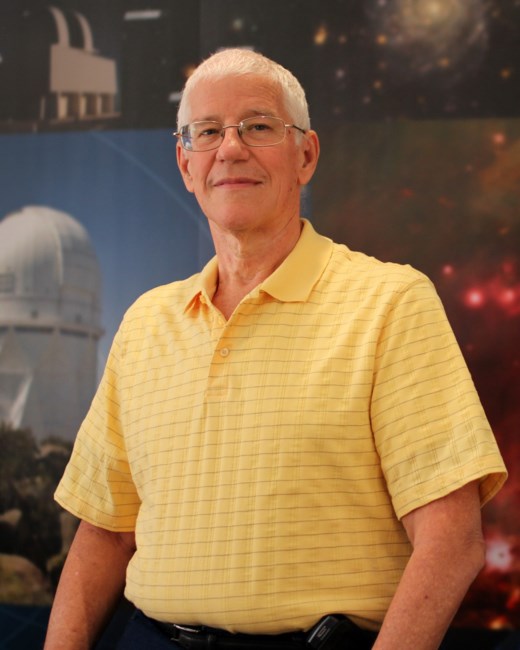
Mike grew up in Jamestown, North Dakota where he knew, at an early age, that he wanted to be an astronomer. He later attended the University of Denver, and the University California, San Diego. He met his wife, Boosik, while at the University of Minnesota, and they have been happily married for 33 years. He has been a source of strength, and a role model for his family. He always maintained a positive attitude, and his good humor kept us all smiling.
Mike is a strong Christian, always active in the church families to which he belonged. He enjoyed teaching children in Sunday School at the Korean United Methodist Church, but was just as much an eager student, yearning to learn. He recently found a comforting church home in Faith Community Church. His faith in Christ and his dedication to family has always been an inspiration.
Over his 43 year career as an astronomer, K. Michael Merrill was a leading developer of near-infrared and mid-infrared instrumentation, observing techniques, and the computer software needed to turn the raw data into science results. He was a catalyst for the growth of near-Infrared observing capabilities at the National Optical Astronomy Observatory (NOAO), based in Tucson, Arizona, and helped train generations of astronomers in the techniques of near-Infrared and mid-infrared imaging and spectroscopy. A 1969 summa cum laude (B.S. in Physics), Phi Beta Kappa and Sigma Pi Sigma graduate of the University of Denver, Merrill completed his M.S. (1971) and Ph.D. (1976) degrees at the University of California, San Diego, working with Wayne Stein and Fred Gillett.
During his time as a graduate student at UCSD and his subsequent tenure at the University of Minnesota (1975-1979), Merrill was a leading participant in the birth of astronomical infrared spectroscopy. He helped develop and deploy innovative near and mid-infrared spectrographs at several observatories. Working with a who’s who of early infrared astronomy, including Bill Forrest, Tom Soifer, Ed Ney, Eric Becklin, and Nick Woolf, Merrill was active in the initial near-infrared reconnaissance of planets, stars, and galaxies. These results included the first published spectrum, in a paper led by Merrill, of the 3.3 micron near-IR emission feature from a galaxy, now known to be produced by polycyclic aromatic hydrocarbons that are a ubiquitous component of organic matter in space. Scientists who worked with Merrill in those early years of near-IR astronomy valued his unique combination of knowledge, modesty, willingness to work hard, kind and friendly personality, and an apparently limitless reservoir of good humor.
In December of 1979, Merrill brought his skills and good humor to the National Observatory, joining the staff of Kitt Peak National Observatory, part of the NOAO. During the next 33 years Merrill was the consummate supporter of the mission of NOAO, enabling world-class astrophysical research by researchers awarded their observing time based on the merit of their ideas. Merrill was a key member of the teams that would deploy several generations of innovative near-IR instruments, including the Simultaneous Quad Infrared Imaging Device (SQIID), a multi-detector near-infrared imager and the NOAO Extremely Wide Field Infrared Imager. During his NOAO career, Merrill played major roles in near-IR detector development, observatory site characterization, telescope operations, and observatory management, including serving for the last five years as the Supervisor of KPNO Mountain Science Support. Throughout his tenure at NOAO, Merrill was renowned for his professionalism, empathy, equanimity, and caring for his colleagues and co-workers. His colleagues at NOAO will miss him greatly.
The memorial service for K. Michael Merrill will be held at Faith Community Church, 2551 W Orange Grove Rd. on Thursday, April 5, 2012, at 2 pm. In lieu of flowers, donations may be made to Faith Community Church for their mission programs.
Montrez votre soutien
Envoyez Vos
Condoléances
Partager
L'avis De Décès
Obtenir les mises à jour
Prestations de Service
Partager l'avis de décèsPARTAGER
- RECEVOIR DES RAPPELS
v.1.18.0