
AVIS DE DÉCÈS
Mr. Edmund W Kobelski
2 septembre 1913 – 10 octobre 2011
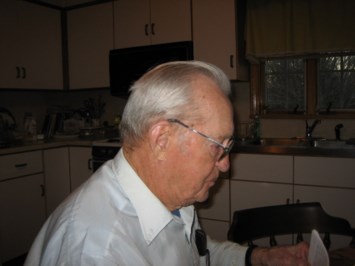
My life from the day I was born, September 2, 1913 in Brooklyn, NY
By
Edmund Kobelski
My father and mother were immigrants. Dad came to the United States in the year 1906 from Poland and Mom came after, in 1907. Both entered through Ellis Island, New York. My father and mother operated a grocery store on Union Avenue in Brooklyn. Dad worked for a file shop, while mother ran the store. My mother liked it in the city and was a good businesswoman. She told how nice it was to have the bakeries with fresh bread and to have running water and indoor plumbing. She told of running the store and getting paid in trade by men bringing stores off the boats like ham and sausage. Dad also ran a small bar and would worry my Mom some times when the patrons became too generous in buying him drinks.
I was born September 2, 1913 in Brooklyn, NY, then part of Williamsburg county. My mother was always reminding me that from the age of 3 I was the worse baby of the bunch (there were 9 of us). To keep me calm back then she bought me a cradle a swing and a rocker. She was very busy with the store and because of my fussing, she would tell me later, many times she was tempted to throw me into the East river.
Around 1917, Dad tired of the city and yearned for the country life so he packed the family and we moved to Eastern Connecticut . It may not seem like far nowadays but there were very few good roads and we traveled by ferryboat, which took us from the city and docked at the city pier in New London, Ct. To me it was the first time on the water and my brother Stan, who was 2 years older than I at the time, would come to my bunk and say “Eddie don’t sleep, this ship might sink!” My mother’s sister later told me this story. She accompanied us on the trip to the new home.
From the dock in New London, a taxi, that at the time was a horse drawn wagon, carried us to Oakdale in the town of Montville. My Dad had rented a farm on Chesterfield Road. My Mom cried back then. She enjoyed the relative comfort of Brooklyn with its indoor plumbing, readily available groceries and baked goods. She did not want to leave the city and come to the country. At that time, the country was wilderness, dirt roads, kerosene lamps, outdoor privies and only wood for heat. Nevertheless, my Dad was persistent. He didn’t feel the city was the place to raise his kids in the city and longed to work outdoors.
Despite the move, my father continued to work in New York, traveling round trip via ferry until he could find work and establish himself in his new home. He would leave us on the farm and come home every weekend until he found work in Connecticut. He began to develop his farm even as he was commuting and eventually found work in a paper mill in Montville.
At the time of the move, our family included three sisters; Lucille, Valerie and Elizabeth and three brothers: Joseph, Stanley and myself. It eventually numbered nine offspring, as three more brothers were born in Connecticut; Max, Henry and Alfred. We all attended a one-room schoolhouse on the corner of Fire Street and Chesterfield Road, called the Chapel Hill School, where one teacher taught all eight grades.
My Dad was used to farming because he worked on farms in the Old Country and having his own place fulfilled his dream. Today I am still thankful for the decision he made because I grew up being a country boy and loved it.
On the farm, we all had to pitch in with the chores, mostly the gardening. We also had cows, pigs, chickens and a horse plus one wagon, one buggy and a sleigh. Winters were cold, with plenty of snow, so we spent the good weather in spring, summer and fall getting ready by planting, harvesting, canning and otherwise storing food for winter
One of my earliest memories on the farm was when I was four years old. A neighbor’s horse was grazing and wandered into the swamp, that was about 200 feet from our house. While trying to free itself out of the muddy part of the swamp, the horse broke its leg and had to be destroyed. I didn’t really understand so I was scared. At the time, we had an upstairs window over looking the swamp area. I saw the man come with a gun and shoot the horse. In a little while, another man came who skinned the horse and left with the hide. Hides at that time were worth a lot of money. He left the carcass of the horse in the swamp. Some time later foxes and crows came and devoured the carcass until it was gone. This was 1917 and the country was full of wild animals and my being so young, I was terrified.
In the months of May and June, Dad would plant corn. When the corn began to sprout, he had trouble with birds, especially crows, as they would pull out the small shoots. The corn had to be replanted. When Dad left for work, he had Mom replant the corn. Mom would take a container of corn and a small garden hoe to do the replanting. While working one day, she heard a funny sound. There in the next row there was a large snake, the biggest she had ever seen. She described it as being as large and black as a stovepipe, that would make it about 6 inches in diameter. Having only a small hoe for defense, she was frightened, even though my mother was a strong person and wasn’t easily scared. She backed away slowly and came to the house. She told us about the snake and warned us not to go into the field. That night, when Dad came home, Mom mentioned the snake. In the morning, Dad when went to plow the field he did not see the snake. However, he was able to see where it had slithered. From the path and groove it made, he himself surmised that it was indeed a very large snake.
Shortly thereafter, my uncle from New York came to visit us for a one-week vacation. He loved to hunt. In those days the woods were full of game so he would take his shotgun and head out early in the day for the woods. While he was walking through the brush and open fields, he came upon a stonewall. As he paused, he heard a rustle on the opposite side of the wall. To his surprise, there was the biggest snake he had ever seen slithering through the dead leaves along the side of the wall. He was reminded then of my Mother’s story about the large snake. When he returned home, he told her, “Now I believe you. I was afraid and did not want to shoot the snake for fear of missing it and have it turn on me. I just backed away slowly and came home.” We described the snake to a neighbor who had lived in the area for a long time and saw many local snakes. He claimed at that time he had never seen one as large as described. Some time later however, in the summer of the same year, we saw where the snake had slithered through the meadow and over the sandy part of the dirt road. That evidence led people to believe what my Mother and Uncle saw was not an exaggeration.
As mentioned earlier, in those days, Connecticut was wilderness. The brooks, ponds, rivers and lakes were plentiful with fish and the woods full of wild game. Money was scarce, but we never went hungry. We worked hard and lived off the land. In the summer, I would help other farmers with their chores so I could earn a few pennies, around 10 to 25 cents a day. My father would take his produce to market with horse and wagon, leaving at 2 AM in the morning. He’d travel to New London on country roads of dirt and gravel until reaching the city where the streets were paved with cobblestones. At times we also went to the city of Norwich but mostly we traveled to New London. I would stay with the horse and wagon while Dad would deliver his produce consisting of corn, potatoes, cabbage, carrots and string beans. Sometimes we brought cottage cheese and eggs as well. At times Dad would park on the street next to the railroad station. We also would often park at the station close to where they would turn the locomotives around known as a roundhouse. Often the engineers would let off a blast of steam that would frighten the horse. Once our horse almost took off with the wagon but my dad ran up and grabbed the bridle and calmed, “Old Nick”, our horse down. I was six or seven years old at the time and was I scared? “You bet”. When the farmers got together in the marketplace it was like a barbershop where the exchanged all sorts of stories. One of those stories was about a horse that reared up from a blast of steam, kicked the wagon, broke the wiffle tree, tore the traces and ran home to his barn. When we were ready to head home, my Dad would buy me a cup of coffee and a jelly doughnut, which was a great treat. The coffee would be ten cents and the doughnut five cents.
In the Fall and Winter I would set traps, hoping to make a few pennies on animal pelts such as skunk, raccoons, muskrat and weasel. One time my brother Stanley caught a bobcat. What an experience! I was eight years old and he was ten. Our traps were of steel and stone. The stone traps were called dead falls. They were made of large flat stones. It would take two of us to set them, one to hold the stone while the other would set the trap made of wood called a figure four. The wooden part was whittled out with a jackknife or pocket knife.
Today this trap is outlawed. Every morning before school I would check the trap and would find either a squirrel, skunk, weasel, rabbit or game bird. It depended on the bait I used; a piece of pork, corn or apple. Squirrels were plentiful, fat and healthy due to wild berries, grapes, nuts and other wild fruits.
I hunted squirrels for food. Their nests were made with leaves high in treetops and tree holes. When hunting them I would watch them scramble into a tree hole. I would then put my hand in the hole and, if lucky, out would come a squirrel and I’d place it quickly into a burlap bag. On a good day we caught 3 to 5 squirrels. We would then prepare them for my mother . She would parboil them and panfry the meat with potatoes, onions, salt, and pork. For us boys it was a good meal. On the farm we always had good food. There were no supermarkets or even grocery stores nearby.. The closet store was two or more miles away and we wouldn’t want to hitch up the horse for a quick trip.
The years from 1920-1927 I was a young boy. When I look back, the country meant a lot to me, especially spring and summer, when nature came to life. Even the kids would help to make a little money when the vegetables were ready for market. My sister Elizabeth and I would hitch the horse (Nick was his name) and load the buggy with tomatoes, potatoes and carrots. Mom would have cottage cheese and eggs prepared for us to sell as well. My sister was 11 and I was 13 and we drove down to the villages of Palmertown and Uncasville. In those days there were only dirt roads some with tar on the surface. I remember the people we greeted. They were pleasant and amazed to see two children with a horse and wagon selling vegetables. My sister was the seller and I was the driver. How wonderful those memories of 80 years ago are when I look back. My parents were hard working people but we always had plenty. They were the golden years of my youth.
In the Spring, when nature opened up, the grass turned green, trees would bud and the colored wild flowers bloomed beautifully. Wild animals and game birds such as grouse, partridge, quail and woodcock were plentiful. In late spring my older brother and I would search for the new offspring of these animals and birds and bring them home. My Dad always made us take them back and not bother them because we could spoil nature’s plan. He said we could hunt them once they got older but insisted we let them grow first.
I brought home two little woodchucks one day. They were full of lice! They were cute but I had to return them. Another day we scattered a female grouse from her nest filled with 12 eggs. We gathered them and brought them home, fried and ate them. We got away with having scrambled grouse eggs but knew if my folks were home the eggs would have to have been brought back to their nests. To add to this story I can recall the day I went grouse hunting with my dog Sport. We came upon a thick forest of laurel bushes. Peering through them, I spied the tops of two one gallon jugs. They were covered with leaves and small branches. I took one, pulled the cork and smelled the contents. It was alcohol! I picked them up and moved them to another place and went on hunting. Later, at home, I told my Dad about the jugs. He said to bring them to the house. I did as was told and he sampled one. Right away he looked at me and said “Moonshine!” It was Prohibition at that time and alcohol was illegal. I knew of a family, long gone now, who had a still back in what is called Deep Hollow Brook, not far from Black Ash swamp road. I came upon their still where they made their alcohol when I was a small boy on my way to fish for trout. That still is gone today but I swear that is where those jugs came from. Black Ash Swamp drains into Deep Hollow Brook and empties into the Thames River basin. It runs a little more then ten miles through parts of Montville and Waterford. The Black Ash Swamp Road is about 2.5 miles long and only had two farm houses and the family farm closest to Deep Hollow Brook owned the still. Every once in awhile the police would show up and raid the Moonshine makers when they heard about it from neighbors.
There were with no phones, dirt roads, kerosene lamps and horse and wagons in those days. Haying time on the farm meant the hay was cut and moved by hand. Scythes were used for cutting hay. My uncle and my Dad would cut side by side. One day while mowing my Dad sent me to people who had the moonshine still. Barefoot, I took a two quart jar about two country miles to the house with the still. When I arrived, a woman came out and asked my name. She said she knew my father. She asked me to follow her and we went to a well in front of her house. It had a long rope and steel pulley. She brought up an old oaken bucket on top of which was butter, cream and cheese. Beneath the dairy food was a gallon of moonshine and she filled my 2 quart jar. I paid her two dollars and she cautioned me not to drop the jar because it cost money. I called them Moonshiners, the “Speakeasys” of the woods. They were young, drunk all the time and fought like hell.
One day my oldest brother, Joe, came home from work with a little puppy dog. He was the cutest thing I ever saw. We named him Sport. At that time we lived on my aunt’s farm and Sport became my companion until he eventually died.
Eventually my father had scrupulously saved enough money and was able to buy his own farm next to my aunt’s place. My dog Sport went with us, of course. When we moved into our new home it consisted of a house, barn and a small chicken coop. My father eventually built a new barn and the old barn, across the road from the house, is long gone. Later, my brother Alfred built a new home on the site.
At the time, automobiles were just starting to appear in western Connecticut including Model T Fords, Buick’s, Dodge and many others. We moved with horse and wagon and brought along the cows, chickens and a couple pigs. Our new house had been built in 1784 and, to this day, is still occupied by family members. I found out when the house was built when Dad was remodeling. I helped of course and, during the remodeling when taking down the stone chimney, we removed a flat stone, which was part of the flue. On that stone was the inscription 1784. Thinking back now, I wished I had saved it.
At this point, I have to go back in time a little. In 1924, Dad bought his first car, a 1924 Ford Model T sedan four-door touring car with side curtains. It had no heater so when we went riding we carried a felt blanket to keep warm. One day my father told us we were going to visit my aunt and uncle in Hartford, Connecticut, which was about fifty miles from our home. As a kid, I thought it was a fabulous ride. The routes we took were 85 and 2, the New London-Hartford Turnpike. They followed the path of least resistance for the early road builders and I remember about ten curves in the town of Glastonbury alone. Today those curves are long gone. The scenery remains but not quite as it was. We now have a four-lane highway in place. Times change as years go by, more people and more automobiles.
I was a boy that could never sit still. Every chance I had, once my chores were done and sometimes not, I would sneak off fishing and hunting with my dog Sport at my side. Sport was always with me. Sport was a great squirrel and bird hunter. The minute I would pick up my 22 rifle, Sport was at my side ready to go. The minute we walked into the woods he would tree a squirrel. He would go to the opposite side of the tree, the squirrel would come done and I’d shoot it. Then “Old Sport” would pick up the squirrel, get back on his haunches and have his meal for the day. All that he left was the tip of the tail and that is when I thought he might have wolf in him. As we continued hunting deep into the woods, Sport would often stop short. A grouse would fly out like a bullet from the underbrush and if I were lucky I’d knock it down. Hunting with Sport will always be a happy memory.
The Chapel Hill School I attended was a one-room building about forty feet from our land and about 250 feet from our house so I had no excuse for being late to school. While at school and after school I had chores to do like cleaning the barn and getting wood for the stove that my Mom used to cook with and keep the house warm.
Here is a bit more information on my school days. I was a good boy and sometimes played jokes on my friends. I remember one little girl who sat in front of me. She had long blond hair. She also kept a handbag in her desk. At times she would open her handbag and look in her mirror. One day while walking to school I found a little spotted turtle. When I got to school, I placed the turtle in her handbag. When she opened her handbag she fainted. I spent an entire week apologizing. I had to write a hundred times on the blackboard, “I will not put a turtle in Rosie’s handbag”. Sometimes, I would bring a little green snake to school and make the girls scream. I started school when I was six years old and I had five teachers until I graduated in 1927.
I was eight years old and we boys were great squirrel hunters. We initially had no guns, just a dog. One Sunday, my cousin Walter with his little beagle hound and I took off to the woods. While hunting, my cousin asked me if I wanted a chew (tobacco). At that time, most country boys chewed tobacco. It was the first time for me. I put the tobacco in my mouth and pretty soon had a dizzy spell and felt nauseous. I left my cousin, headed for home and threw up all the way. My mother asked me what happened but I really didn’t say. I knew what the outcome would be if I said I was learning to chew tobacco. She gave me a cup of tea and I went to sleep. Let me tell you it was a lesson learned and I never chewed again.
I always dreamed of pond fishing and trout brooks. Every chance I had, I would take my fishing pole and rifle, call Sport and take off for my favorite pond called “Toad Hollow”. It was a pond always full of fish such as perch, pickerel, sunfish, catfish etc. Many times I would come home with a string of fish. When I caught some large pickerel, Mom would make fish chowder. Mom was a very good cook. The trip to the pond was about two and one-half miles from home, all woods by way of some old paths made by early settlers who traveled by horse or on foot. I would come across some old foundations where people had homesteaded but were gone by then. On my fishing trips with school friends, coming back with a string of fish, we would stop at an old mug cellar, start a fire and have a fish roast. Sometimes we even roasted frog legs, as we kids were always hungry. I want to explain what a mug cellar is. Its made of stone walls on three sides, seven to eight feet high and eight to ten feet wide. It had large flat stones for a ceiling and a roof covered with loam and sod. The doors were made of wood. Some cellars were ten to 15 feet long. It was a storage place for food made by the early settlers.
There were times when the horse needed shoeing. My Dad would ask me to hitch the horse to the wagon or go on horseback to the blacksmith shop, which was about a two-mile run to Chesterfield. A Mr. Zaist had his shop at the junction of routes 161 and 85 in the village of Chesterfield. Mr. Zaist was an old country smithy from Poland. He settled here about the same time my Dad and others arrived in Oakdale. If the horse needed new shoes or if the shoes were still good he would repair, adjust or replace them. I started for home on that cloudy and rainy day in late March when two little skunks decided to cross my path. I stopped the horse and wagon and grabbed my burlap bag. I grabbed each by the tail and through them into the sack and did I get peppered by their protection! “Phew”. When I got home, my Dad demanded I take the skunks back to the woods and release them. I said “There goes my new pets”. I buried my clothes and when I recovered them the next day the scent was gone. That was my Mom’s remedy.
Blueberry picking season was in late June and early July when both the blueberries and huckleberries were ripe. I would go picking, trying to make money at 10 to 15 cents a quart. We mostly sold them on weekends when people with horse and buggy would ride to explore the countryside. Autos would come by once in awhile. Model T Fords, Buicks and Chevrolets would appear and we’d be overjoyed and excited to see these first cars. I told myself those were city folks and probably rich. Blueberry picking was always great. We picked the farms where cattle would pasture and where the best picking was. I went on one farm of 200 acres owned by a Mr. Morgan Chaney, partly in Montville and Waterford. It was called Morgan Chaney’s Ranch and he trained horses for the army. He also had a ranch in Texas. He bought about 100 head of Brahma cattle to graze on the ranch On one sunny day, picking blueberries on his ranch walking about one mile through brush and pasture and heard a noise while picking. I looked up and a herd of cattle were coming towards me. I decided to head for the woods, threw my bucket towards the cattle, figuring it would halt them. The first tree I came to I didn’t miss a branch. I was up there. Those Brahma steers are wild and mean. Three of them followed me to the tree. I sat on a limb, throwing bits of branches. One left to join the herd while the other two pawed the ground and snorted. I kept harassing them and they finally left. I got down and never returned until the cattle were gone. Mr. Chaney’s ranch is a now nature trail which he donated to the State of Connecticut. He was a native of Connecticut. He also ran great rodeos that we often attended and never missed. One time the cowboy philosopher himself, Will Rogers, was a guest at the ranch. Mr. Chaney eventually retired to Texas.
Now, back to growing up on the farm. I was fourteen or fifteen years old when one day Dad and I were cultivating the corn fields while leading the horse through the rows of corn. I had a pack of Liberty tobacco in my back pocket. Back then I rolled my own cigarettes. I took a wad of tobacco, placed it in the palm of my hand and then put it in the horse’s mouth. In a second it was gone. A little while later, while bending down to adjust the corn “Old Nick” (the horse’s name), reached down, and grabbed my back pocket where the tobacco was and he picked me off the ground. If he had gone a little deeper, I would have been short some flesh. After that, I placed the tobacco in my front pocket. There are so many memories of those days.
Living off the farm, we had to work long hours to produce our food. Of course, at times, I would try to earn a few pennies and save enough to buy shoes, pants and overalls. Most country boys wore overalls. Back then they were work clothes, meant to get dirty. Today people wear them as dress clothes.
When I was 12 or 13 years old I started to smoke. I would find cigarette butts along the road or smoke dried corn silk. At times, I would snitch a cigarette from my Dad’s pack. Even so, every once in awhile he would scold and say, “Whatever you do, don’t smoke!” especially when you are so young. My father smoked and it took its toll in his later years. I smoked until I was 26 years old then gave it up and never smoked again.
As I mentioned before, there were plenty of wild fruit trees, cherry trees especially. My brother and I would spread a big blanket under a tree and I would climb up and shake it and the cherries would fall on the blanket. This process was much easier than picking cherries by hand. Mom and Dad would make three to five gallons of cherry wine and use it for medicinal purposes. If we had a cold, my mother would add the wine to a cup of tea and it would help cure the cold. Today there are still some cherry trees growing but they bear little fruit. I believe air pollution is part of the problem. It seems like around 90% of the trees today are stunted. I remember when hunting or hiking through the woods I would come upon apple trees loaded with fruit and also find blueberry and huckleberry bushes filled with berries. Today most of those trees are gone along with the berry bushes. Maybe when we clean up the oil and gas pollution and toxic waste, nature will have a chance to survive and recover. For someone who has seen things in nature like they used to be it is discouraging. We still have a lot to clean up.
There was always plenty of snow in the winter. When walking to school, many times the roads were covered with three or four feet of snow so we walked on the high banks and stonewalls. Most country roads had stonewalls along the sides built by the early settlers. The stones came from the fields while clearing the land for agriculture. The stonewalls were also used to keep the livestock within the premises since, at the time, barbed wire hadn’t yet been invented. The people in those days when building their homes, barns or other structures, built on the poorest part of their land. The purpose was to leave the good land for grain and vegetable gardens.
While in school we read history about the American Indians. The Mohegan tribe lived in our area. Their settlement was on the upper Thames River, which is in Montville. They called it Fort Shantok. I used to hear the old timers tell how the Indians would leave Fort Shantok in their hunting parties and travel to Moodus, Connecticut that is south west of the Fort. Their trek would take them through Montville. Salem, East Lyme and Hadlyme. I’ve heard the old timers say that the land I own is close to Deep Hollow Brook where the hunting parties would travel. I still find spots where they had small campfires while on their hunting trips. Today, their paths are covered with brush and trees, hardly recognized. Even the land around Fort Shantok has become the site for a very large Casino. On my land, when my father was farming I found arrowheads, some still in good shape but most are broken due to plowing and dis-harrowing. The fields exist where the Indians planted corn, beans and squash. I have about a full quart of broken arrowheads I’ve collected. I guess my land was part of the Mohegan territory back in the 1600s.
One day I walked into my mother’s kitchen and sitting at the table were two young girls I judged to be about 7 and 8 years old, one with dark hair and the other with blond. They were selling vegetables and flower seeds for spring planting. They introduced themselves as Mr. and Mrs. John Pilecki’s daughters who lived about 2 and a half miles south on Fire Street road. The dark haired girl had a lot of freckles on her face and looked like a little gypsy. I was later told that Pilecki neighbors actually called her gypsy girl because of her long dark hair. As time passed, one day when I was walking past my sister’s house on Fire Street, I saw that same raven-haired girl again with all those freckles helping my sister with all her small children. In those days I was pretty good at walking on my hands and felt I could go about a half mile that way. In a bit of showing off for that raven-haired beauty and to entertain the small children I did some hand walking. The children sure enjoyed it and I suspect I was at least a bit noticed by that pretty girl. When I left that day, little did I know that one-day that girl would become my future wife.
There was always some excitement around the farm, especially with the animals and fowl. Once while I was keeping busy with chores I happened to walk by the house. My sister’s little girl, Irene, around a year and a half old, was being attacked by our black Jersey Giant rooster. The bird flew up on her shoulder and started to peck on her head. She was lucky I was there because I immediately hit him with my fist and knocked him to the ground. Some of those birds were mean and that one surely was. I immediately went and told my mother what happened and she told me to get rid of the bird. I had a hard time trying to catch him and, in the end, I got my 22 rifle and shot him. That bird weighed about ten to twelve pounds so of course, my Mom cleaned the bird and the next day we had a good chicken dinner and some mighty fine chicken soup.
A fox, a weasel or an owl, would raid our chicken coop and it would create a ruckus. It happened many times. The screech owls would also help themselves to a pigeon or two and we would try to set steel traps in the small openings where the pigeons would roost above the chickens. That ploy didn’t work so we just closed the entrance at night and it stopped the bird kills.
The nights were especially clear and one could listen to the many different sounds then that are long gone today, as the farms have disappeared. When things were quiet I would sometimes mimic a dog’s howl and then listen to 7 to ten dogs from nearby farms, each of which had at least one or two, serenade me with their howls in return. The environment was so different. Most folks in the country lived on small or large farms, the cities were small and far away and the connecting unpaved roads were of dirt or gravel. There were no streetlights and automobiles were few and it was a rare event to see one. At night the stillness would be broken by the moo of a cow, the neigh of a horse the squeal of a pig. You could clearly hear a rider coming on horseback or see a farmer on his buggy moving along with a lantern tied to the back. Darkness didn’t seem to matter to the horses they seemed to be able to see as well day or night...
Then came the Great Depression days, before I was old enough to work. High school for me was out of the question. I stayed on the farm and helped clean land. Such as cutting brush, digging out stones, burying big stones, building stonewalls and helping with plowing and planting. I got my first actual job away from home on road construction. There we maintained roads by doing such things as loading trucks with gravel, spreading it on the surfaces and building culverts. This was pick and shovel work. We’d oil roads with tar, and then with hand and shovel we’d cover the tar with sand. We’d also clean culverts, catch basins and all other forms of road maintenance. In the early years of 1929 and 1930 you were lucky if you got 9 days work a month from the town so I was always looking for more. In 1932, I got a job with the Robertson Folding Box Paper Company. Because of the times, that work didn’t last long either and, shortly after, I went to work for the Robert Gair Paper company. I worked there for about two years and then was laid off. The Gair Company shut down and moved out of town.
As time went on I went to work on road construction for Zaist Brothers Contractors of Chesterfield, Connecticut. After that I went to work for Charter Oak Construction. They were out of Hartford, Connecticut. Those days were “Catch as catch can”. Times were hard and work was scarce. Because of the shortage of jobs I often spent more time at home on the farm where there was always a bed and food plus plenty of work with my Dad.
At one point, my oldest brother Joe, who had found work in New Jersey, suggested I visit him and perhaps find work with him. He was working at Gibraltar Corrugated Box Company, a company that made paper boxes. I accepted that invitation, borrowed $10 from my mother, took the ferry from New London to New York and met up with my brother. I was accepted for a job and made $19 a week and lived with my brother at a rooming house where room and board was $9 a week. In roughly six months the work started to slack off and the mill was down to 2 to 3 days a week. The corresponding cut in pay made it so I couldn’t meet my living expenses and I decided to return to the farm. I was able to save the $10 I borrowed from my mother and paid that back, apologizing for not giving her any interest.
I soon went to work for a retired businessman by the name of William F Bogue. He lived in Norwich, Connecticut and owned a hotel in Stafford Springs, Connecticut. I became sort of a handy man. Mr. Bogue also owned land on Chesterfield Road in Oakdale near the reservoir for the City of New London. I became caretaker of his Colonial home in Oakdale that was built in 1830. The house was across from the Bogue’s Brook Reservoir. On the property he raised chickens, ducks and pigs. Although he owned a beautiful home in Norwich, he drove out to Chesterfield nearly every day, roughly 20 miles, to enjoy his family’s old homestead. He paid me forty dollars a month to live there and $2 for every day I worked. He always brought plenty of food with him as well and I learned to become a pretty good cook. He truly became the gentleman farmer in his retirement.
Mr. Bogue had another parcel of land of about eight acres, which was not adjacent to the old homestead. On that land he wanted a stone house and asked me to build it. There were plenty of stones on the land and I became very excited because I always loved to work with stone. I started work on that house the following year in 1938.
Around that same time one evening I was playing cards with my cousin Walt . Getting bored, we decided to take a ride into New London to Ocean Beach. We took the back roads, Fire Street ran from Oakdale to Waterford and into New London. Driving by one of the farmhouses we passed two young girls sitting out front on the grass. It was the Pilecki’s home on Fire Street I mentioned earlier. We went by but then I convinced Walt to stop and drive back and introduce ourselves. At first the girls were reluctant to speak with us but one of them went into the house and soon came out again. After a while they seemed to believe we were well intentioned and knw we were neighbors. We therefore were able to convince them that our intentions were honorable and asked them to take the ride to the beach with us. We drove to Ocean Beach and, as we parked overlooking Long Island Sound , we could see a storm brewing. Little did we know that the next day would bring the Hurricane of 1938, one of the worst to ever hit Connecticut. After the brief acquaintance on that ride we drove them home.
The next day at work, despite the storm, my thoughts were about getting to know that one girl with the dark hair a bit more. I knew the family name since they lived down Fire Street just a few miles from my home and soon I stopped by to see her again. Neither of the girls were there. The family told me that when we had met them previously, the daughters were home on vacation from New York City where they worked. That dark haired girl, who eventually was to become my wife Steffie, was an assistant to a lady at Shraft’s Restaurant and Bakery in New York City, one of New York’s finest. She lived while working there with her aunt in Brooklyn. Through her family I remember getting her aunt’s phone number and calling her. I said I wanted to meet her again and she told me she would be coming home to her folks again in about a week and that I could come and see her then if I’d like. That got me thinking about what she meant. If I’d like? I wasn’t sure if it was yes or no. Nevertheless, I took it as a yes of course. We met when she came home and had a true first date. One thing led to another and after a brief courtship we were married in 1939 at a church in New London and had a real home reception at her parent’s farm. Everyone brought food and her father built a nice dance platform. My brother Max and three of his friends furnished the music. It was a wedding one would not forget.
For our honeymoon we went to Washington, DC and a tour of our Nation’s Capitol. From there back to New York and the World’s Fair of 1939. In a little over a week we settled into the home in Chesterfield where I remained the caretaker for the retired owner.
I continued in the construction of the stone house and completed it except for the interior painting and plumbing. The stone house was completed in 1940. It took two and one half years to complete. The house was 42 feet by 24 feet. There was also a full basement and a four-car garage. My original salary was 2 dollars a day and in 1939 I received a one-dollar a day raise. Today, one could not build a stone house of that size unless one had plenty of money. In those days for what I received for one month’s salary would today be a day’s pay for an unskilled laborer.
We had no electricity in the house because electrical power still hadn’t reached that far into the country. It wasn’t until 1946 after the War was over when most rural areas were getting electricity and that is when that part of town received it.
Eventually, the city of New London bought the land and the house Steffie and I were staying in from Mr. Bogue because it was located too close to the reservoir. Since the stone house was on a different parcel of land, it remained in his possession. I wanted to buy the stone house and the land but the price was too high.
When World War II started in 1941 I left Mr. Bogue. I didn’t have any work right away but found a job with a construction contractor and Steffie and I rented a small house. The War changed things very quickly. Most construction jobs ceased as the government took control of much of the heavy equipment. The contractors either gave up private work and went into the service or to work for the government.
Although I tried to sign up, I did not make it into the service. I took the physical and was rejected for some reason that wasn’t discussed. To this day I don’t know why I was rejected. Curious and bothered, I went to my Doctor the next day and he gave me an exam, a clean bill of health and told me to go home and relax. I did have some severe back trouble at the time but my Doctor always seemed to find a way to help me. I don’t believe that was what caused my rejection. It does go to show you the state of medicine back then because here I am at 91 years old still wondering why I was physically unfit to serve my country.
I went to work for the State of Connecticut Department of Transportation shortly after the beginning of the War.. I had a long career with the department and moved through the ranks to eventually become a foreman. The work wasn’t always easy and many a night I’d find myself responding to problems or out plowing in a snowstorm. However I stuck with it and in the long run, the job helped us make a good life. I retired from the department after thirty years. I was far from through making a living. In 1972 I became a deputy sheriff for New London County. I moved a lot of prisoners between the jail and the courthouse. I worked under the offices of the High Sheriff, James McDermott. Three years after signing on, Sheriff McDermott retired. I stayed on with newly elected high sheriff Thomas Martin. After 15 years, I retired again to my private life, traveling once in awhile and keeping busy on my small spread. I started raising a few beef cattle, mowing a little hay, cutting wood for home heating, clearing land and building stonewalls. I actually rebuilt a stonewall that was torn apart when the town reconstructed and oiled the road. My Dad had given the town enough land to widen the road in 1930. At the time the road was only about 14 feet to 16 feet wide. My Dad asked that the stonewall be rebuilt, but the town was short of money and the stone masons charged 65 to 75 cents per hour. The town elected instead to put up a barbed wire fence to replace the stonewall which was less expensive. I told my Dad then that maybe someday I would replace the barbed wire with a fine stonewall and it became my pet project over these many years. Today it runs along the part of the old farm on Chesterfield Road.
Getting back to when I first started with the State Of Connecticut and the early years of our marriage we had many projects to keep us busy making a home. As soon as I felt that the job was secure and steady, Steffie and I started building our own home. My father had given me a track of land to build on, so with pick, shovel and wheelbarrow we started. We first dug out the cellar using shovel and wheelbarrow and built the foundation using native stones. We used every large stone we uncovered for our foundation and although with World War II going on, it was hard to get materials we eventually obtained enough to close the house in. Little by little, as we could afford it, we started on the house. When we had two rooms built, the kitchen and a bedroom, we moved in. I also built a small outhouse, which I called the “House of Necessity”.
The next major project was water. I dug a well 350 feet from the house on higher ground, dug a pipeline by hand, 3 feet wide by 350 feet long and made sure the water was gravity fed so we didn’t need a pump. After we moved in, I used every spare minute I had to work to finish the house.
There was no electricity at the new home either because the power lines hadn’t come to our area yet so we were truly rural and had to manage without many things people take for granted today. There were no power tools, only kerosene lamps to see by and wood stoves for cooking and heating. It wasn’t until 1947 that the President signed into law that all farmlands and rural roads would have electrical power.
Our home today stands on the same premises where my wife Steffie and I built it together. Before I dug the well and had running water in the house, my wife used to wash clothes at our spring, which was about three to four hundred feet from the house. It still is running today and never goes dry. It forms a little stream and flows into Deep Hollow Brook and ends up in the Thames River. Years ago, as a young boy going to school, the old timers had a footpath which hauled water from that spring. I can remember when brook trout swam up to spawn. I caught some beautiful trout in the big brook called Deep Hollow.
Our home was next to my father’s farm where he raised vegetables and also had a few cows and chickens. The latter mostly to supply the family with milk, eggs and a chicken dinner once in awhile. Dad was known as a truck farmer, selling his produce by driving into the markets in New London and selling it to vendors there.
Dad passed away in the mid-fifties and Mom was left alone on the farm. They had lived together to see their 50th wedding anniversary. Because we were a large family, help was always there for her. Some time after Dad’s death, in order to keep the spirit of the farm alive, I bought some beef calves, and started a herd of Angus cows. Since mom continued to stay on the farm I tried to keep it going. I went out and bought a tractor, a mower and a rake for haying and we made hay, rain or shine for 35 years. Things began to change quickly. Land that was once full of blueberry bushes and grazing are soon became a housing development. Traffic picked up immensely and the roads were widened and the speed limit increased. It was then I decided to quit raising beef and sell off the herd. I kept my equipment however and kept the fields clean and bailed and sold hay to people with horses. It wasn’t long before I was tired of doing that. The equipment itself was wearing down. Quitting is not in my vocabulary however and I could never see myself being idle. Steffie and I are still doing what we love, especially in the summer. She has a wonderful green thumb and always had a large spread of flowers at our home. People driving buy would stop to admire her garden and rave about the colors and the fragrance.
Steffie does not grow as many flowers now although her love for them is never ending. Our home, which we proudly built with our own hands and planted the gardens and trees around it, although small, is still wonderful to us. Had we been blessed with children, we had the space and certainly the ambition to make it as large as we needed. We have both hills and flat areas on our lot. I call it our hole in the hill although Steffie laughs when I say that because it makes her think of the many animals we have nearby who actually do have their homes as holes in the ground or, in our case, in the hill. I have a never ending job now in taking care of the buildings, keeping the land and pastures clean, cutting wood for our furnace, repairing old stone walls and building new ones. I even have replaced old barbed wire fences and wooden ones, several originally built by the early settlers. Those old rail fences were made of American Chestnut, which I believe is not to be found anymore. When I was young there were still some in existence but today I do not think any exist. A beautiful tree, the American Chestnut, one of the greatest, lost to the press of civilization.
This about concludes my story of how I lived my life. I hope those of you who get a chance to read this story will enjoy it as much as I had writing about my life of 88 years in Connecticut. What the times were like and how things have changed. My wife Steffie and I still live on the same land and in the home we built together and God willing, hope to continue the way we are. As for me, I’ll always remain a country boy.
Complete and unabridged as the author wrote it with some very minor edits.
Montrez votre soutien
Envoyez Vos
Condoléances
Partager
L'avis De Décès
Obtenir les mises à jour
Prestations de Service
Partager l'avis de décèsPARTAGER
- RECEVOIR DES RAPPELS
v.1.17.0