OBITUARY
Lenna Erica Jones
13 April, 1935 – 24 October, 2025
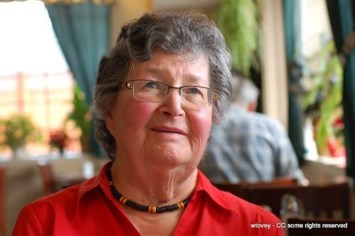
Lenna Jones died peacefully at the age of 90, following a long illness. She is survived by her children Carolyn, Toni, and Faith Jones, and their partners Meic Haines, Brian Lobley, and Winnifred Tovey, as well as numerous cousins in the Harrison, Shapiro and Jones families.
Lenna was born in Pasadena, California, although the family was from New York and returned there shortly afterwards. Lenna spent her childhood in Greenwich Village, surrounded by other left-wing, bohemian Jews as well as a diverse community of immigrants and artists. Her earliest political action was decorating matchbooks to sell as a fundraiser for the Abraham Lincoln Brigade. Her family was targeted during the McCarthy period and moved to Cincinnati to find employment in industries that often evaded HUAC scrutiny. Shortly before leaving Cincinnati to attend university, she met her future husband, Louis Jones. They both attended University of Chicago, where Lenna received a BA and then began law studies, which she quickly abandoned due to the conservatism of the field. After marrying, the couple moved to New York where Lenna pursued her Master’s degree in Social Work. Lenna and Lou then moved to Ann Arbor, Michigan, for Lou’s PhD program, but they quickly realized they were both unhappy there. In early 1961 they made their way to revolutionary Cuba via Mexico, as travel was suspended from the United States. From the airport they took a cab to a mass demonstration in the Plaza de la Revolucion, catching Fidel mid-speech. They were encouraged to stay, and within a few weeks they were housed and put to work. Lenna found a position in the Ministry of Education, where she had the unique opportunity to create country-wide curriculum for the rapidly expanding education of a low-literacy nation. She is credited with being one of the central creators of the “circulos de interes” system for vocational education, a program which continues to this day. She learned Spanish as she worked, eventually publishing professional and scholarly articles to assist educators throughout the country in using her pedagogical system. All three of her children were born in Cuba.
In 1966, the family returned to New York, where Lenna and Lou separated and later divorced. While serving as a social worker at Mount Sinai Hospital, her workplace was visited by federal agents empowered by HUAC, who demanded she be fired. A quick-thinking secretary made sure to lose the paperwork before it reached Lenna’s supervisor; Lenna was not even made aware of her “firing” until she handed in her resignation a few years later, when the secretary confessed. In 1969, with New York City in bankruptcy and schools lacking basic facilities, Lenna took her children to Toronto.
In Toronto she supervised provincial social work teams and spent time traveling through the province. Lenna developed close friendships with a number of women, some of whom she later maintained life-long friendships with. These included Lilein Schaeffer, the activist nuns Judy and Peggy, Freida Forman and Curdell Turner.
In 1974 she moved the family to Vancouver, where she lived until her death except for one year spent teaching English in China.
In Vancouver her community became focused around the women’s movement and her union (CUPE 389). During the long 1981 civic strike, footage of Lenna pushing her way into City Hall to protest became the regular visual background for television reporting on the strike. Her later move to the Commercial Drive area cemented her relationships with activists in a wide variety of social movements. Close friends such as Aphrodite Harris, Marcy Cohen, Marion Pollack, Tim Shireman, Bernadette Stringer, the Engler brothers, Janet Patterson, Susan Dales, Wendy Frost, and many others, supported and strengthened her social activism. Pat Davitt, with whom she walked picket lines during the civic strike, became a favourite travel partner and companion at musical events, and inspired Lenna’s interest in visual art.
After her retirement, she threw herself into two new endeavors. She became active in the Jewish movement for Palestine through the organization Independent Jewish Voices, and she became a docent at the Vancouver Art Gallery. These two responsibilities balanced her desires for justice and for beauty: bread and roses. Already in her 70s, at the Art Gallery she gained an entirely new circle of friends among the docents, a group that became known as “The Posse.” They explored modern dance and experimental music, tried new restaurants, and supported each other when crisis hit. Lenna also gained a new group of friends a few years later when she moved into the Laura Jamieson Housing Co-op, where she was welcomed by new friends such as Louise Leclair and Barbara Pulling, and old friends such as Esther Shannon. She was also able to spend considerable time with her two daughters who live overseas in Australia and Wales. Her frequent, lengthy visits to these countries stimulated new interests in art, music, history, food, and politics.
The last few years of Lenna’s life marked a slow, devastating decline, which infuriated her and reduced her ability to take pleasure in life. She did not lose her capacity for friendships, however, with her daughters’ childhood friend Pamela Dettwiler emerging as a fourth daughter, and a young companion hired by the family, Shiwani Shrestha, becoming another adopted family member. The family is grateful to Windermere Care Centre for their extraordinary care and endless consideration during Lenna’s final year, and to the many friends who continued to visit her until the last days of her life. In her memory, donations may be made to Independent Jewish Voices or any other group fighting for the rights of vulnerable people.
Show your support
Add a Memory
Share Obituary
Get Reminders
Services
SHARE OBITUARYSHARE
- GET REMINDERS
v.1.18.0