
AVIS DE DÉCÈS
Juri Jurisson
1 novembre 1928 – 30 avril 2015
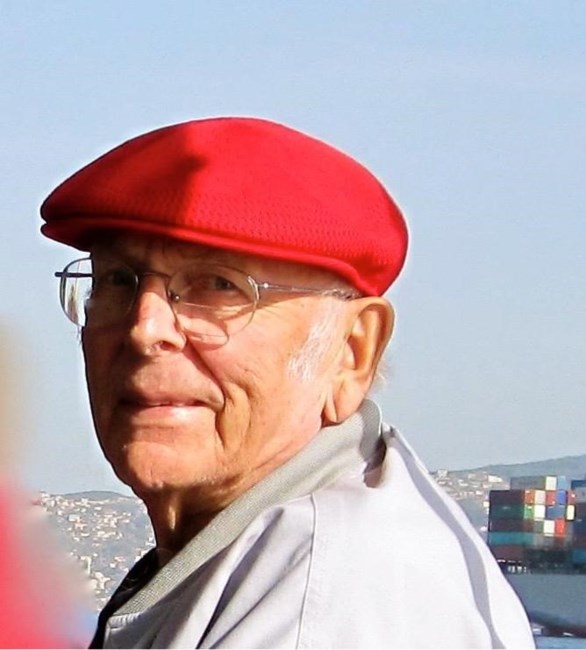
Juri Jurisson was born on November 1, 1928 to Woldemar and Ida Tonismann Jurisson, who lived on a large farm near Vandra, Estonia that had been in the family for many generations. Juri was baptized at the local Lutheran church and attended grammar school in Vandra. The Jurisson farm was in a small town in a remote corner of a tiny county at the far northeastern edge of Europe, but it was not remote enough to escape the cataclysmic, life-altering events of WWII that claimed the lives of so many millions of innocent people. Juri, along with his brother Jaan and his cousin Varjo were among the more fortunate Estonians of that era. Fleeing their homeland in 1944 as teenagers, as the USSR invaded Estonia for what would be the final time, they traveled through Eastern Europe on foot, by boat, by truck and train, eventually arriving in Germany, though becoming separated along the way. At the close of the war, the three were reunited. Juri and Jaan were brought to the United States as part of one of the largest humanitarian efforts in history, the resettlement of millions of refugees left homeless and stateless as a result of WWII. The Lutheran Church, along with several other churches, played a prominent role in that resettlement effort; the brothers were met by the Lutheran Welfare Society, and taken to North Dakota, where Juri was enrolled as a boarding student in Oak Grove Lutheran High School in Fargo, ND, and Jaan was enrolled as a freshman at Concordia College in Moorhead, Minn. Soon after, through the determined efforts of his brother Jaan and the profound kindnesses of countless good people in North Dakota and Minnesota, Juri joined his brother at Concordia College. To earn money for college, during several of his summers he worked at a construction company, where he learned the skills of house-building: brick laying, plumbing, carpentry, roofing, cabinetry, and his favorite, electrical work. Midway through his college years, war interrupted Juri’s life once again, when he was drafted into the Army during the Korean conflict. After two years of service, he returned to Concordia College and completed a bachelor’s degree in mathematics. Juri started his career as an electrical engineer at the Western Electric Company in Chicago, Illinois, where he shared an apartment with his cousin Varjo, who had also made his way to the United States after the war. Juri worked in both telecommunications and defense projects at various subsidiaries of AT&T, including Bell Laboratories and Lucent Technologies. While in Chicago, Juri met his future wife, Geraldine Lien, a career woman and professional Home Economist who had a radio program in Chicago, and who was also a graduate of Concordia College. Set up on a blind date by a mutual friend and chemistry lab partner from college, their first date was at the Berghoff, an old German restaurant in the Chicago Loop, nearby to Geraldine’s office. Juri and Gerri were married on July 18, 1957, and lived in Chicago for two years, until Juri began working in defense projects at AT&T. Because of this assignment, they had the opportunity to live in many regions of the United States, including Madison, Seattle, Cape Cod, Virginia, Chicago, and Denver. Through this experience they gave their three daughters, Cindy, Doris, and Ila, the remarkable opportunity to become well acquainted with and deeply appreciative of a wide variety of people, places, and traditions across the United States. Most important of all, because of Juri and Geri’s love and devotion, despite an unusually peripatetic childhood spent crisscrossing the United States by car, attending many different schools, and memorizing new phone numbers and addresses every few months, their daughters learned early on the truth of the old saying that home is where the heart is. They also learned from Juri and Gerri the importance of hard work, persistence, and sacrifice. Following the lead of his own parents, his children’s education was one of Juri’s highest priorities, and he and Gerri made every effort, as well as substantial sacrifices, to ensure that their daughters would be not only well educated, but as Juri put it, strong, independent, and “well rounded,” which meant not only academics, but church, sports like skiing, figure skating, and tennis, and of course music. Several years after retiring from AT&T, Juri and Gerri left the Chicago area and bought a home in Sun City, where he lived for the last 15 years of his life. As active in retirement as he had been in during the rest of his life, Juri continued to use the house-building skills he learned in college, to turn yet one more house, this one, into a home for his family. Because, as Gerri often said “I don’t mind nature, I just don’t want to feel it on me,” with his own hands Juri built an addition to their home, the green room, where Gerri comes each morning to drink coffee and look out on the fruits of Juri’s considerable labor: a dusty back yard transformed into a paradise of citrus trees, flowers, and desert plants surrounding a large patio where his children, grandchildren, other relatives and many friends have often come to visit and relax. It was Juri’s great joy to entertain friends and family, and though he never did learn how to cook (a fact he could never fully admit) he compensated by enthusiastically helping with every other detail of the many parties, Christmas celebrations, and dinners that he and Gerri hosted over the years. For that reason, the family decided that it was especially fitting that his memorial service be held in that backyard, the place he built for his family and friends to enjoy. When Juri wasn’t working on the house and garden, he spent a good deal of time researching his family’s genealogy and reconnecting with Estonian family and friends around the world. Most recently he was delighted to meet long-lost nieces Anne, Inge, and Aino Parlo. Juri could also be found having coffee with his buddies, making innumerable trips to the grocery store for his wife (sometimes even coming home with the items on her grocery list), playing Sudoku, reading the Wall Street Journal, going sailing on Friday and Saturday mornings (garage “sailing”), and of course, continuously fixing and building things for family and friends. Juri loved to fix things as much as he loved to build them, and nothing made him happier than salvaging broken objects and restoring them to their intended purpose. Juri took great personal pride in the fact that his neighbors always felt comfortable calling on him for help, and frugal man that he was, he also took great pride in the fact that during 57 years of marriage he almost never had to rely on a repairman for anything (cars included). It was with great sadness, for example, that in the year 2000 as he and Gerri were preparing to move to Sun City, that he finally bid nagemist (Estonian for goodbye) to the Maytag washer and dryer that he had lovingly nursed through 3 children and 41 years of service, not because they were broken but because they were just too large to move. Though his daughters did not inherit their father’s fix-it ability, they benefitted immeasurably from his skills, wisdom, and especially his generosity with his time and labor. Well into his late 80’s Juri and Gerri continued to work tirelessly to help their daughters transform each of their own houses into a true home for themselves and their families. Both their homes and their lives bear testimony to Juri’s extraordinary gifts of building and repairing, and to his extraordinary care and generosity, which he always expressed in so many tangible ways. Juri experienced great sadness and tragedy in his life: he never saw his mother again after 1944, even though she lived until 1967 (his father died in 1942); and he lost his nephew Jaani, his beloved older brother Jaan, and most recently his sister-in-law Margaret, far earlier than he expected. Even so, his life was rich, full, and happy, and it turned out far better than he could ever have predicted when he fled his homeland in 1944. Juri was fortunate to live long enough to witness the liberation of his motherland, when, in 1989, the Estonian people literally sang their way to freedom in what was likely the most peaceful revolution in world history. Though in 1991 Gerri had to drag Juri back to Estonia for his first visit since WWII (she secretly bought the airline tickets before he actually consented to go), that trip became the first of many, many visits to Estonia during which he had the chance to walk the fields of his family’s farm, see the fruits of his own parents’ hard work still visible even after years of decay, and most important of all, introduce his wife, daughters, nieces and nephews to the many relatives and friends which war had taken from him decades earlier. In a symbolic way, the arc of Juri’s remarkable life, from Estonia to the United States, and back to Estonia again, was brought full circle this past Christmas when he, Gerri, and Ila spent Christmas Day, 2014, at the home of the American ambassador to the free and democratic nation of Estonia. Juri is lovingly remembered by his wife Gerri, and three daughters: Cynthia Ann (Martin Buchheim) of Chicago, Doris Jeanne (Reed Alexander) of Cambridge, Mass., and Ila Susan of Tallinn, Estonia; three grandsons, Benjamin, Lucas and Micaiah of Chicago; one granddaughter, Olivia Alexander of Cambridge, Mass; his beloved sister-in-law Norma and dear nieces and nephew Mary, Ann, and Karl; and his cousin Varjo Jurisoo and his sons, and Juri’s adored nephews, David and John, and dear nieces Anne, Inge, and Aino Parlo. Memorials in Juri’s honor can be sent to Hospice of the Valley, Samaritan’s Purse, or the Salvation Army. Care entrusted to Advantage Golden Door Chapel, Youngtown, AZ. Condolences for the family may be left at www.advantagefunerals.com.
Montrez votre soutien
Envoyez Vos
Condoléances
Partager
L'avis De Décès
Obtenir les mises à jour
Prestations de Service
Partager l'avis de décèsPARTAGER
- RECEVOIR DES RAPPELS
v.1.18.0