
OBITUARY
Rear Admiral Kleber Sanlin Masterson Jr. USN (Ret.)
September 26, 1932 – November 14, 2025
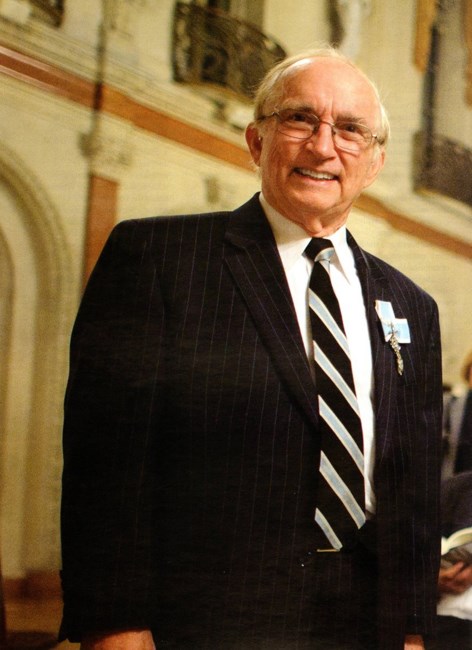
Known throughout his life as “Skid,” Rear Admiral Masterson was born in San Diego, California, in 1932. He was the son of Vice Admiral Kleber S. Masterson (1908–1998), a distinguished ordnance expert and former Commander of the U.S. Second Fleet. He was also the son-in-law of Rear Admiral Joshua W. Cooper (1906–1998), recipient of the Navy Cross for his significant role in the victory at the Battle of Surigao Strait as Commanding Officer of the destroyer USS Bennion during World War II.
After graduating from the Navy high school in Guantanamo Bay, Cuba, Skid entered the United States Naval Academy, graduating in 1954 second in his class with a bachelor’s degree in engineering. He went on to earn a master’s degree in physics from the U.S. Naval Postgraduate School in 1963 and a Ph.D. from the University of California, San Diego, in 1969. In 1980, he completed the Advanced Management Program at Harvard Business School.
Throughout his career, Rear Admiral Masterson demonstrated a rare ability to integrate cutting-edge technology with operational leadership. Early on, he became a pioneer in computer science for the U.S. Navy, developing in 1960 the first compiler that translated the first algebraic programming language ALGOL for use across multiple computer systems — an innovation foundational to modern computing.
He specialized in introducing advanced technologies aboard cruisers and destroyers, culminating in his command of the guided-missile destroyer USS Preble during the Vietnam War. Before being deployed to the Gulf of Tonkin, he oversaw the installation of advanced systems that enabled helicopter rescue missions and provided early warning of Soviet MiG aircraft entering U.S. operational areas.
In subsequent senior assignments, Rear Admiral Masterson played key roles in introducing the Phalanx Close-In Weapon System (CIWS) and the NATO Sea Sparrow missile defense system – which are still used across the Navy’s surface fleet. He later served as Executive Assistant to Secretary of the Navy W. Graham Claytor, Jr. His final uniformed assignment was as Chief of the Studies, Analysis, and Gaming Agency
(“Chief SAGA”) for the Joint Chiefs of Staff, where his team tested military strategy, including the deterrent force of a “Star Wars” missile defense system, and forecasted geopolitical shifts including the fall of the Berlin Wall.
During his naval service, Rear Admiral Masterson received the Defense Superior Service Medal, the Legion of Merit (three awards), and the Navy Commendation Medal (three awards), including two with Combat “V” for valor.
He also made lasting contributions to military scholarship and publishing as an editor for the U.S. Naval Institute Press. His earliest editorial project was The Book of Navy Songs, first published in 1954 and still in print. He later served on the editorial team that selected and published the Naval Institute’s first work of fiction, Tom Clancy’s The Hunt for Red October.
Following his retirement from active duty, Rear Admiral Masterson became a vice president and partner at Booz Allen Hamilton, where he designed and led innovative “industry war games” for private-sector clients such as Volkswagen and John Deere. He later served as senior vice president at Science Applications International Corporation (SAIC), contributing to national security across defense, intelligence and civilian sectors.
After retirement from SAIC, he became the highest-ranking naval officer ever elected President General of the Society of the Cincinnati, joining a lineage that includes George Washington, the Society’s first President General. Serving from 2010 to 2013, he led establishment of the American Revolution Institute of the Society of the Cincinnati, expanding the Society’s museum, library, and educational outreach.
Education was his most enduring legacy within the Society. He championed the development of the fifth-grade textbook Why America Is Free, still used in classrooms nationwide. As he often said, “In order to make history memorable, it has to be interesting.” Under his leadership, the Society formalized its education department, launched a comprehensive website, and elevated Cincinnati Fourteen into a professional historical journal.
Rear Admiral Masterson remained active in civic and professional organizations, serving as President of the Military Operations Research Society, President of the Old Town Civic Association in Alexandria, and Chairman of the Historic Alexandria Resources Commission.
He is survived by his wife, Sara (“Sally”) Masterson, their two sons, Thomas Masterson, M.D., and John Masterson, Esq., four grandchildren, Marshall (and his wife Pamela), Samer (and his wife Ling), Rena and Tariq Masterson, and two great-grandchildren, Kleber and Liam Masterson.
The Society of the Cincinnati remembers Rear Admiral “Skid” Masterson as “a gentleman and a patriot committed to his family and dedicated to our One Society of Friends.” His life reflected that same dedication to the United States Navy, to education, and to the civic institutions he led with integrity, intellect, and vision.
Authorships (Partial List):
· The Book of Navy Songs, editor, Naval Institute Press, (1954, still in print).
· “Compilation for Two Computers with NELIAC;” Communications of the Association for Computing Machinery 32, 607 (1960).
· “The Influence of Diffusion Losses on the Probe Potential in a Dense Plasma,” with G. Ecker; 13th Gaseous Electronics Conference, 12-15 October 1962, Monterey, California.
· “Nuclear Matter Calculations and Phenomenological Potentials,” with K.A. Brueckner, Physical Review 128, 2267 (1962).
· “Probe Theory in Dense Plasma,” with G. Ecker and J. J. McClure; University of California Radiation Laboratory Report 10128, 21 March 1962.
· “Properties of Finite Nuclei,” with A. M. Lockett; Physical Review 129, 776 (1963).
· “Uncoupled Nuclear Matter Approximation;” Physical Review 135, 776 (1963)
· “Energy of a Many Particle Normal System,” with K. Sawada; Physical Review 133, B595 (1965).
· “Numerical Methods for the Many-Body Theory of Finite Nuclei;” Methods of Computational Physics, Vol. VI, edited by B. Alder, S. Fernbach and M. Rotenberg. Academic Press, New York, N.Y. (1966)
· “The President and Advisors on Science Policy” in The President: Defense and Diplomacy, The Miller Center Forums, 1981, Part IV,” edited by Kenneth W. Thompson, University of Virginia Press (1981).
· “National Security in the Year 2005,” Proceedings of the La Jolla Physics Symposium, University of California, San Diego, September 6 - 8, 1985
· Military Operations Research Society (MORS) Oral History Project: Interview of Dr. Kleber S. Masterson, Jr., Military Operations Research, V30, N1 (2025) (online at https://www.jstor.org/stable/27374950)
Select Non-Military Positions:
· Editorial Board, U.S. Naval Institute Press
· President, Old Town Civic Association, Alexandria, Virginia
· Chairman, Historic Alexandria Resources Commission
· President, Military Operations Research Society
· President, Massachusetts Society of the Cincinnati
· President General, Society of the Cincinnati
Show your support
Add a Memory
Share Obituary
Get Reminders
Services
SHARE OBITUARYSHARE
- GET REMINDERS
v.1.18.0