
OBITUARY
Patricia A. Jensen
April 3, 1929 – December 8, 2022
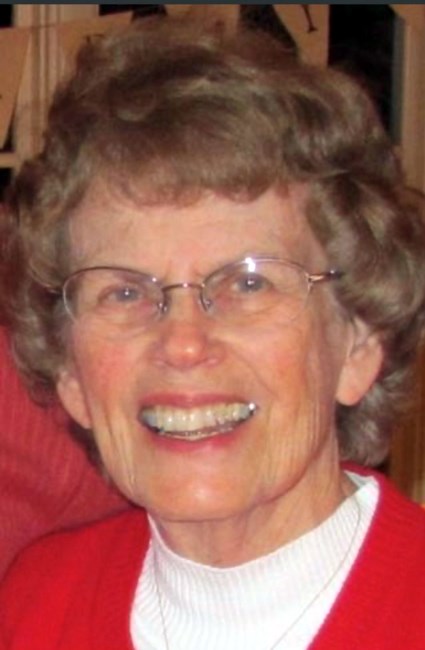
Pat was born in Hooker, Oklahoma on April 3, 1929 to Lowell Winfield Austin and Agnes Regina Brinkman, her father a descendent of early Texas settlers in Parker and Wise County, and her mother a new arrival to St. Francis in the Panhandle. She grew up in Amarillo, Texas and Kingman, Kansas and graduated from Marymount College in Kansas. She then taught seventh and eighth grade English for several years in oil boom town Hobbs, New Mexico before getting a master’s degree at the University of Colorado. There at a Newman Club dance she met her future husband, Dick, a Navy veteran and native of New York City. She was attracted to his gregarious manner and colorful stories; he was drawn to her intelligence and devotion to family. When she was recruited to teach in White Plains, New York, Dick followed and they married soon after. After several years they moved to Houston, Texas and later had three children while living in Wichita, Kansas and Richardson, Texas, then staying for almost 30 years in Spring, Texas where she taught English at a community college, before moving to Fort Worth in 2005 to be near family.
Pat was a teacher at heart, believing not just in the importance of education but in the central role it should play in life. She was meticulous in her speech and was always looking up facts in the encyclopedia. She also firmly believed that a good education was not a privilege for some but something that could and should be attained by everyone. Family was at the heart of her life, talking with her children at dinner every night, traveling to visit relatives every summer, and later gathering for dinners and vacations with her children and grandchildren. Her faith was quiet but strong, seldom expressed directly but at the heart of her life and the foundation of all she did. She is survived by her children Patricia J Grindereng and Richard Jensen; daughters-in-law Tammy Jensen and Sandra Jensen; grandchildren and their spouses Mary and Daniel Brezik, Christopher and Dimple Grindereng, Elizabeth and Timothy Becker, Meg and Noah Hahn, Sarah and Michael Kelly, Katherine and Cole Hammer, Anne Jensen, Magdalene Jensen, and Emma Jensen; and great-grandchildren Katie Beth, Nora, Nate, Emily, Callum, Jack, and Claire. She is preceded in death by her husband, Dick, her son David, and her granddaughter Eileen.
Her family is deeply grateful for the care and dedication of Ricondria (Rico) Ferrell and David Worshum, who attended not just to her physical needs, but freely gave of themselves as devoted companions.
Patricia Jensen
April 3, 1929 – December 8, 2022
If I had asked Mom to help me write this eulogy, you’d better believe it would have been a five paragraph theme. There’d be an introduction with a topic sentence, transition to three or more supporting paragraphs, and then a conclusion. If I objected, as I might have, that the five paragraph theme is an expository form and perhaps not suited to a eulogy, she would have had none of it. She believed in the value of the five paragraph theme, of grammar, of form, structure, knowing where you’re starting, where you’re going, and how you’re getting there, in dotting the i’s and crossing the t’s, parsing and diagramming sentences, analyzing word elements, understanding their etymology. And when she didn’t know them, looking them up and learning – in the dictionary, the encyclopedia, any of her many books. In short, she believed in education; she loved it and lived it. She was a teacher at heart, and she herself never stopped learning, never wanted to stop. “Ancora imparo” – “Still I learn” – could have been her motto; attributed to Michelangelo at the end of his long life, it’s from a letter of Seneca – I looked it up – curious in someone whose parents didn’t graduate from high school. She treated learning as a pastime, as a game we sometimes played with each other. When I’d call her driving home from work a quote or reference might come up, and we’d look it up in her well-thumbed Bartlett’s Familiar Quotations or complete works of Shakespeare. She believed it mattered to check facts, get things right, state them clearly and precisely – and not just for herself, but for everyone. And I do mean everyone. She believed a good education is something that shouldn’t just be available to everyone but was attainable by everyone, not a special achievement for special people but an ordinary thing for ordinary people who should put in an ordinary amount of work to attain it. And she was very happy to help them. People who thought they were special cases who needed exceptional treatment were mistaken. She was deeply opposed to stratification by ability in school – honors classes and the like – and thought those with greater proclivities or advantages should be able to learn without special treatment – and that they should be helping others get up to the same level.
She was a child of her time, born 6 months before the stock market crash and the Great Depression. The Oklahoma panhandle was at ground zero for the Dust Bowl, which lasted until she was 10 years old. But I never heard any stories about that time, at least not the ones you’d expect, not about hardship and suffering. Instead, they all talked about how great it was, no one had much and how everyone helped someone out if she could, since they were all in the same boat. Here’s something I think shows how she thought: Tammy made her dinner a few days ago after coming home from a short visit to the Emergency Room, and she couldn’t finish the last four bites of oatmeal and asked Tammy to save it for her. Saving oatmeal - things like this can seem almost comic to my generation – to me – but she wasn’t saving it because of its value, but because that’s the kind of person she wanted to be, the kind who saved whatever she could, made due with what she had and was grateful for it. Maybe I should have thought of her like an athlete in training, preparing herself for the day she needed it, because you never can tell. The virtues Mom learned from her childhood weren’t fancy or impressive: being patient, able to wait things out, steady, levelheaded, steadfast – although that word’s a little too fancy for her to have used for herself. The things she enjoyed most cost nothing: visiting with friends and family, telling stories, playing bridge, eating home-cooked meals (although not, in Mom’s case, making them), looking things up.
And yet Mom seemed most drawn to people who complemented her; my Dad who was outgoing, talkative, a born-storyteller who loved to tease; Adriana – so full of life, always on-the-go and ready to shake things up; and many other friends over the years. She liked, she appreciated differences, she didn’t want everyone to think and act like her. She was never contemptuous of others and their opinions – or unduly swayed or impressed by them, either.
I think all of these traits came out in the way she played tennis, with a conservation of effort – really a parsimony of effort – and maximum of strategy, winning points by carefully placed shots, and rarely running to hit a ball – she’d better save up that energy for another point. And playing bridge is another example – she bid very conservatively so that she hardly ever went down, but after careful calculation when she knew she had the cards, snapping her trump on the table and almost mechanically stacking the trick and leading her next card in a single motion, like some practiced Las Vegas dealer.
I haven’t yet mentioned her faith, but it isn’t really one supporting paragraph in the theme of who Mom was. It was the foundation of her life, taken for granted really, not something she often mentioned, only occasionally, assuring a friend she was praying for her during her difficult time. – or praying for her own. These last few years she prayed for patience to deal with the rehabilitation from her falls, acceptance of the limitations on her mobility, and help to endure the pain. Rico told me in her last days she heard Mom talking to Dick, telling him that she needed help in dealing with the pain. I never got the impression she feared death – naturally, it wasn’t something she talked about. But I think she was ready to go.
The night before she died as I said good bye, one of us – I don’t remember which – said, “parting is such sweet sorrow” – and I immediately quizzed her, “Which play?” Of course she remembered it was Romeo and Juliet, but neither of us could remember the second line of the heroic couplet. But I looked it up.
Good night, good night, parting is such sweet sorrow
That I shall say goodnight till it be morrow.
Romeo and Juliet II ii 186-7
And so we bid goodbye to Pat until we see her again.
Show your support
Add a Memory
Share Obituary
Get Reminders
Services
SHARE OBITUARYSHARE
- GET REMINDERS
v.1.18.0