
OBITUARY
Philip Lawrence Roe
May 4, 1938 – April 26, 2026
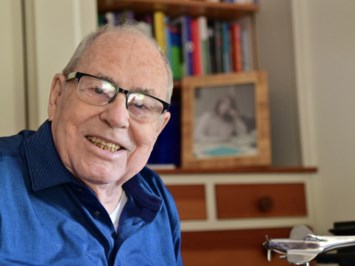
Phil was born on the 4th of May 1938, into a working-class family in Derby, England, where he grew up in the shadow of the Rolls Royce aircraft factories during World War Two. Awarded a place at Derby grammar school, he excelled at English, Maths, and building model airplanes.
After compulsory National Service, Phil took up a place at Christ’s College, Cambridge, to study engineering. Taking a somewhat relaxed approach to his studies, he developed into a national-level chess player, which remained a deep, life-long passion.
Following his childhood obsession, Phil joined the Royal Aircraft Establishment in 1962. His initial research focused on experimental and theoretical aircraft designs for hypersonic flight; and his early lectures remain among the clearest expositions of the principles. With the advent of scientific computing, Phil became a founding figure of the field of computational fluid dynamics. He transitioned into academia in 1984, working first at the Cranfield Institute of Technology, U.K., before joining the Department of Aerospace Engineering at the University of Michigan in 1990, where he remained on the faculty until 2022.
He was actively involved in research collaborations until his death, and he considered his most recent work to be among his most important. Phil was a prolific, highly cited, and widely admired researcher. He leaves a worldwide community of colleagues and former students not only with the substantial legacy of his research, but also as an exemplar of the highest standards of scholarship, mentorship, and intellectual generosity. He was a Fellow and a medalist of the American Institute of Aeronautics and Astronautics, among many other awards, including one from NASA.
Phil was an incurable fixer and maker, perhaps stemming from postwar privation. To his own designs, he doubled the size of an English stone cottage. Hand tools progressed to a basement workshop. The construction of a houseful of fine furniture, and toys for his grandchildren, was a source of much pleasure and satisfaction.
In the last twenty-five years professional recognition and acclaim led to numerous international invitations to conferences and workshops. He and his wife Jacqui richly enjoyed the resulting global travel. In addition to Jacqui, Phil is survived by his sister Frances, his children, Natasha and Gerard, his first wife Sue, and his nine grandchildren (Tam, Edie, Gus, Rupert, Katherine, Zoey, Charlotte, Cole and Riley).
We miss him enormously.
Show your support
Add a Memory
Share Obituary
Get Reminders
Services
SHARE OBITUARYSHARE
- GET REMINDERS
v.1.18.0