
OBITUARY
Eduard Bender
June 13, 1937 – March 17, 2023
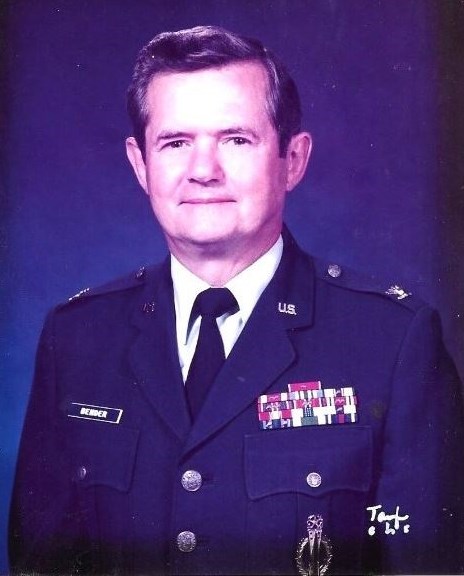
Colonel Eduard Bender of Austin, Texas died on Friday, March 17, 2023. He was 85.
Eduard was born on June 13, 1937, in Minsk, Belarus to parents of German descent Johanna (Schiebelbein) and Peter Bender. He and his family emigrated from Germany to the United States in 1952.
Eduard earned his bachelor’s degree in liberal arts from the University of Akron in 1960. While attending the university, he was a member of Phi Delta Theta fraternity. He was captain of the university soccer team and was selected to the All State and the All Midwest teams for four years and the All American team for one year. He received the top University of Akron “A” key award and was listed in “Who’s Who in American Colleges and Universities” in 1959 and 1960. He was selected by the student body to be vice president of his senior class. Eduard joined the Air Force Reserve Officer Training program. He was selected to be the Arnold Air Society commander and was deputy cadet wing commander. After completing four years of ROTC education and training, he was commissioned as a second lieutenant in the United States Air Force on July 1, 1960. In 1967, he received a master's degree in industrial management from the University of North Dakota. As a USAF major, Eduard completed the Industrial College of the Armed Forces in 1974.
On August 16, 1958, he married Harriet Harwell in Akron, Ohio. In 1960, he and Harriet left Akron as he embarked on a 30-year career as an officer in the U.S. Air Force (USAF). After a brief period as a security and law enforcement officer, Colonel Bender would spend 10 years in the Strategic Air Command as a deputy and Missile Combat Crew Commander with the Atlas F, Minuteman and Airborne Intercontinental Ballistic Missiles Systems in Texas, Oklahoma, North Dakota and California.
In 1970, Colonel Bender was the first USAF exchange officer to attend the two-year German War College in Hamburg, Germany. After completing the course, he was the first USAF officer to assume a position with the German General Staff, residing in Bonn/Bad Godesberg for 2 1/12 years. Returning to the United States in 1975, he became the deputy chief of the Aircraft Production Management Branch, Hill AFB, Utah, overseeing the maintenance of thousands of F4 USAF aircraft worldwide. In 1976, he was assigned to the Sixth Allied Tactical Air Force in Izmir, Turkey, supporting member NATO nations and ensuring NATO Air Force facilities were ready to support incoming NATO weapon systems. After spending more than a year without his family in Turkey, he was selected to attend USAF’s War College at Maxwell AFB, Alabama in 1977. After graduating from the War College, Colonel Bender returned to the Strategic Air Command at Malmstrom AFB, Montana, where he was in command of a 50 Intercontinental Ballistic Missile (ICBM) unit and later was given operational control over 200 ICBMs.
In 1981, he was assigned to the Pentagon in Washington, DC, where he was responsible for ensuring the successful, on-time deployment of the Ground Launched Cruise Missile (GLCM) weapon system. He directed and managed GLCM activities of more than 40 Air Staff and interagency organizations. To carry out President Reagan’s highest priority military deployment, Colonel Bender oversaw the creation of six new military installations in five European countries.
In 1984, Colonel Bender asked to become Professor of Aerospace Studies and Commander of AFROTC at the University of Alabama. In 1987, he was chosen to become the AFROTC Central Region Commander in Austin, Texas. In that capacity, he commanded hundreds of officers and non-commissioned officers and established policies for 32 universities and 56 high school units in 11 states.
In October 1990, Colonel Bender retired after serving his country for more than 30 years during the Cold War. While serving his country, he was awarded many decorations, including two Legion of Merits, three Meritorious Service Medals, a Joint Service Commendation Medal, two Air Force Commendation Medals, three Air Force organizational awards, three Combat Readiness Medals, a National Defense Service Medal, and a Master Missileman Badge. While assigned as an exchange officer with the German Air Force, he was awarded the German Armed Forces Performance Medals in bronze, silver, and gold.
Eduard’s wife Harriet died on Oct. 28, 2002, after 44 years of marriage.
On Sept. 25, 2004, he married Kathleen Greengrass Blair of Austin.
Survivors include his wife, Kathleen Bender of Austin; son Dr. Erich (Dr. Marianna Jung) Bender of Arlington, TX; daughter Heidi (Steve) Edwards of Granbury, TX; daughter Dr. Kirsten (Greg) Madden of Boulder, CO; Kathleen’s sons and their spouses, Eric (Heather) Blair of Austin, TX, and Darren (Carissa) Blair of Montgomery, TX; grandchildren Payce Madden, Amaya Madden, Gabriel Edwards and Jack Edwards, and Zachary and Madison Blair; siblings Johanna Kramer of Uniontown, OH; Irma (Bob) Herceg of Jackson Township, OH and Eugenia (Dr. James) Long of Grayslake, IL; nieces and nephews, Ingrid (Robert) Fields, Dr. Milan (Mollie) Herceg, Laurel Herceg, Neil (Stephanie) Herceg, Heather (Greg) Lennartz, and Brian (Mary Beth) Maite; other relatives and close friends.
He was preceded in death by his brother Waldemar Bender; infant brother Viktor Bender; and his brothers-in-law Hans Kramer, Richard Maite, Ishmael Harwell, Ralph Harwell and John Harwell.
After Eduard retired, he had his second open heart surgery. It took him a few years to recover from the operation. He would like to express his gratitude to his longtime doctors Dr. Adam Schneider, Dr. Joe Gallinghouse, Dr. David Terreson and Dr. Jonathan Klocek. He thought they were the greatest doctors anyone could ask for, and credited them with giving him the opportunity to lead a long life.
Colonel Bender will be buried at Arlington National Cemetery in Arlington, VA on a date to be determined. A Roman Catholic Mass will precede burial at the Post Chapel, Fort Myer, next to Arlington National Cemetery.
In lieu of flowers, memorials may be made to the charity of one’s choice.
Show your support
Add a Memory
Share Obituary
Get Reminders
Services
SHARE OBITUARYSHARE
- GET REMINDERS
v.1.18.0