OBITUARY
Wm. Roger Louis
May 8, 1936 – October 23, 2026
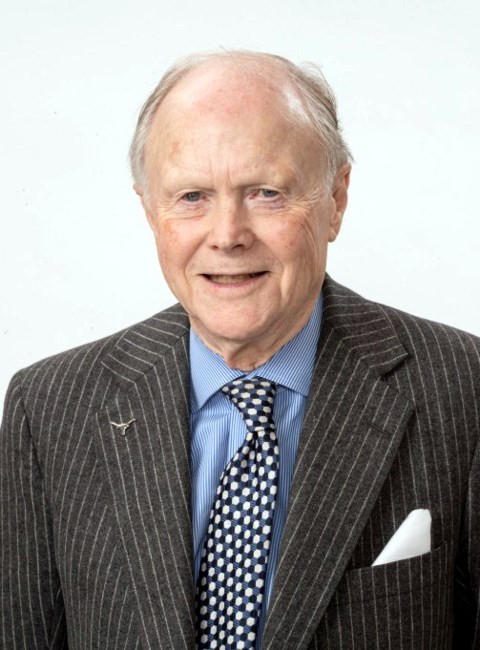
Wm. Roger Louis was born May 8, 1936, in Detroit, Michigan, to Henry Edward and Bena May (Flood) Louis. He had one sibling, a sister, Carolyn. He grew up in Oklahoma City, attended Classen High School, excelled in sports, and played French horn in the Oklahoma City Symphony Orchestra. Roger first dreamed of becoming a professional musician. At the University of Oklahoma, he said he slowly began to think about becoming an historian.
At OU, Roger studied in the Letters Honors Program and was president of his fraternity, Sigma Alpha Epsilon. He spent his sophomore year in Europe, living six months in Paris and six months in Freiburg. While traveling that summer, he found himself in Cairo on July 26, 1956 when Gamal Abdel Nasser, Egypt’s president, nationalized the Suez Canal Company. It was a transformative experience. Roger said he dated his interest in Egyptian nationalism, and more broadly Asian and African nationalism, to that night, as he listened with his Egyptian friends to Nassar’s voice playing over loud speakers rigged to lampposts across Cairo.
After graduating Phi Beta Kappa from OU, he attended Harvard University on a Woodrow Wilson Fellowship, receiving his MA in 1960. Roger studied with the historian Ernest May and the sociologist Barrington Moore. From Harvard, he went to St. Antony’s College, Oxford, on a Marshall Scholarship. His supervisors were A.J.P. Taylor and Margery Perham. Other Oxford scholars who shaped Roger’s outlook included Jack Gallagher, Ronald Robinson, and especially, Albert Hourani, the historian of the Middle East, who became one of Roger’s closest friends.
Roger said it was from Margery Perham’s writings from the early 1960s that he perceived the connection between the African movement for colonial freedom from the British Empire and the movement for civil rights in the U.S. Having grown up in Oklahoma during racial segregation in the 1950s, Roger was exceptionally compassionate, and he was committed to civil rights.
Roger married his OU sweetheart, Patricia Ann Leonard, in Duncan, Oklahoma in 1960. Their two children, Antony Andrew and Catherine Ann, were born in Oxford over the next two years. Roger’s son was named after Andy Blane, a very close friend, and a former leader at Amnesty International. After divorcing in 1979, Roger married Dagmar Caecilia Friedrich in 1983.
Upon receiving his DPhil in 1962, Roger turned down an analyst job at the CIA, choosing instead to join the faculty of the Yale University Department of History, where he advanced from assistant to associate professor. It was at Yale that Roger began teaching the history of the British Empire, which became his lifelong pursuit. In 1970, at the age of 34, he became Professor of History and Historical Advisor at the Humanities Research Center at the University of Texas at Austin. He taught at UT for the next fifty years. In 1985, he was appointed the Baine and Mildred Kerr Professor of English History and Culture. Roger said it was through the Kerr's generosity that he was able to pursue historical work that would have been unimaginable without the help and support of the Kerr Chair.
In 1975, Roger started the British Studies seminar at UT, and he presided over it for the next forty-five years. Held at the Harry Ransom Center on Friday afternoons, it used the Oxford model in which a scholar presented original research to a group of invited students, faculty members, and guests, followed by spirited conversation and debate. British Studies became an institution renowned in both historical and literary circles. The best of the lectures were collected in the book series “Adventures with Britannia,” which eventually ran to twelve volumes. Roger always noted that Dagmar’s unwavering support as a gracious hostess contributed to the success of the British Studies program.
In the early 1990s, Roger was named editor-in-chief of the “Oxford History of the British Empire.” At this time, the study of British imperial history was somewhat in the doldrums, and his project played a crucial role in its revival as a major scholarly field. The energy and determination with which he drove through the whole series from conception to publication have become legendary.
His appointment initially elicited dismay from some British academics who were incredulous that an American, and a Texan at that, had been chosen for such a position. Unfazed, Roger led a team of one hundred and twenty-five historians who produced, over the next eight years, a landmark five-volume work that brought praise from even the strongest of former critics. For his service to the study of British history, Roger was made an honorary Commander of the British Empire by Queen Elizabeth II in 1999.
That CBE was one of many honors and awards bestowed on Roger. In 1979, Oxford awarded him the DLitt, one of its highest degrees. He was a Visiting Fellow at All Souls College, Oxford, from 1979-80 and 1984; an Overseas Fellow at Churchill College, Cambridge, in 1985; and a Supernumerary Fellow (1984-96) and Honorary Fellow (1996-2026) of St. Antony’s College. He was elected a Fellow of the Royal Historical Society in 1984; a Fellow of the British Academy in 1993; and a member of the American Academy of Arts and Sciences in 2011.
Roger was the founding director of the National History Center (2001-13); a member and then chair of the Historical Advisory Committee of the U.S. Department of State (2000-8, from which he resigned on a point of principle); Kluge Chair at the Library of Congress (2010); and president of the American Historical Association (2001-2), the first from UT since Walter Prescott Webb in 1958. In 2013, he received the Benson Medal from the Royal Society of Literature, one of only three Americans so honored, and in 2016 he gave the Chaim Weizmann Memorial Lecture in Israel.
Roger had a deep passion for teaching, and for encouraging students to realize their potential. One of his greatest joys was discussing ideas and new findings with students and colleagues. He was known for being unfailingly friendly, intellectually curious, unpretentious, candid and sympathetic. At UT, he received numerous teaching awards, including being named a Distinguished Teaching Professor in 1998 and Professor of the Year in 2009. In 2001, he received the Pro Bene Meritis award from the College of Liberal Arts, and in 2018, the Civitatis Award, the highest university-wide recognition for outstanding faculty citizenship and service.
A voracious reader from childhood, Roger credited his parents with nurturing his love of literature. Even later in life, his tastes ran from the latest books on imperial history to the novels of P.G. Wodehouse and Alexandre Dumas. He was perhaps even more tireless as a writer. He regularly put in 13-hour days at UT, from six o’clock in the morning to seven o’clock at night, which he viewed as doing what he enjoyed. From 1962 to 2025, he wrote or co-authored ten books and edited an astounding fifty-four more. His first book, Ruanda-Urundi, 1884-1919, was published by the Clarendon Press in 1963. His last, The End of the British Empire in the Middle East, 1952-1971, was published by Oxford in 2025.
Roger was a gifted scholar, an indefatigable researcher, and an excellent writer. He diligently pored through mountains of material at Britain’s National Archives for more than fifty years and regularly consulted other collections around the world. His work is indispensable to the understanding of British and European imperialism; colonization and decolonization; the great power rivalries of the 20th century; the modern history of Africa and the Middle East; and British political history. His former Oxford supervisor, A.J.P. Taylor, once praised him as “the foremost historian of the British Empire and Commonwealth in his generation.”
Married for forty-six years, Roger and Dagmar shared a lifetime of love and devotion. Dagmar provided a loving sanctuary for him at home, hosted endless large parties with elegance and charm, and was always by his side as they traveled extensively around the world. Roger said he never could have managed without her, and she was the love and joy of his life. Through his life, Roger held a profound love for his two children and his extended family.
Roger passed away peacefully at home on October 23, 2026, surrounded by his loved ones. He is survived by his wife, Dagmar; his daughter, Catherine Louis; his daughter-in-law, Joni Louis; his grandchildren, Lauren (Michael Logan) Louis and Andrew (Nicole) Louis; Dagmar’s daughter, Michelle Keahey; Dagmar’s son, Michael (Elizabeth) Keahey, and their children, Kendra and David Keahey; and Roger’s nieces, Juliana and Carrie Shultz. He was preceded in death by his son, Antony Andrew Louis (2026). Roger was deeply loved by his family, and his brilliant loving presence is dearly missed. He also will be mourned by hundreds of former colleagues and students, as well as numerous friends on both sides of the Atlantic.
In lieu of flowers, future donations can be made to the Annual Wm. Roger Louis Distinguished Lecture on the British Empire and the US-UK Special Relationship, which is being established at the University of Texas at Austin. Contact details will be shared online soon.
A memorial service will be held at 12 p.m. on November 4, 2026 at Weed Corley Fish, 5416 Parkcrest Drive, Austin, Texas 78731.
Show your support
Add a Memory
Share Obituary
Get Reminders
Services
Celebration of Life
Share
Service
SHARE OBITUARYSHARE
- GET REMINDERS
v.1.18.1