
OBITUARY
Eve Soumerai
May 15, 1926 – February 2, 2024
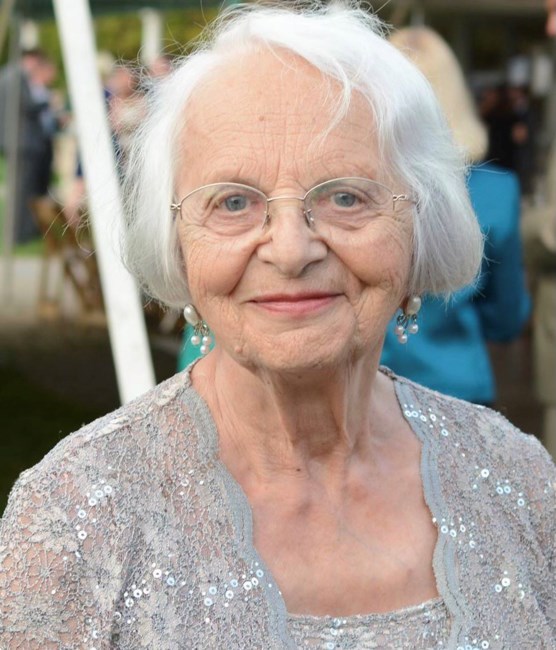
Eve Nussbaum Soumerai’s loving parents, Berthold and Frieda, saved her life by sending her out of Nazi Germany in the spring of 1939 at the age of 13. She died peacefully eighty-five years later, on February 2, 2024, surrounded by love and singing. She is survived by her three children, Stephen, David and Heidi, her son-in-love and daughter-in-love (as she liked to say), her five grandchildren and eight great grandchildren, with one more on the way who she so looked forward to meeting.
Eve was a surviving member of the Kindertransport, in which German Jewish families sent their children to England to save them from extermination during the Holocaust. She was the beloved matriarch of her family, social justice activist, teacher, writer, and community builder. Into her 90s she was still working tirelessly towards educating children about an array of histories of oppression, and raising important moral questions about humanity. Eve loved to tell stories about her childhood, painting a picture of her as a spunky, thoughtful, imaginative child who challenged authority. Her father loved children and was an expert at making her and her brother laugh. Her mother was quieter, a little sensitive and was easily moved by poetry, art and nature. Her younger brother, Norbert, was her best friend.
Eve chronicled many of her favorite childhood memories in her books titled, “A Voice from the Holocaust” and “Daily Life During the Holocaust.” Elie Wiesel included her essay of her family’s experience during Kristallnacht in his book, “After the Darkness: Reflections on the Holocaust.” Eve has been, and always will be, the embodiment of Elie Wiesel’s summons: “We must become sensitive to the pain of all human beings. To remain indifferent is to become an accomplice of the tormentor.”
Eve’s father was a German war hero during WWI, having fought and survived as a prisoner of war in France, and was highly regarded in his community. He loved Germany and couldn’t imagine that his country would betray him. However, growing more apprehensive after Kristallnacht, he left the house at dawn each day, standing in line at embassies trying to save his children. Finally, he was able to secure a spot on one of the last Kindertransport trains to Britain only for Eve, not her brother. Unable to get an entry visa to the United States, Eve’s family–her parents, younger brother and large extended family–all stayed in Germany to the bitter end.
Eve described her father’s unconditional love as most influential to her survival. “My father never thought I needed any kind of improvement.” Without fail this line was followed by the story of her parents receiving a disciplinary call from her school complaining that Eve, then 10, had tried to get out of doing revisions on an assignment. She attempted to erase the penciled edits and handed it in as a new draft. Eve could never hide her excitement from the start of this story, a broad smile covering her face, anticipating the best part. “He smiled at me and said, ‘Eva, if you want to do this sort of thing, you must get an excellent eraser.’”
Eve spent the rest of the war in Britain, not knowing her family’s fate. When she first arrived to her foster home, she began going door to door with a photo of her younger brother, searching for anyone who would be willing to take him in. She was never able to find him a sponsor, a terrible burden she carried all her life. She sought refuge in three important ways: being with, and inevitably laughing with, children; immersing herself in written works of people who had overcome injustices; and connecting with people who she believed would help her better understand what was going on in the world. On her own at age 15, she began working at a shelter for other children separated from their parents, displaced by the London Blitz. The renowned child psychiatrist, Dr. Donald Winnicott, hired her when she was 16 as his personal nurse assistant at Paddington Green Children’s Hospital in London. Anna Freud interviewed her for research on the impact of war on children.
At 17, shortly after the war ended, she lied about her age in order to join as an Allied Civilian Employee for the US Army. She returned to Germany to translate and interpret documents that included the hiding places of SS officers and locations of cherished art stolen by the Nazis. She began to discover the atrocities that had befallen her world. It wasn’t until much later that she learned that her mother had survived the camps until November of 1944, and her father and brother until May of 1945, only to be killed in the final days of liberation.
Eve worked for over 70 years to bring children together from diverse backgrounds to learn about individuals who have overcome injustices such as Harriet Tubman, Roberto Clemente, Martin Luther King Jr, Langston Hughes, Nelson Mandela, Anne Frank and dozens more. She created multimedia programs called “Tributes,” which exposed children from all backgrounds to powerful role models and gave them the chance to walk in their shoes, so that they too could be inspired and have renewed hope in goodness and humanity. Tributes allowed children to research these remarkable individuals and create theatrical scripts, which they then performed for their communities, engaging them in provocative intellectual and moral discussions. A central objective for Tributes was to bring children from different communities together, such as those from the inner city and those from suburbia, or from different cultures or faiths. Eve believed in the power of kindness and laughter to bring people together, and she tried to make every person she met believe they had the courage, the character, and the capacity to be a leader for social justice.
Eve was committed to the same core desire as many Holocaust survivors like her: the duty to never forget and to share not only her story, but countless other important histories, in an effort to prevent genocide from recurring. Over the past several years she was particularly concerned with the state of affairs in our country, from the shootings of unarmed black men and women, to reports of rising rates of suicide, frighteningly familiar acts of antisemitism, and all other forms of hate. When a grandchild arrived at her apartment for a visit, as they often did, it wasn’t uncommon for Eve to greet them with, “Oh good! You’re here. Let’s get right to work and do something about this world!”
We will miss her infectious laughter and the way she could root out joy under any circumstance, a gift she inherited from her father. We’ll miss the feeling of her seemingly unlimited and undivided attention. How she never appeared in a hurry to be anywhere but with you. We’ll always have the stories of her childhood, which she performed for us countless times. We will keep her and her family’s spirits alive as we repeat those stories to our children and their children, just like she taught us.
We are filled with reverence and gratitude for Eve’s parents, Berthold and Frieda, for making the unimaginable decision to send their child away. They sacrificed in unspeakable ways so that she could survive to live a long, full, beautiful life. They filled her up with enough love in those 13 years to last lifetimes, to overflow into the hearts of all of us who were lucky enough to know her.
The Soumerai family is honored that the Boston Globe shared Eve’s story.
Show your support
Send a Gift
Add a Memory
Share Obituary
Get Reminders
Services
- Send Sympathy GiftsSEND
GIFTS SHARE OBITUARYSHARE
- GET REMINDERS
v.1.18.0